
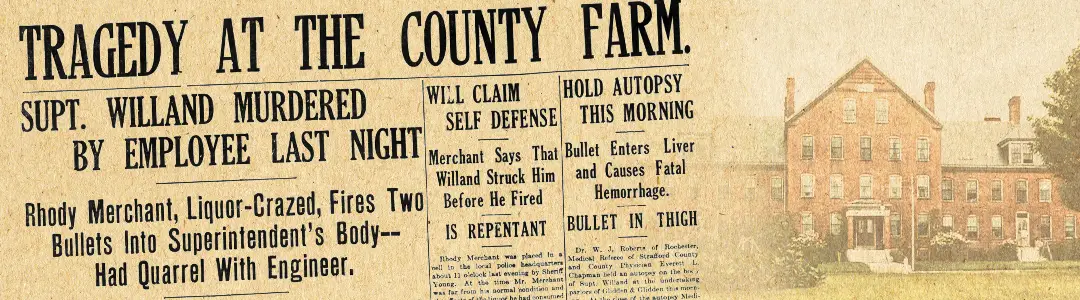
July 9, 1915, and a headline in caps: “TRAGEDY AT THE COUNTY FARM.” Then three separate stories: “Rhody Merchant, Liquor-crazed, Fires Two Bullets Into Superintendent’s Body,” “Will Claim Self Defense…Is Repentant,” “Hold Autopsy This Morning.” It’s hard to know where to begin …
The victim was Edward A. Willand, and he was the superintendent of the Strafford County Farm. The accused was an employee, and the shooting took place around 7 p.m. in a room of the electric light plant at the institution where Rhody Merchant served in the position of fireman. Willand was shot in the abdomen and hip, survived approximately four hours before death occurred at the Wentworth Hospital. Merchant, who was described as “considerably intoxicated,” had been involved in an argument with a co-worker, Walter Whitehouse. Willand was notified of the altercation and appeared in an attempt to resolve the dispute. He had been able to remove Merchant to his nearby room, but upon arrival the latter went to his bed, pulled out a .32-caliber revolver and fired three shots, two of which struck Willand. In spite of being wounded, he was able to walk from that point to the main building, and both city physician Everett Chapman and county physician Rolland Bennett were notified. Willand’s condition was obviously serious, and an ambulance was called. Surgery was attempted, but he passed away around 10:45.
In the meantime, two other employees, Frank Cheney and Frank Drew, were able to disarm Merchant, and he was escorted to the nearby House of Correction building and placed in a locked cell. County Solicitor Albert Sherry and Sheriff Young were notified and responded to the scene. Merchant was questioned and said he was sorry he had shot Willand but said he “would kill Whitehouse.” Sheriff Young then moved him to a cell at the Dover Police Station in anticipation of a court hearing in the morning.
It is clear that the reporter from Foster’s had access to all the players involved. Direct observation of the defendant at the station: “the effects of the liquor he had consumed were especially apparent. He acted nervous and continually inquired as to the condition of Mr. Willand at the same time expressing regret for his acts of the few hours previous.” The blame, he said, was on Whitehouse, who had “aggravated him” about his handling of the electric department maintenance and was commenting on Merchant’s liquor intake. It appears that the reporter was present the following morning when Merchant woke up, again quoting him directly when he inquired as to Willand’s condition, and when “officials avoided an answer” he again expressed his regret about “that thing that occurred last night,” but continued to put the blame on Whitehouse. When Chief of Police Clark arrived, Merchant stated that he was hungry, and some food was provided. He made the statement that “he would plead guilty to the shooting offense although he had fired in self-defense,” claiming that Whitehouse had reported him to Willand, who then appeared and “after reprimanding him had struck him a violent blow in the face.” It was then that Merchant, according to his telling, fearing a further assault, reached for the revolver under his pillow and fired three shots, intending only to “scare Mr. Willand.” (The reporter noted that in fact Merchant did have bruised lips which were considerably swollen.)
Merchant had been employed as a fireman at the electric light plant at the farm for several months prior to the shooting, “and when under the influence of drink he is said to be violent.” According to the report, Willand had been notified and appeared after his confrontation with Whitehouse “and was trying to make peace when Merchant, without the least provocation, opened fire …” He then made no attempt to escape and made no trouble for the men who disarmed him. It also was made known that Merchant was no stranger to Dover’s law enforcement. “In the past, when under the influence of alcohol, Merchant has done some rather peculiar stunts in this city.” One incident, when “totally intoxicated,” he took a dive off the Central Avenue bridge. This was observed by a former Dover cop, John Cornell, who was able to procure a boat and went to Merchant’s aid. “After a long and hard struggle the officer succeeded in fishing him out of the river and landing him on terri firma {spelling error in the original …}, after which he took him to the police station.” (Given his history, you might inquire how Merchant had managed to secure his employment with the county …)
At some point Sheriff Young arrived at the station to advise Merchant that Willand had died from his wounds. The reporter — who must have been present — reported that Merchant “stared at the sheriff, then put his face between his hands and assumed a serious, thoughtful attitude for a few seconds.” Then, standing, he asked, “Who will I procure for counsel?” Sheriff Young advised that it was entirely up to Merchant to make the connection.
(to be continued)
Read Part 2 here.
Want to know when the next article is published? Sign up to be notified here.
Visit the Crimes Along the Cochecho for all stories released so far.
Anthony McManus is a Dover, New Hampshire historian whose column “Crimes Along the Cochecho” explores the darker chapters of local history. A Dover native and Boston College Law School graduate, McManus served as City Attorney for Dover (1967-1973) and held various public offices before practicing law until 2001. His extensive historical work includes the “Historically Speaking” column in Foster’s Daily Democrat and his 2023 book “Dover: Stories of Our Past,” released for the city’s 400th anniversary. Through research, writing, and public presentations, McManus continues to illuminate both significant events and lesser-known stories that enrich understanding of Dover’s colorful past.