
Missed Parts 1 through 3? Start here first.
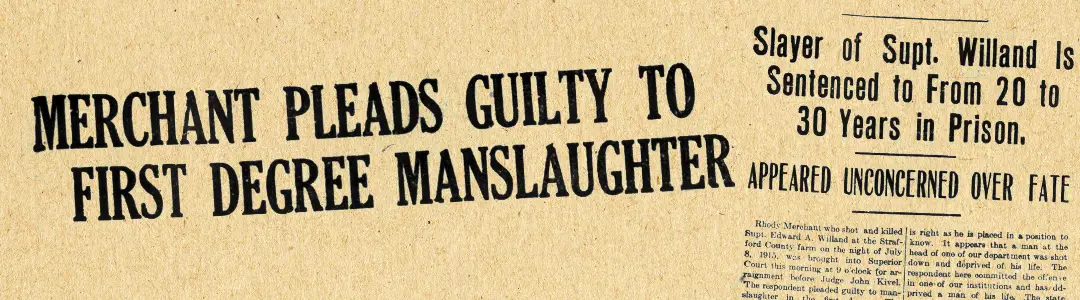
When Rhody Merchant entered his guilty plea, “in a clear tone of voice,” on the 22nd of November, the reporter noted that there were very few people in the courtroom. His attorney, W.W. Scott, made the point that Merchant was now 58 years of age. If he were to be sentenced to the maximum — which would be 30 years — it would mean, in effect, a life sentence. According to Scott, “The respondent has seen fit to throw himself on the mercy of the court and I will leave the matter to his wise discretion.” Judge Kivel responded, acknowledging the defendant’s age: “I cannot feel justified in giving him the full penalty,” so the sentence announced was a minimum of 20 years, maximum of 30. “The prisoner when sentence was imposed took it very calmly and he apparently had become resigned to the fate that awaited him. From the condition in which he is in at his age it seems doubtful about his living to complete his sentence.”
“The papers were immediately made out,” and Sheriff Young and Deputy Sheriff Goodwin, with Merchant and the papers in hand, left on the 10:58 train to Concord. And Foster’s had the final word: It’s likely that Clerk of Court Roberts will be notifying the jurors chosen “that their services will not be required on Monday next.”
There was a fourth person making the trip to Concord that day, “ironed” to Merchant for the duration of the ride. This was Franklin P. Cheney, a/k/a J.T. Gorman, a/k/a F.O. Pearce. He had also appeared before Judge Kivel, charged with the theft of two diamond rings, “the goods and chattels of Auren W. Hayes” on Aug. 7, 1911. Mr. Hayes was the owner of a local jewelry shop, and on the day in question, the defendant, claiming to be J.T. Gorman, visited the store and asked to have a look at some rings. He chose two and asked if they could be delivered to the Central Park Theatre where, he said, he was the manager of the traveling company presenting a stage production, with his wife a member of the cast. Mr. Hayes made arrangements for a clerk, Edward McClintock, to bring the rings to the theater, where he met Cheney/Gorman, who asked him to wait while he brought the rings to his wife’s dressing room for her perusal. “He never came back.” After a bit of a wait, McClintock “gave the alarm,” and a search commenced.
Cheney had indeed fled the area, by way of an auto driven by a man named Edward J. Ackroyd, who transported him to Boston where, upon arrival, Cheney gave him one of the rings in payment of the ride. Upon his return to Dover, however, he learned that the rings had been stolen and the police were looking for Cheney. Ackroyd did the right thing and “turned the ring over to the authorities.”
At some point, Solicitor Albert Sherry somehow had learned that Cheney had made it to Milwaukee, Wisconsin, and had been arrested and convicted of some offense there. Deputy Sheriff Goodwin made the trip at the conclusion of Cheney’s sentence and brought him back to Dover to face the music. Judge Kivel: “Do you have anything to say?” Cheney/Gorman: “I don’t know as there is anything I can say that will be of benefit to my case.” He was correct. The sentence was three to five years in New Hampshire State Prison, plus the costs of prosecution (presumably including travel to and from Milwaukee). Cheney joined the others on the 10:58 to Concord.
Want to know when the next article is published? Sign up to be notified here.
Visit the Crimes Along the Cochecho for all stories released so far.
Anthony McManus is a Dover, New Hampshire historian whose column “Crimes Along the Cochecho” explores the darker chapters of local history. A Dover native and Boston College Law School graduate, McManus served as City Attorney for Dover (1967-1973) and held various public offices before practicing law until 2001. His extensive historical work includes the “Historically Speaking” column in Foster’s Daily Democrat and his 2023 book “Dover: Stories of Our Past,” released for the city’s 400th anniversary. Through research, writing, and public presentations, McManus continues to illuminate both significant events and lesser-known stories that enrich understanding of Dover’s colorful past.