
Missed Parts 1 and 2? Start here.
At some point, as noted, both Smith and Collins had been retained by the police and “locked up in jail.” A hearing was initially scheduled for that afternoon, but continued to the following week “in order that all the evidence might be produced, and to ensure all parties a fair and impartial hearing.” All told, there were competing versions of the event: one, an attack by the workmen without provocation; the other, that the “ready submission of the Italians to the commands of Russo was noticed in several instances.”
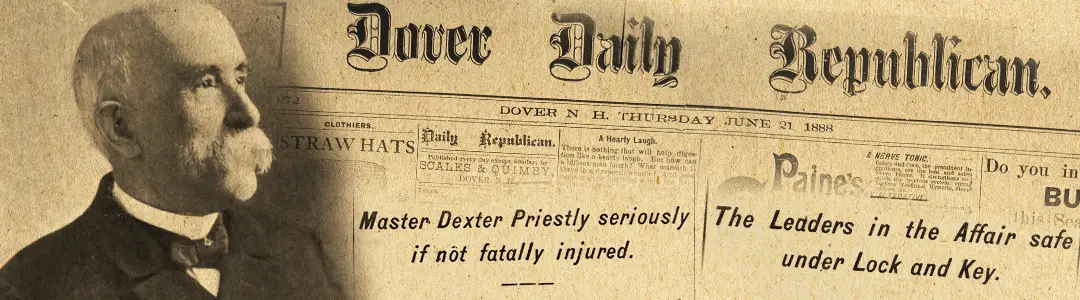
There were also varying reports as to the condition of Dexter Priestly. Initial statements were promising. “The bullet is so located that it cannot be extracted,” yet the attending physician is hopeful of the ultimate recovery of his charge, providing that hemorrhage or blood poisoning does not intervene.” “The shock sustained by the parents of the Priestly boy when they learned of his serious, if not fatal, accident can better be imagined than described. It was heart-rending to witness their grief.” This is from the initial report published on June 21, 1888. Yet the article from the Alexandria, Virginia, Gazette, dated June 22, reports that “An eight year-old son of J.H Priestly, who was standing in the yard, was struck in the head with another bullet, and the doctors say he cannot live.” A third newspaper reported that Smith had “shot one Italian through the arm and a Yankee boy in the stomach, from which it is thought the boy will die.” Even back then, the accuracy of the news depended upon where you got it.
Which might be a good time to offer some background on the Daily Republican. John Scales was born in Nottingham, New Hampshire, in 1835 and died in 1928. He graduated from Dartmouth and came to Dover to serve as principal of Franklin Academy from 1869 to 1883. That was the town’s premiere elementary school, located between what were Orchard and Waldron streets, set back a short distance from Central Avenue. (Unfortunately, this later became the location of the tannery building, the output of which led to the phrase: Portsmouth by the Sea, Dover by the Smell.) Scales was publisher and editor of the Dover Enquirer and the Daily Republican from 1883 to 1898, when he became an editorial writer for Foster’s. He remained in that position for the next six years, then devoted himself to historical research and writing. This resulted in the publication of History of Strafford County (1914), which contains a wide selection of biographical summaries—many of whom would have been contemporaries—and a History of Dover (1923). He married Ellen A. Tasker in 1865 and, not to be outdone, she was the author of “The Great Fires of Dover” for the Northam Colonists sometime around 1908.
The person listed as “Business Manager” of the Daily Republican was Fred E. Quimby, who served as Dover’s city clerk for a number of years. In his spare time, he composed “Historical Sketch of Dover’s Participation in Spanish-American War, 5/12/1898 to 10/31/1898.”
Which brings us back to our story.
(to be continued)
Read Part 4 here.
Visit the Crimes Along the Cochecho for all stories released so far.
Anthony McManus is a Dover, New Hampshire historian whose column “Crimes Along the Cochecho” explores the darker chapters of local history. A Dover native and Boston College Law School graduate, McManus served as City Attorney for Dover (1967-1973) and held various public offices before practicing law until 2001. His extensive historical work includes the “Historically Speaking” column in Foster’s Daily Democrat and his 2023 book “Dover: Stories of Our Past,” released for the city’s 400th anniversary. Through research, writing, and public presentations, McManus continues to illuminate both significant events and lesser-known stories that enrich understanding of Dover’s colorful past.