
Missed the previous installments? Start here.
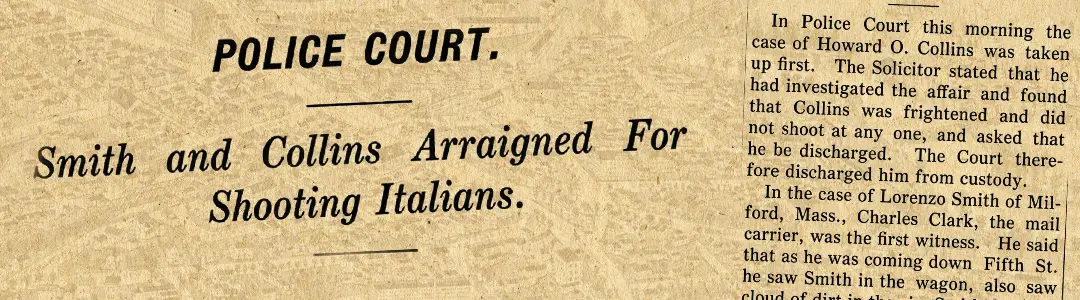
A hearing took place in the Dover Police Court on Monday, June 25. The defendants are Thomas Collins and Lorenzo Smith, but the article does not identify the specific charges. Curiously, there is no identification of who was serving as prosecutor or what attorneys appeared on behalf of the accused. Judge Frost was presiding.
Collins’ case was the first to be called. Whoever the prosecutor may have been, he advised the court that he had investigated the case, “and found that Collins was frightened and did not shoot at anyone, and asked that he be discharged.” The motion was granted, and Collins was released from custody.
Next up was Smith, and the first witness was the mailman, Charles Clark. He testified that he was on Fifth Street and observed Smith in the wagon. He also saw dirt being thrown in Smith’s direction. Smith drew his revolver and started firing, men coming out of the ditches and heading toward the wagon, one maybe getting within three feet. The horse was moving, Hull was driving. “Smith was shooting and the men were striking at him, throwing dirt.” He heard the young boy crying, who said he had been shot. Another man helped him into the nearby house. On cross-examination he said that one man had a shovel. He “heard the yell, but don’t think the men came out for that; they came out after the shot was fired. They were looking ugly.” He thought that one of them had struck Smith with the shovel.
Dr. Sullivan took the stand. (Miah Sullivan was a well-known and active member of the community. You may remember him from previous stories—he testified, for example, in the Walter Sterling murder case. Just as an aside … he was also married to my grandmother’s sister …) He stated that he had not seen the Priestly boy since Saturday. He was “getting along well and there was no damage.” He had not seen “the Italian” since he took out the bullet. He had examined Smith on Thursday, the day of the incident. He observed what appeared to be a blow on the sixth and seventh left ribs, but nothing broken. There was likely injury to the cartilage, and Smith was complaining of pain.
The next witness was Joseph Tommaro. He was unable to speak English, so a Frank Dondero acted as interpreter. The reporter noted that the witness was sworn in “on a Catholic bible.” Tommaro related that Smith had ordered him out of the trench. “He asked for his bill. He did not give the bill to him … got on the wagon and fired the revolver.” Another worker got out of the ditch. Neither of them did anything to Smith. Others did have picks and shovels, but claimed that Smith took the shovel away. He did not strike Smith and did not see anyone else strike him. When cross-examined, he testified he had previously worked for Smith. There had been no trouble that morning, but “they would not work as Mike Russo had been discharged.” Several other workers left the area to look for Dacey.
He was followed by another worker, Joseph Menillie, who was also fired by Smith. There had been a third firing, and that person demanded that he be paid on the spot. He testified that Smith said, “Shut up, or I will throw you to the ground.” One worker had a pick and shovel. Smith jumped into the wagon and fired a revolver. “The men got out of the ditch as they did not want to be shot as dogs.” At that point, Dacey appeared, reversing the orders of discharge, at which point the men went back to work in the ditch. The employee who had been shot was still in the trench.
Frank Grosto testified. He was in the ditch when he saw the team and wagon with Hull and Smith coming in his direction. He was hit in the arm by the last shot fired by Smith. He knew nothing about the trouble until he heard the first shot fired and saw the men start to leave the trench. (It would appear that this is the person identified as Malta in the newspaper’s first reporting of the event.)
(to be continued)
Read Part 5 here.
Visit the Crimes Along the Cochecho for all stories released so far.
Anthony McManus is a Dover, New Hampshire historian whose column “Crimes Along the Cochecho” explores the darker chapters of local history. A Dover native and Boston College Law School graduate, McManus served as City Attorney for Dover (1967-1973) and held various public offices before practicing law until 2001. His extensive historical work includes the “Historically Speaking” column in Foster’s Daily Democrat and his 2023 book “Dover: Stories of Our Past,” released for the city’s 400th anniversary. Through research, writing, and public presentations, McManus continues to illuminate both significant events and lesser-known stories that enrich understanding of Dover’s colorful past.