
Up to this point, the stories related in Crimes Along the Cochecho have involved events from the late 1800s to the early decades of the 20th century. The main reason for that is that (1) the editions of Foster’s have been digitized only through 1923, and (2) the files at Strafford County Superior Court for that time period are still kept here in Dover. Hopefully, readers have found these cases of interest, even though they are somewhat dated in subject matter: bigamy, adultery, the “dry list,” and the early days of motor vehicle legal issues. I have learned a lot about Dover’s past from digging through these files.
The case that follows, however, gets us somewhat closer to the present day and offers a good example of how things have changed over the years. It is a long story, compared with what you’ve read before. In addition to the newspaper reports and court files, I have been aided in the research by the help of Kelley Tidball and others at the Dover Police Department who have allowed access to the substantial police record involving the investigation of the case. There is another source of information I can add to the story.
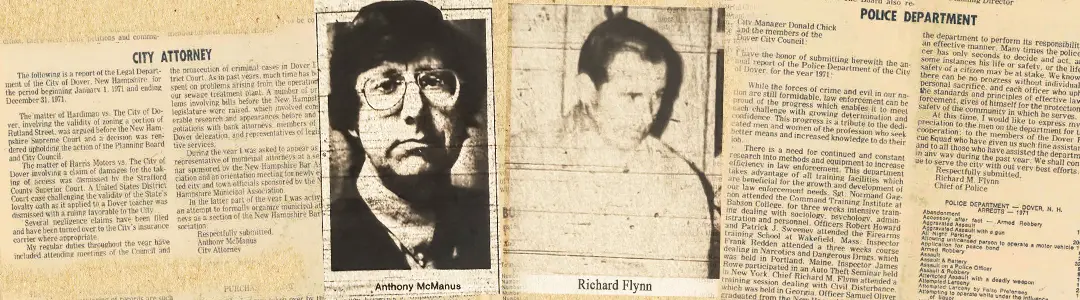
In 1971, I was serving as Dover city attorney. Back then, the job was still part-time, but it included the task of prosecutor for the Dover District Court. On the early morning of Jan. 2, I received a telephone call at home from Dover’s chief of police, Richard Flynn, asking if I would come to the Kidder Press building on Broadway to assist in an ongoing criminal investigation. Ordinarily, that call would have gone to the county attorney, T. Casey Moher, but he was away over the holiday, and Flynn decided that I was next in line. As I recall, I was not aware, until arriving on the scene, that the victim of the previous evening’s murder was my classmate from the DHS Class of 1956, Robert Dodge.
My input was minimal. The police were already in the process of gathering evidence, taking photographs, and interviewing potential witnesses. At some point, I was asked to go to the funeral home, and there I met with Henry Spaloss from the Attorney General’s Office and took part in conversations with him, Jim Rowe, and Medical Examiner Paul Young about the status of the investigation and what should happen from that point on. I was present for a substantial portion of the autopsy, which was a mixed experience. It was fascinating to watch and learn how such was carried out, but having it happen to someone I had known personally for a number of years was somewhat uncomfortable.
From that date on, Spaloss was in charge of the investigation, with the county attorney as second-in-command upon his return from vacation. I did attend a meeting of law enforcement officials on Jan. 7, where the investigation was reviewed in detail, and my memory is that I was present during the preliminary hearing in District Court, following the arrest of the two brothers charged with the crime. I can also say that, as the part-time prosecutor in that court, I had come to know most of the individuals involved throughout the case: Flynn, Rowe, Redden, Gilpatrick, and the other Dover officers; State Troopers Newhall, Heon, and Wiggin; Sheriff Knight and Deputies England and Keniston; Chief Worster from Farmington; and Paul Young. Through my connection in other cases, I had come to know Henry Spaloss, even though he was a resident of Nashua and worked solely through the AG’s office in Concord. Because of my connection with Bob Dodge, I was personally concerned about the outcome of the case, and so I kept in touch with most of the people involved in the investigation until the matter was finally resolved.
Several things I hope you will note from the story. One is the amount of time and degree of dedication given to this matter by the people charged with the investigation, but beyond that, the degree of what appears to have been a personal concern for the individuals involved. Not only trying to figure out what had happened, but why, and how do situations such as the murder of Robert Dodge arise; the devastating effect on his family, but also, as you will see, what it means to those close to the principal offenders and their community as a whole. I hope I have been able to tell the tale.
(to be continued)
Read Part 1 here.
Want to know when the next article is published? Sign up here to be notified.
Visit the Crimes Along the Cochecho for all stories released so far.
Anthony McManus is a Dover, New Hampshire historian whose column “Crimes Along the Cochecho” explores the darker chapters of local history. A Dover native and Boston College Law School graduate, McManus served as City Attorney for Dover (1967-1973) and held various public offices before practicing law until 2001. His extensive historical work includes the “Historically Speaking” column in Foster’s Daily Democrat and his 2023 book “Dover: Stories of Our Past,” released for the city’s 400th anniversary. Through research, writing, and public presentations, McManus continues to illuminate both significant events and lesser-known stories that enrich understanding of Dover’s colorful past.