
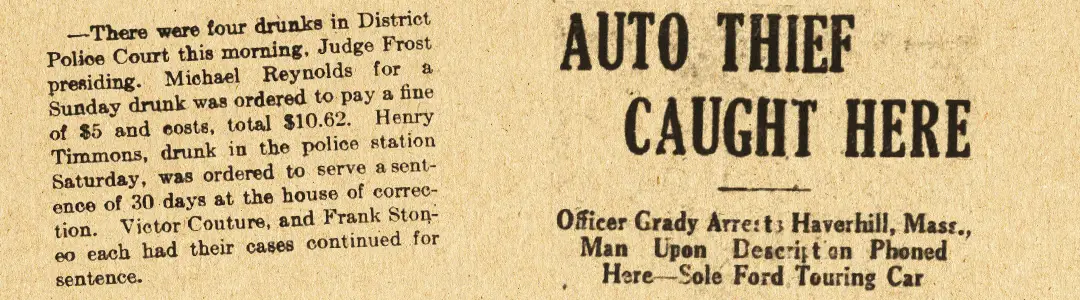
Here’s a variety of stories from November 1915. Dover might still be a relatively small city—the population back then was around 15,000—but there seems to be more than enough criminal activity to keep our police department occupied at least 24/7.
Take the case of Francis McDonald, who, when he was “considerably under the voting age”, had been sentenced to a six-month term of confinement at the County Farm in 1913 “on a charge of being an idle person”. He stayed 18 days, “then made his escape”. He had been back to Dover once previously, but had avoided the police on that occasion. This time, however, he was arrested by Officers Grady and Lothrop on the Upper Square. “As neither recognized him they arrested him on suspicion”, and took him to the station where he was recognized by Captain Murray. “He has been returned to the farm and will be held there in the future in such a manner that his quiet exit will be a little more difficult.”
That was not Officer Grady’s only arrest on this weekend, for on Sunday morning, around 3 a.m., he “rounded up” Dennis F. McKenna, alias Ghehan, who was wanted by the police in Haverhill, Massachusetts, for the theft of a Ford five-passenger touring car. Earlier that evening, a request to be on the lookout was received, including a description of the vehicle and the alleged thief. Captain Murray shared this with the officers on duty by way of the department call boxes. Several hours later, with this information in hand, Grady observed the car in question and arrested the operator. Two passengers were also taken into custody, and the Haverhill PD was notified.
The passengers claimed to know nothing about the theft. They had not known McKenna prior to that date, but ran into him at a lunchroom in Portsmouth. He was looking for directions to Dover, “and they came along with him to show him the way”, unaware that the vehicle was stolen. At least, that was their story. Upon the arrival of the officers from Haverhill, the two men were released pending further investigation. McKenna agreed to return voluntarily to face charges. A local driver was engaged to return McKenna, the officers, and the stolen car to Haverhill.
The final chapter here is a “Letter of Praise” reported on Dec. 2, received by Marshal Wilkinson. It is written in thanks to the local department for assisting in a case “in which we were desirous of getting results, and it was through your hearty co-operation that it was made possible”. It contained the news that McKenna, “who has been rated a bad man”, had been sentenced in Massachusetts to six months in the House of Corrections for the theft of a Ford vehicle. “I feel personally indebted to you and your officers. Cordially Yours, John J. Mark, City Marshal. From Haverhill, Massachusetts.”
On the same page as the first McKenna story is a letter to the editor: the writer refers to the acquisition by the Portsmouth PD of a new “patrol automobile” and describes the immediate benefit of having such a vehicle available. “The citizens of this city hope that our recently appointed Police Commissioners will act on this important matter and restore an auto ambulance in their department, which did such splendid work for the last year and a half.” Signed: “Citizen”.
On Monday, the 22nd, we find the following: “In view of the attitude of Judge Nason in the Dover Municipal Court this morning the days of leniency for the so-called “Sunday drunks” are numbered. In those instances where there is evidence that the intoxicating liquor was procured on Sunday, the respondent is quite liable to be called upon to suffer the consequences of either a fine or a jail sentence”.
In the case in question—no name is given—the Defendant had been before the court once previously, “about a year ago”, and received a suspended sentence. Being on good behavior since then, until his arrest the previous day, he sought another suspension. The fact, however, that he fell within the category of a “Sunday drunk” led this time to the imposition of a $5 fine. “It is believed that the intention of Judge Nason was to impress upon the mind of the Monday morning characters at the headquarters the unpopularity of Sunday nuisances.”
Five dollars may not look like much of a fine, but the equivalent in 2025 dollars is in the vicinity of $160! For the average worker back then five dollars would amount to about half a week’s wages. Failure to pay would mean a short stint at the County Farm, and if employed, hoping the job was still there upon your release.
(more to come….)
Read Part 2 here.
Visit the Crimes Along the Cochecho for all stories released so far.
Anthony McManus is a Dover, New Hampshire historian whose column “Crimes Along the Cochecho” explores the darker chapters of local history. A Dover native and Boston College Law School graduate, McManus served as City Attorney for Dover (1967-1973) and held various public offices before practicing law until 2001. His extensive historical work includes the “Historically Speaking” column in Foster’s Daily Democrat and his 2023 book “Dover: Stories of Our Past,” released for the city’s 400th anniversary. Through research, writing, and public presentations, McManus continues to illuminate both significant events and lesser-known stories that enrich understanding of Dover’s colorful past.