
Missed Part 1? Read it here.
As has been mentioned in past articles, the use and/or abuse of alcohol was a constant issue for law enforcement. In addition to the Sunday Laws there were limitations on making … and sharing … alcoholic beverages in private residences. Case in point:
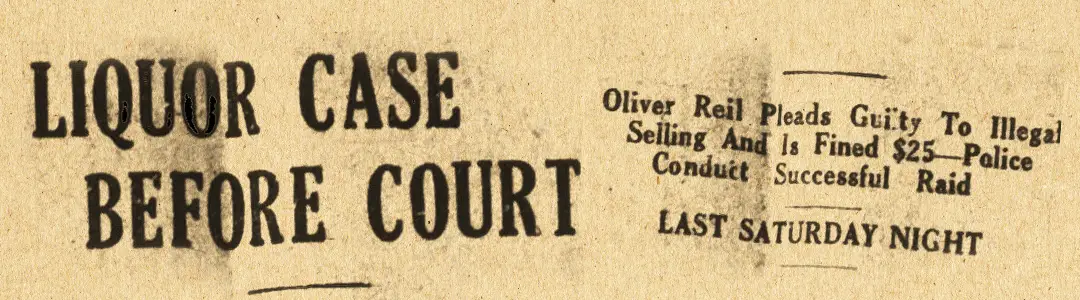
Dover’s Marshal Wilkinson had information that there was a “speak easy” to be found at a home on Cocheco Street. Armed with a search warrant, Captain Murray, with Officers Brownell and Grady, appeared at the residence of one Oliver Reil. “They demanded an entrance”, and as they were awaiting a response “a dress suitcase containing a dozen pint bottles of spiritous liquor was thrown out of the window”. A search of the interior produced a case of beer. Reil was arrested and brought to the station to await a hearing. He appeared in court on the 29th and pleaded guilty to a charge of keeping liquor for sale at his home. He was ordered to serve a term of 60 days in the House of Correction, a fine of $25, plus costs of $8.62. The jail sentence was suspended upon payment of the cash assessment. “Up to a late hour Mr. Reil had been unable to procure the required $33.62 and will undoubtedly be called upon to serve the entire sentence at the county farm.” (Mr. Reil was not the only one to be in trouble for possessing illegal booze. That same night, the 27th, Rochester police raided the home of Benjamin Hayes in Gonic and confiscated a quantity of alcoholic beverages. A not altogether serious crime wave to keep local law enforcement on their toes, but this is only a small example of the role played by the presence of alcoholic beverages in the community.
The question of the use … or misuse … of alcoholic beverages was a frequent subject of hearings before the local courts in the early years of the 20th century. Prohibition didn’t come into effect until 1920, but in 1915, Dover had what was known as the “dry list”, and the folks who ended up on it were often identified by the local press as “dry listers”.
Take, for example, the events of Tuesday, May 25, 1915. “For the first time in the history of the local police court two disclosures and two convictions for selling liquor were disposed of this morning”. The first case being that of Mrs. Helen Wiggin, arrested on the evening before, “after she had been reprimanded by her husband, Albert Wiggin, who came home and found her in the company of H. Glidden”. It seems that Glidden had appeared at the home with “a half-pint of liquor,” which he and Mrs. Wiggin proceeded to consume. Following a hearing before the court both were found guilty, whereupon City Solicitor Adams filed a charge against Glidden for having sold the liquor to Mrs. Wiggin. That resulted in a sentence of 30 days on top of 90 days and costs of $5.62. Whatever sentence may have been imposed on Mrs. Wiggin, if any, was not reported. No comment was made as to the status of the Wiggin marriage, but do you recall the story of the couple who, in 1922, seven years after the incident described above, found themselves in the Dover court, faced with a charge of adultery? The woman was Lucy Court. The man was… Albert Wiggin. When testifying in that case, he described himself as “a carpenter by trade, divorced, the father of two children,” and the Dover directory for 1921 shows him residing at 144 Court St. It is the same Albert Wiggin. So now we know.
(more to come)
Read Part 3 here.
Visit the Crimes Along the Cochecho for all stories released so far.
Anthony McManus is a Dover, New Hampshire historian whose column “Crimes Along the Cochecho” explores the darker chapters of local history. A Dover native and Boston College Law School graduate, McManus served as City Attorney for Dover (1967-1973) and held various public offices before practicing law until 2001. His extensive historical work includes the “Historically Speaking” column in Foster’s Daily Democrat and his 2023 book “Dover: Stories of Our Past,” released for the city’s 400th anniversary. Through research, writing, and public presentations, McManus continues to illuminate both significant events and lesser-known stories that enrich understanding of Dover’s colorful past.