
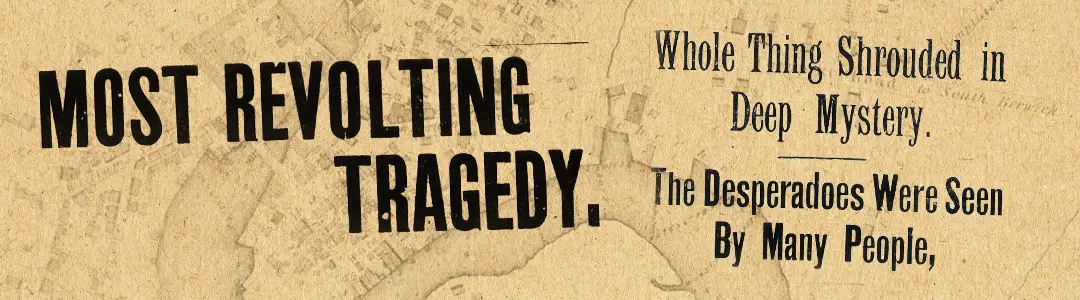
It is July 4, 1900. A Wednesday. Many people have the day off from work because of the holiday. The local press reports that in Somersworth, “The Fourth Passes in Rather Quiet Manner”. This is not the case in Dover, however. There, the front page headlines tell a very different story: “Most Revolting Tragedy,” ”The Whole Thing Shrouded in Mystery,” “The Desperadoes Were Seen By Many People”.
With it being the 4th of July, the sound of gunfire might not be easily detected amidst the expected fireworks. You would not really anticipate such an event to take place here, or anywhere, for that matter. What happened seems to be some kind of movie script, strangers showing up in a small town (Dover’s population being just slightly over 12,000), wreaking havoc, innocent people being shot, those responsible being hauled down in a dramatic capture. But it all happened right here in mid-town Dover, and the facts are as follows:
The story actually begins on the evening of the 3rd. Several Dover residents, Daniel Sullivan, his brother Jerry, and Daniel Connolly, were at the Woodbine Barroom on Third Street. There, they encountered two out-of-towners, Frank Gold and John Brown. A short time later, they ran into them again on the street, now accompanied by a third person, John Williams. Words were passed between the two groups, and Williams physically assaulted Danny Sullivan. Gold produced a revolver, striking Sullivan in the forehead, causing an injury above one eye. Williams also had a gun, which he fired three times into the air, threatening to take the locals to the nearby railroad tracks for target practice. That offer was declined by the Sullivans and Connolly, and they immediately left the area and headed for home. They did not report the incident to law enforcement that evening.
The following day, Williams, Gold, and Brown reappeared in town in mid-afternoon, when they arrived at the Wesley House, located at 1 Cocheco St. This was a building that no longer exists, a hotel with a restaurant and bar, and a somewhat questionable reputation. When there, they came into contact with Ross Ritchie, a visitor from Manchester, and her friend, Sadie Tuttle. (Foster’s has this wrong on the first report. It later appears that her last name is Follet.) The three men had a drink or maybe more. They also asked for food, but were advised that they were too early for the evening menu. Ritchie observed that all three appeared to be armed and also seemed to have plenty of money at hand. They left, but returned around 5, stayed about an hour and a half, and then left again to return around 7:30. However, this time, they were not given access to the building.
It is not clear where they went after that, but around 10 p.m., they were observed on Main Street. At some point, they had been joined by a John Farrell and were heading south toward School Street. Several people later claimed that they overheard Williams suggest to the others that they exchange the blanks in their revolvers to live ammunition, and it appeared that this was done. Shortly after this one or more of the group had some words with several men standing nearby and Williams fired his gun in the direction of the sidewalk, one shot hitting a man named Arthur Russell in the lower leg, and two shots striking Joseph Gagnon, one grazing his chin, the other penetrating his stomach area. Russell fell into the street, and the three involved in the shooting continued south on Main Street.
Dover Police Officer William Smith was out that night walking his beat and was advised of the shooting. As he went north on Main Street, he observed three men in the vicinity of Portland Street, and as he approached, one of them fired a shot in his direction. Smith returned several shots, but the man ran off in the direction of Cocheco Street and disappeared behind several of the buildings at The Landing. Smith continued up Main Street, where he came upon the wounded Russell, and he sent notice of the situation to the police station, requesting assistance. He was then notified of another shooting in the vicinity of Young Street, and upon arrival found two victims, John F. McNally and Thomas Dobbins, both of whom had been wounded, presumably by the same people involved with Russell and Gagnon, and likely one of them had been the person to fire at Smith a few minutes previous.
(to be continued)
Visit the Crimes Along the Cochecho for all stories released so far.
Anthony McManus is a Dover, New Hampshire historian whose column “Crimes Along the Cochecho” explores the darker chapters of local history. A Dover native and Boston College Law School graduate, McManus served as City Attorney for Dover (1967-1973) and held various public offices before practicing law until 2001. His extensive historical work includes the “Historically Speaking” column in Foster’s Daily Democrat and his 2023 book “Dover: Stories of Our Past,” released for the city’s 400th anniversary. Through research, writing, and public presentations, McManus continues to illuminate both significant events and lesser-known stories that enrich understanding of Dover’s colorful past.
3 Responses
Thank for the details.. About where was the third street bar located please ?
In the 40’s I lived on Second & Chestnut so I was quite familiar with 3rd street in n the late 40’s.
Thank you.
I truly enjoy reading your stories…so much history I never knew!
Thank you for posting our town’s history.