
Haven’t read Part 1? Check it out here first.
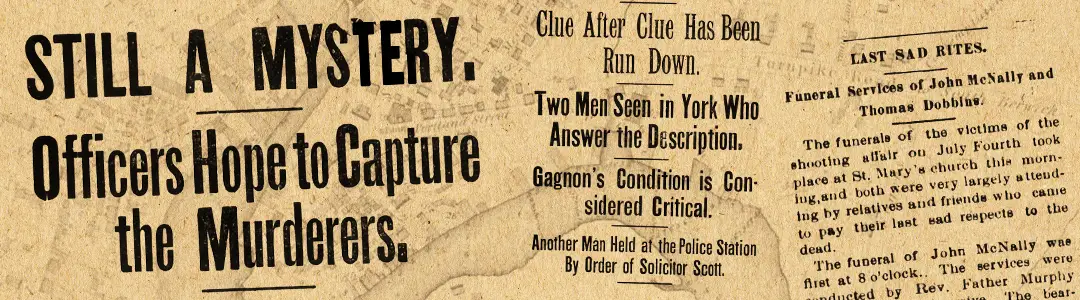
The search was on. None of the men were located in the adjoining neighborhoods. Several people in the immediate vicinity of the shootings had vacated their homes and contacted the authorities, asking that their properties be searched, fearful that the trio might have sought refuge in one of the nearby buildings. A “Wanted for Murder” notice was sent to communities through the state and seacoast to be on the lookout, with descriptions of the three, possibly four suspects. In the meantime, Dover police, with County Solicitor Scott in charge of the investigation, attempted to identify and interview potential witnesses. They learned of the confrontation the previous evening on Third Street involving Daniel Sullivan and took statements from those involved. They also received word from the owners of Smart and Mitchell, a guns and ammunition store on Central Avenue just north of Chapel Street, that on several occasions on the 3rd, a man had bought ammunition, but following reports that guns were being fired “carelessly about the streets,” he was refused an additional purchase, whereupon he bought a supply of blanks. (At one point, the police were notified that a pane of glass at the American House on the Upper Square had been shattered, quite likely by an errant bullet.)
There were a number of eyewitnesses to the activities of the three on the street, so police had fairly complete physical descriptions, but since it appeared they were from out of town, no one was able to provide accurate names. One name, “Williams”, was brought forward, and that led to a call from the Rochester Police Department who had a Somersworth man, James “Foxey” Williams, in custody on a charge of drunkenness. He was transported to Dover and questioned, but was able to account for his whereabouts–not in Dover–during the time involved in the shootings. Following his interrogation, “he was allowed to depart”.
Information was received that a man named George Hogan had been seen with the wanted men earlier in the day. He was located, brought to the station “for safekeeping”, but also later released. As reported in Foster’s, “every man that was met on the street was held up and if the officers did not know him to the station he went”. Kitty Scanlon, one of two women who had been with McNally and Dobbins, was also brought to the station and questioned. One eyewitness had claimed that just before the shooting, she appeared to be having a conversation with one of the two armed men, but she claimed not to know anything about any of them. Solicitor Scott believed that Kitty knew more than she was telling, and ordered her to be placed in a cell.
Another person came forward to say he had seen men in and around York County who fit the description of the shooters, so several Dover officers were sent to follow up on that information. At one point, a call was received from law enforcement in Manchester advising that they had several individuals who fit the descriptions under surveillance in that city. Then word came from Somersworth that the men had been at the Salmon Falls Hotel, so Solicitor Scott, accompanied by the reporter from Foster’s, went there and interviewed Nathaniel Rivers, the hotel clerk, who related that four men had arrived late morning on the 3rd, had lunch, then a few drinks in the bar. They told Rivers that they had recently finished employment at a quarry in Westbrook, Maine, and were now “out for a good time”. Around noon, they had been joined by two others, one described as red-headed, and Rivers thought him to be a local resident, though he did not have specific names.
Still others came forward. Police interviewed Joseph Lawrence, Sr. and Jr., who said they had transported five men to the Waverly House, a hotel in the vicinity of Central Park, on Thursday evening, and stated that en route “they were cutting up all kinds of shines”, throwing their hats and other items off the wagon, and at one point one had his coat caught in the vehicle’s wheels.
Officers also located Peter Dube, who had been identified as part of the group on Main Street when Russell and Gagnon had been shot. There was some indication that Dube resembled one of the shooters. Before questioning could take place, however, an interpreter had to be found, as Dube claimed not to be able to properly understand or speak much English. One of the owners of the gun shop, Smart & Mitchell, was able to state that Dube was not one of the group who had purchased ammunition, and he was released.
In the midst of all of the investigative activity, word was received of the death of Thomas Dobbins, who had passed away at his home. Arrangements were also announced for the funeral of John McNally, to be held on the morning of the 7th at St. Mary’s Church. And from Somersworth came a positive report on Arthur Russell’s condition. Five doctors had assisted in performing surgery on his shattered leg. They succeeded in removing the bullet fragments, which were retained to determine the caliber and to compare with those involved in the deaths of McNally and Dobbins. Due to the extent of damage, amputation had not yet been ruled out, but for the time being, the leg was set in a plaster cast.
And then, at mid-afternoon on the 6th, a man named Edward Ellis drove into town and provided information to Solicitor Scott about a gang of men at the Waverly House who fit the description that had been broadcast regarding the fugitives. This tied in with the earlier statements of the Lawrences, father and son, although no immediate connection had been made at the time. Special teams of officers were hastily assembled and transported by horse-drawn wagon to the Waverly. Upon arrival and entry into the building, Assistant City Marshall Wilkinson and Officer Young observed one individual attempting to exit through a window in the lobby area. Young was able to grab hold of an arm and “hung to him like grim death”. The man attempted to withdraw a weapon, but the officer produced his first and held it “within an inch” of his head, threatening to shoot. The man, now identified as John Farrell, is reported to have responded, “Shoot. I will take the chance.” Hauling Farrell back into the room, the two engaged in “a desperate struggle”, during which Farrell was disarmed and placed “in irons”.
Two other men, then identified as William Scott and John Brown, were in the same room. They did not resist and were taken into custody. A further search of the premises, including the exterior and several outbuildings, uncovered a fourth man, who turned out to be Frank Gold. He was located hiding beneath a stable area, but was coaxed to surrender under threat of physical harm by the arresting officers.
Amid all this activity, the police were informed that a fifth member of the group had left the hotel approximately 20 minutes before their arrival, heading in the direction of Somersworth. Before a proper search could be underway, several New England Telephone and Telegraph employees appeared on the scene to say they had recently passed a man who appeared to be asleep on the side of the road. Going to that location with these men, the police discovered the individual they now believed to have been the principal shooter in Dover on the 4th, John Williams. He surrendered without resistance.
(more to come….)
Visit the Crimes Along the Cochecho for all stories released so far.
Anthony McManus is a Dover, New Hampshire historian whose column “Crimes Along the Cochecho” explores the darker chapters of local history. A Dover native and Boston College Law School graduate, McManus served as City Attorney for Dover (1967-1973) and held various public offices before practicing law until 2001. His extensive historical work includes the “Historically Speaking” column in Foster’s Daily Democrat and his 2023 book “Dover: Stories of Our Past,” released for the city’s 400th anniversary. Through research, writing, and public presentations, McManus continues to illuminate both significant events and lesser-known stories that enrich understanding of Dover’s colorful past.