
Haven’t read Parts 1 and 2? Start here first.
All five men were now brought to the police station in Dover. They were searched for weapons or any other possibly incriminating evidence. John Brown, upon being searched, had “considerable jewelry and a large number of postage stamps in his pocket,” leading some to consider that the group was a gang of professional thieves, rather than common laborers, as previously reported. “They are old timers at the business, for they are very shrewd, and do but very little talking to anyone”.
Kitty Scanlon, still in custody at the insistence of Solicitor Scott, was taken from her cell, “and when her eyes rested on Williams, there was a change in her countenance”. At the same time, when Williams saw Scanlon, “he turned deathly pale”. It appeared likely that the case had been solved.
But the police did not stop there. James Lord, who had been a witness to the shooting of Russell and Gagnon, came to the station and “quickly identified” Williams, Brown and Gold as the men he had seen on Main Street. Daniel Sullivan identified Williams and two of his companions as the men who had assaulted him on Third Street, “a narrow escape from their hands at meeting the same fate as Dobbins and McNally”. Nathaniel Rivers, the clerk from the Somersworth Hotel, appeared to identify all five as the men who had been at his premises. George Hogan, who had been with the men briefly in the area of The Landing some time prior to the shooting, positively identified Williams as the leader of the group.
Given the above, Foster’s felt comfortable in reporting that “there would appear to be no reasonable doubt but what the right persons have been apprehended for they have been identified by several witnesses as the desperadoes who did the shooting”. And so, at 2:45 on the afternoon of the 7th, Williams, Farrell, William Scott, John Brown, and Frank Gold appeared in the Dover Police Court for an initial arraignment. “There was a great rush to obtain an entrance to the room, and so fierce was the struggle to gain admittance that the police feared that someone would get injured, and they had to interfere.”
There were pleas of not guilty entered by all; Williams was charged as a principal, and the others were charged with being accessories. Solicitor Scott asked for a continuance to Aug. 6 for a full hearing, none of the defendants objecting. Several indicated they would seek counsel. Judge Frost urged an earlier hearing date, either the 23rd or 30th, and an agreement was reached as to the latter. All were remanded to jail to be held without bail. Kitty Scanlon and Peter Dube were ordered to post $100 to guarantee their appearance as material witnesses. She was unable to do so, so she was also ordered to be held in jail, but within a short period, several people came forward with contributions toward her bail, and she was released. At some point, with the assistance of friends, Dube was also released.
Once at the jail, the five prisoners were weighed, stripped, and given a bath, then outfitted in what was described as “a prison suit”. “After being clad in their jail costume, the men’s personal statistics were taken by Mrs. James E. Hayes”, the jailer’s wife. In terms of height, the tallest was John Williams, listed as 5’9”, considerably shorter than the “tall” man described by several of the witnesses at being over 6 feet. At 138 pounds not the “heavy” person of several of the very early identifications. Williams was the oldest at 39 years, Gold the youngest at 23. Interestingly, several described themselves as “American” (Williams, Brown), several as “Irish” (Gold and Scott), and “Irish-American” (Farrell). After all the preliminaries were completed. The personal information in hand, they were each placed in a cell of what the reporter listed as “the revolver”.
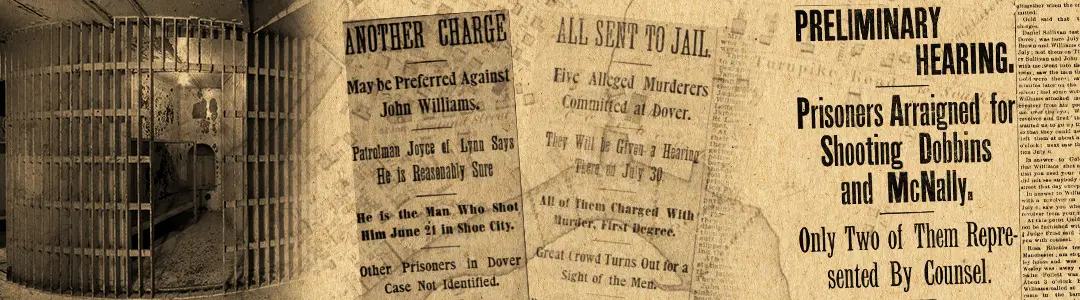
But wait. What did the reporter mean by “the revolver”? And here we digress… and perhaps build suspense as to the upcoming fate of the “desperadoes,” to offer a brief history of the jails in Dover.
Being the County seat, Dover has been the location of the County jail from an early date. The first formal building was a wooden structure dating back to 1774, located on what was then known as Pleasant Street, now Central Avenue, just north of the Friends Meeting House, on what was commonly referred to as Gaol Hill because the jail was situated on that spot. This was later replaced by a newer building on Silver Street, opposite the end of Cushing Street and to the west of today’s Community Trail. Then in 1888, as the population grew and the number and seriousness of the criminal offenses increased, a larger brick structure was completed on high ground at the far end of Washington Street, overlooking the land that is slowly becoming Dover’s Waterfront Development. The jail building is no more, torn down in 1918, but the jailor’s residence, once attached to the main structure, remains in place as a private home.
This new Strafford County jail was rather unique, being one of fewer than 20 similar designs found in jails throughout the country. The idea was as follows: It was a round building. The cells were not rectangular, but triangular. Each was separated from the cell next door by a thick wall, but there were no doors. There was a central mechanism, operated by a jail employee, that allowed the interior structure to be rotated to a single point, creating an opening that permitted entry and exit to only one cell. There were no common rooms for dining or recreation. In theory, that made the jail escape-proof; no way to get out unless your cell was directly in line with that one point that provided access to the public areas of the building (although as we may see in future columns, the best laid plans and designs of man are not always foolproof…).
In any event, the rotating design of the jail was the basis for the Foster’s reporter’s reference to Williams and the gang being housed in “the revolver”.
And so, back to the story. The five remained in custody, their stay interrupted on one occasion by the appearance of a local photographer, A.P. Drew, with a directive to make a permanent record of the prisoners, who “did not like the idea of having their pictures taken”.
Which brings us to the preliminary hearing, July 30. One headline described the event as the “Court Room Packed Full of Interested Humanity”. Not only that, but people had lined up along Washington Street as the defendants were transported from the jail to the municipal building. Solicitor Scott was the prosecutor, and our old friend John Kivel appeared as counsel for William Scott and John Farrell, the remaining three without representation. At the outset it was noted that one or more of them had been allowed to shave their moustaches, making identification between the defendants Brown and Farrell a “trifle mixed between the two men”.
Attorney Kivel asked that any and all witnesses be sequestered, and that request was approved. Frank Gold and John Brown requested a separate hearing, which was denied.
The first witness was Daniel Sullivan. He described meeting Gold and Brown at the bar on Third Street and having words outside a short time later where he was attacked by Williams, then struck on the forehead with a revolver at the hands of Gold, following which Williams fired a gun three times in the air, challenging Sullivan and his companions to a further confrontation along the nearby railroad tracks. The next time he saw them was at the police station following their arrest. At this point, Frank Gold advised the Court that he would like to make arrangements for a lawyer; Judge Frost denied the request.
The second witness was Ross Ritchie, who identified herself as a resident of Manchester, but who had been in Dover on July 4. She was at the Wesley House, the hotel at 1 Cocheco St., accompanied by Sadie Follett. In mid-afternoon, Williams, Brown, and Gold arrived, had a few drinks, and asked about the availability of an evening meal, which was not yet available. Ritchie said she noted that all three were armed and seemed to have a fair amount of cash. They left for a short period, but returned around 5 and stayed for a little bit more than an hour and a half. They left and appeared to be heading north on Main Street. Some time close to 7:30 they reappeared, but this time were not allowed entry. She could not say they were intoxicated when they first arrived, and could not testify as to the number of drinks they consumed thereafter. In response to a question from Kivel, she said that at no time did he observe either Scott or Farrell.
Sadie Follet then testified as to her observations, consistent with Ritchie’s recollection, though she claimed not to have seen any weapons. She felt it was obvious at some point that they had been drinking, given their manner of speaking.
Samuel Jackson, who lived in Rollinsford, related that he came into Dover early evening on the 4th. He stopped to speak with a Mr. McLaughlin, and identified John Farrell as being present. He ran into Farrell again later in the evening, now in the company of Frank Gold and John Williams, in the vicinity of Chapel Street. He testified that he overheard Williams suggest to the others that they exchange bullets for blanks, and heading south on Main Street Williams suggested to the others that they go to the Wesley House “to clean it out”. Jackson claimed to have observed the confrontation in the vicinity of Chicoine’s store and saw Williams fire one shot, then, further down the street, two more, before heading away in the direction of Young Street. Jackson followed them at a distance, but close enough to observe Williams shoot Dobbins and McNally. He saw Farrell standing nearby, but at the first shot he turned and headed up Portland Street. At some point, Officer Smith appeared and was fired at by Williams, Smith returning fire as Williams disappeared from the scene.
There was extensive cross-examination by Attorney Kivel, which produced some additional information. Jackson said he saw the men exchanging the cartridges in their revolvers, he saw Russell getting shot, and at that time, Williams was the only one holding a weapon. He agreed, based on his observations, that the men appeared to be intoxicated. As to the incident involving Dobbins it appeared that he was responding to some comments made by Williams, and “got up as if he was to square off” when Williams shot him. He saw McNally and the two women. Farrell was standing near the house off to the side, but began to run away from the area when the first shot was fired. Gold was also there, but walked off in the direction of Portland Street. Officer Smith approached from the direction of Mill No. 1 at the time Williams shot McNally. At no time did he observe either Scott or Brown.
The next witness was James Lord, a Dover resident and employee of the mill, who was standing on the opposite side of the street from the corner of Main and School streets. He saw Gold and Williams, the latter who “went out of his way to bump into a boy” on the sidewalk, and observed him fire a gun in the direction of the street, which “kicked up dust”, then fire a second shot, the one that hit Russell. Lord first went to attend to Russell, but then headed down Main Street, hoping to find a police officer, or get to the main gatehouse at Mill No. 1, where he felt he would find a telephone to call the station.
Under cross-examination by Kivel, he acknowledged not seeing Scott or Farrell directly involved in any of the shootings, but in response to a question from the Defendant Brown Lord testified that he did see Brown, wearing the same coat that evening that he was now wearing in court, although, he noted, Brown was no longer sporting a moustache.
At 2 p.m., Judge Frost called a recess, and until the parties all return, we will join him.
(More to come….)
Visit the Crimes Along the Cochecho for all stories released so far.
Anthony McManus is a Dover, New Hampshire historian whose column “Crimes Along the Cochecho” explores the darker chapters of local history. A Dover native and Boston College Law School graduate, McManus served as City Attorney for Dover (1967-1973) and held various public offices before practicing law until 2001. His extensive historical work includes the “Historically Speaking” column in Foster’s Daily Democrat and his 2023 book “Dover: Stories of Our Past,” released for the city’s 400th anniversary. Through research, writing, and public presentations, McManus continues to illuminate both significant events and lesser-known stories that enrich understanding of Dover’s colorful past.