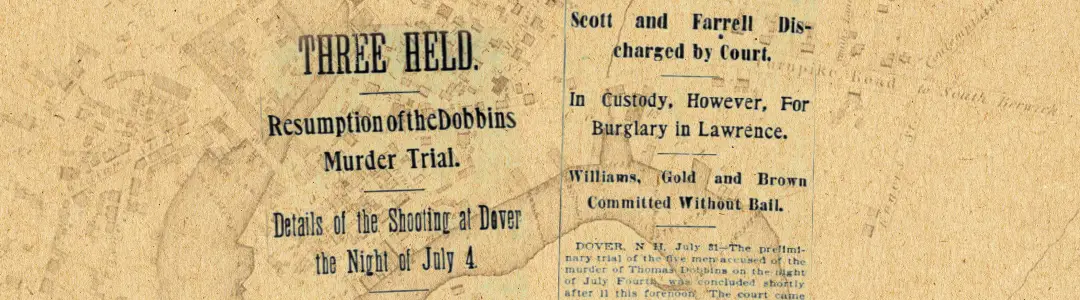
As William Scott exited the courtroom following the hearing on July 30 he was tailed by Assistant Marshall Wilkinson and another Dover officer who then assisted several police officials from Lawrence, Mass., in taking Scott into custody, charged with being a fugitive from justice regarding Scott’s alleged participation in a safe-cracking job at a brewery in that city on July 2, just prior to his arrival with the others in Dover. As noted by the local reporter: “While the warrant was being read, Scott could scarcely keep a limb still; he trembled and appeared to be very much excited”. He refused to voluntarily return with the officers, demanding a hearing, and as a result, found himself locked up once again in a cell at the police station.
Back in the courtroom, Attorney Kivel was arguing that John Farrell should also be discharged, claiming that out of all the witnesses, only three — Jackson, Ida Donahue, and Officer Smith — had placed Farrell in the vicinity of McNally’s shooting. It was nighttime, and under the circumstances, anyone’s observations would have been obscured. On the other hand, there had been four witnesses who said he was not present and no evidence had been presented that he had assisted or abetted the crime, pointing out that there had been a variety of testimony regarding four men, or possibly six men, at various locations and at different times along Main Street. The Court then asked Frank Gold and John Brown if they had anything to add. Neither offered a response.
Solicitor Scott argued that there was sufficient evidence, from several witnesses, to tie Farrell and Brown to the shooting, and he opposed any request for dismissal. Judge Frost then took what would seem to be a very odd approach, stating, as reported: “I can only hold three men”. He then ordered that Farrell be discharged as he believed “the witnesses who testified against him had been mistaken”. Williams, Gold, and Brown were then ordered to be held without bail to answer to the September term of the Supreme Court. Each of the witnesses was held to personal bail in the sum of fifty dollars, not to be posted at this time, but forfeited in the event they failed to appear at the time of trial.
It is not clear from the newspaper report exactly what has happened here. It would appear that the only charge involved in this hearing had been a murder charge based on the shooting and resulting death of Dobbins, and possibly the assault on Russell. That being the case, the decision to release William Scott had probably been correct; none of the witnesses had placed him anywhere near either event. But for purposes of a preliminary hearing, which is to determine if there is any “probable cause”, there was ample evidence that Farrell was with Williams as he approached the four sitting on the steps at 14 Young St., and left the scene as Officer Smith approached, certainly greater evidence of his presence than in the case of John Brown. The statement — assuming it was reported correctly — that Judge Frost felt “he could only hold three men” is hard to fathom, both from a legal and evidentiary standpoint.
It may be that the prosecution decided to focus on the more serious charges, the murders of Dobbins and McNally and the wounding of Russell and Gagnon (and another person had come forward, a man named Dionne who lived on Second Street, who reported that he had been grazed by a bullet during that same event.) You would not be remiss in asking what happened to the other very obvious criminal conduct: the assault of Daniel Sullivan on the evening of the 3rd, the shot fired by Williams at Officer Smith, the attempt to pull a gun on arresting officers at the Waverly Hotel; the list could have been extensive against one or more as principals, and certainly each of them as accessories before and after the fact. The decision-making process that led us to this point may never be fully understood, but it raises a wide range of unanswered questions. Based on Judge Frost’s remark that he could only hold three men, it may be that he was already aware of the presence of the police from Lawrence and the charges there involving Scott and Farrell. However, this would raise some ethical issues beyond the facts of the crimes in Dover.
But back we go to John Farrell who, as he attempted to leave the premises as a free man, was also arrested as a fugitive from justice, charged with the same offense as William Scott, burglary at the brewery in Lawrence, where a night watchman had been bound and gagged and left in a nearby freight car. Farrell also refused to return voluntarily, so all five ended up being returned to the County jail (the “revolver”), Farrell and Scott being scheduled for arraignment the following morning on the charges from Massachusetts.
That hearing took place as scheduled, but was brief. Attorney Kivel could not be present. His law partner, George Hughes, entered pleas of not guilty, and by agreement, the case was continued for hearing to the 9th. Bail was set at $500 each. “The prisoners were quickly ironed and conveyed back to the jail…”.
Comes the 9th of August, and Farrell and Scott are back before the Dover Police Court where there was “a great rush for admission by spectators”. (Keep in mind that in 1900 there was no internet, no TV, no radio, so free admission to a juicy court case was a very popular pastime.). The evidence now relates to the alleged theft at the brewery in Lawrence, Mass., on July 2. (Strictly speaking, not “Dover true crime”, but all part of the package…) It was immediately observed that the defendant Scott no longer had a moustache, which “caused several of the witnesses to become somewhat mixed in their identifications of the men. The Lawrence officials did not take very kindly to the prisoner being allowed to shave himself…”.
The judge this time was Associate Justice William F. Nason. Solicitor Scott and a representative of the District Attorney from Massachusetts appeared for the State, while, as usual, John Kivel appeared for the defendants. As usual, he requested that all potential witnesses be removed from the courtroom. The hearing that followed took up most of the day. Two men, both employees of the brewery, and one other man, a nearby resident, testified that at various times they had seen both Farrell and Scott in the vicinity of the building within a day or two of the burglary. Another brewery employee testified as to the contents of the office safe: a quantity of cash in assorted bills, $50 in gold pieces, several checks, and revenue stamps. After the fact, this same witness described the condition of the safe as “a total wreck, with pieces all over the floor”. Another witness said the safe had been “blown up” and there were various tools scattered about the floor of the office.
Joseph Praetz, the watchman on duty, and Max Espig, an engineer with the brewery, both testified that at approximately 12:15 a.m. on the early morning of July 2, they were separately confronted by five men, all of whom had their hats pulled down and were wearing handkerchiefs over their faces, and all of whom were armed. Praetz was relieved of his weapon, and both men were eventually bound, hand and foot, while three of the intruders entered the office, followed by a small explosion. The three returned to the safe, one of them carrying a sledge, hammer, and other tools. Once the safe had been cleaned out, the two employees were taken from the office area and left in an empty freight car adjacent to the building. After about 45 minutes, Espig was able to free one hand and assist Praetz. They then spread the alarm. In the midst of all this activity, Espig felt he was able to identify Farrell and one other, but he did not see that second person present in the courtroom.
Inspector John Sheehan from the Lawrence PD described the damage to the safe, and then accompanied two civilian witnesses to Dover to identify Scott and Farrell. The former refused to acknowledge his presence, refused to answer any questions when requested, and instead “made an obscene remark.” Sheehan did not explain how the connection had been made between the brewery burglary and the men in Dover, but we may recall that something akin to an all-points-bulletin had been sent out following the shootings on the 4th and Dover’s description of the five men then in custody certainly would have caught the eye of those involved in the Lawrence investigation.
The final witnesses for the day were Napoleon Rivers from the Salmon Falls Hotel and Joseph Lenox, the proprietor of the Waverly House. Both testified as to their contact with the five and the fact that rooms at the Waverly had been paid for with an assortment of cash, and Brown and one other paid for drinks with a gold piece.
Attorney Kivel then made an extended argument on behalf of the defendants, to the effect that no evidence had been presented as to which specific Massachusetts law had been violated, and thus no proper basis existed for holding them in custody in New Hampshire. Beyond that, there was no evidence that these two had ever been connected to the other three until well after the incident in Lawrence. The mere fact that they had been identified at the jail in Dover did not place them at the scene of the crime at the brewery. None of the money they may have had in their possession on the 4th and 5th had been identified as coming from the brewery heist. (You have to give Kivel credit for trying…) The Court, having heard from the defense, took the matter under advisement and the matter was adjourned to the following day.
The next morning, the State first offered an amended complaint clarifying the language of the conduct charged as it related to the Massachusetts criminal law, and William A. Noyes, a Massachusetts attorney, testified that the matter properly stated the laws in that State. Following this presentation, the Court ordered that the defendants be held to appear at a hearing on September 9, pending extradition to Massachusetts, and in the meantime, bail on each was increased to $ 1,000.
The September 9 date must be in error, that day being Sunday. Still, in any event, there is no further news regarding the case until the 12th, when it is reported that Lawrence City Marshall Michael O’Sullivan came to town, spent the night, and left the following morning, accompanied by Dover’s Assistant City Marshall Wilkinson, Joseph St. Lawrence, Napoleon Rivers, and a Joseph Lanois of Somersworth, all obviously to testify to a grand jury in Massachusetts. Foster’s noted that although the men were not yet indicted, “there seems to be but little doubt but that they will be”. And so it was: on the 17th came the report from the Essex County Superior Court that William Scott, alias McFarland, John Farrell, Williams, Brown and Gold had all been charged with two counts of breaking and entering and putting Espig and Praetz in fear. (The reference to the alias for William Scott is not surprising. Somewhere along the way the authorities had also learned that John Williams was known from time to time as John Brooks, and John Brown identified himself as Joseph Huddle.)
There were also indictments in Strafford County; these were against Williams, Gold, and Brown. The trial was scheduled to begin on October 5, when the three entered pleas of not guilty; Gold and Brown were represented by Attorney Kivel, assisted by William F. Nason, John Williams without counsel. A jury was chosen, all men, and none from Dover, presumably to avoid having anyone who might have been influenced by the previous extensive newspaper coverage of the events. At the conclusion of the day’s proceedings, it was noted that “a large crowd of people, men, women, and children, assembled in the street outside the building…. When they came from the courthouse, in charge of the officers, there was a great scramble among those gathered there to get a good look at the trio”.
And here we take a time-out for a bit of background on the creation of these stories.
The trial in 1900 took place in what was then designated the Supreme Court. At that time, this included both the County trial courts and the appellate division. The change to Superior Court was made by legislation adopted in 1900, effective Sept. 1, 1901. What we have referred to in the past as the “police” court became, over the years, a system of “District” courts in the larger communities, “municipal” courts in smaller locations, most of which have all but disappeared in a consolidation of the lower courts, now all part of a Circuit Court system. In researching previous cases in this series that have undergone trials, I have relied not only on Foster’s reporting but also on the actual files still maintained by the Superior Court here in Dover.
The first trial in our present case begins on the 5th of October, 1900. It is interesting to note, compared to today’s experience, how quickly these cases progress. Three months from the actual offense, and the State is ready to proceed. In our modern world, it is more likely that there will be a year or more between the alleged crime and a formal trial. There are likely several reasons for this. The increase in the crime rate would be one. The population is substantially greater. In the 1900 census, Dover reported slightly over 12,000 residents, compared to nearly 33,000 today. There are more laws. Just one example: consider all the statutes we now have relating to automobiles that didn’t exist at the turn of the century. We now have a wide range of forensics that were not previously available or in widespread use, such as extensive fingerprinting, ballistics testing, blood typing, genetic comparisons, and more. Criminal investigations back then were pretty basic, for the most part based on personal observation.
One other change has led to more lengthy delays in bringing a major case to trial. If you look at a court file from the early 1900s, it will likely be less than an inch thick, consisting of the original complaint from the police court, a transfer order to the sheriff to transport the defendant to the jail, perhaps a form relating to bail, a copy of the grand jury indictment, and depending on the outcome, either a commitment order, or a discharge.
The initial plea, the bail order, hearing date, change of plea (if that occurs), and final disposition are all written in hand on the original form that contains the charge. And that’s the file. There are cases where the defendant’s mental capacity is at issue, and the file may contain requests from defense counsel for State Hospital examinations, followed by surprisingly brief reports from the Superintendent in Concord.
Times have certainly changed, with Motions for Discovery, Motions to Suppress, multiple depositions, bail hearings, Motions to Dismiss, and Requests for Change of venue. All of this creates scheduling issues with the Courts, counsel, and expert witnesses, leading to substantial delays. Over time, many criminal statutes have become increasingly complex, creating avenues for more pleadings and hearings. In the early 1900s, there was no system of probation officers or Department of Corrections employees who are now often tasked with creating detailed reports regarding confinement pending trial and the ultimate outcome, as well as final sentencing upon conviction. As a result, files that might have previously filled a very thin portion of a shelf may now require a full filing cabinet.
One final comment: you may have noted that Attorney William F. Nason is listed as assisting Attorney Kivel as defense counsel. This is the same William F. Nason who sat as judge on the police court extradition hearing for Farrell and Scott regarding the burglary charges out of Lawrence. While the criminal complaints are not directly related, there is definitely a relationship between the several defendants in both cases. During the time in question, district and police court judges were part-time and were free to practice law. Nason’s name occasionally appears as counsel in criminal cases at the Supreme or Superior Court level. There may not yet have been a formally adopted Code of Professional Responsibility, but Nason’s involvement in any case that originated in the Dover Court would not be his best choice.
(Now… having delayed our story to a large extent… we finally come to the trial. Stay tuned.)