
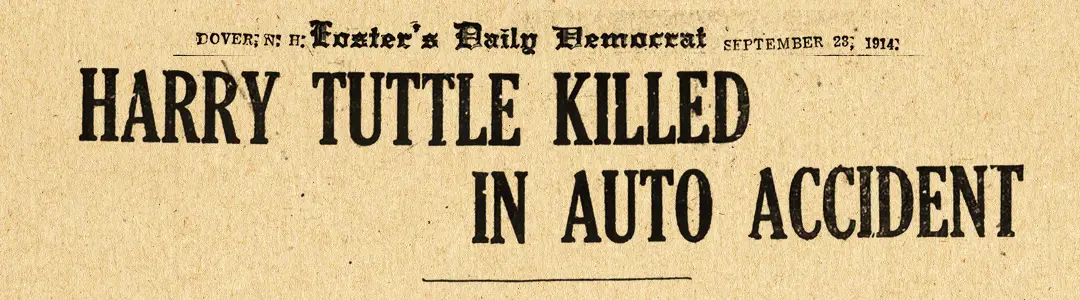
When you hear the name Tuttle, and Dover Point Road, it would be natural to assume that this story is about the Tuttle family of the Tuttle Family farm, but such is not the case. This is about Harry Tuttle, no relation, a native of Newmarket, about 40 years of age who, at about 5:15 on the afternoon of Sept. 22, 1914, was struck and killed by an automobile in close proximity to the Tuttle farm, leading to an arrest and a charge of negligent homicide against the driver, Leo Maloney.
Harry Tuttle was, in fact, a farm worker. He had moved to Dover about 20 years before this incident, and on the day in question had been working at the Elbridge Gage Farm, south of Tuttle’s. His residence was on the same road, but a bit north, and he was on his way home at the end of the day when struck. Charles Pinkham, a co-worker at the Gage Farm, observed Harry leave the premises at approximately 5 p.m. and cross to the left-hand side of the road going north. A few minutes later, he observed a vehicle, a Ford, pass in the same direction.
The Ford was owned and driven by Charles Burnham of Dover, accompanied by his wife, Ella, and his daughter, Mildred, traveling home from a trip to Portsmouth. He claimed to be traveling approximately 20 miles per hour, and at some point, observed an individual walking to the left side of the road some distance ahead. A second vehicle, which he described as traveling at a high rate of speed, came up behind, blew its horn, then passed the Burnham vehicle on the left. He saw this vehicle strike the pedestrian, throwing him into the air, then head across the roadway to the right, where it came to a stop some distance ahead. It’s not clear how officials were notified, but within a very brief time, several police officers and an ambulance were at the scene.
Perhaps the first to arrive was Dover Police Officer Brownell, who was not far from the area on a motorcycle patrol. This should be noted as a step up for the Dover Department, which, as we’ve seen in past stories, was still reliant, at least to some extent, on horse-drawn vehicles well into the start of the 20th Century. (The newspaper report doesn’t reflect the means of locomotion for the ambulance…) Harry Tuttle was obviously beyond needing medical care: a preliminary determination of the nature and extent of the injuries, a cut in the back of the head which had penetrated the skull, a broken neck, his right leg crushed, and, more than likely, serious internal injuries. Doctor Everett Chapman, a late arrival at the scene, issued the formal pronouncement of death.
So, the focus turned to the circumstances leading up to the accident. Witnesses were interviewed, measurements taken, and the immediate area examined for possible evidence. Leo Maloney, and the occupants of his vehicle, were questioned at length.
(more to come…)
Ready for Part 2? Read it here.
Visit the Crimes Along the Cochecho for all stories released so far.
Anthony McManus is a Dover, New Hampshire historian whose column “Crimes Along the Cochecho” explores the darker chapters of local history. A Dover native and Boston College Law School graduate, McManus served as City Attorney for Dover (1967-1973) and held various public offices before practicing law until 2001. His extensive historical work includes the “Historically Speaking” column in Foster’s Daily Democrat and his 2023 book “Dover: Stories of Our Past,” released for the city’s 400th anniversary. Through research, writing, and public presentations, McManus continues to illuminate both significant events and lesser-known stories that enrich understanding of Dover’s colorful past.