
Missed Part 1? Read it here.
It was not Maloney’s car. For the previous two summers he had come to Rochester to act as chauffeur for the Rev. Charles Salyme Lacroix, pastor of Holy Rosary Parish. (Fr. Lacroix had been the moving force in establishing St. Charles Orphanage the previous year.) Maloney, who lived in Massachusetts, had arrived about three weeks prior to the 22nd to fill that position for another year. Fr. Lacroix was the owner of a Jackson, a long-gone and little-known make of vehicle, manufactured in and named for Jackson, Michigan, produced from 1903 to 1923, in our case, most likely a 6-cylinder model, open top (or no top) touring car, which may explain why Maloney was a “summertime” chauffer. (As an aside, there was an article during the same week as the accident describing the availability of the new 8-cylinder Cadillac: “tests show better than 60 miles per hour…First of the Type to be Marketed This Side of the Water”.). Earlier that afternoon Fr. Lacroix had passed on going for a ride, so Maloney met up with two friends, brothers James and Joseph Sanfacon, and off they went for a tour of the area. First for a stop at a drinking establishment in Somersworth, where the three had several beers apiece. A trip to a similar spot in Dover for one beer each, and then off to Portsmouth. The Sanfacon brothers admitted to another beer while there, but all three stated that Maloney did not join them. At some point close to 5 p.m. they left for the return trip to Rochester.
Maloney’s statement at the scene was that he had been traveling 25 miles an hour when he had driven to the left to “avoid a Ford car which occupied the center of the road” and slipped into the left gutter where he “had struck in a glancing manner a walnut tree about 18 feet from the center, then to the right of the road, struck a post and continued several feet”. Maloney subsequently acknowledged that he had seen Tuttle ahead of him and was attempting to pull his vehicle to the right when Tuttle turned, “and jumped in front of the machine…did not see him when I struck him”.
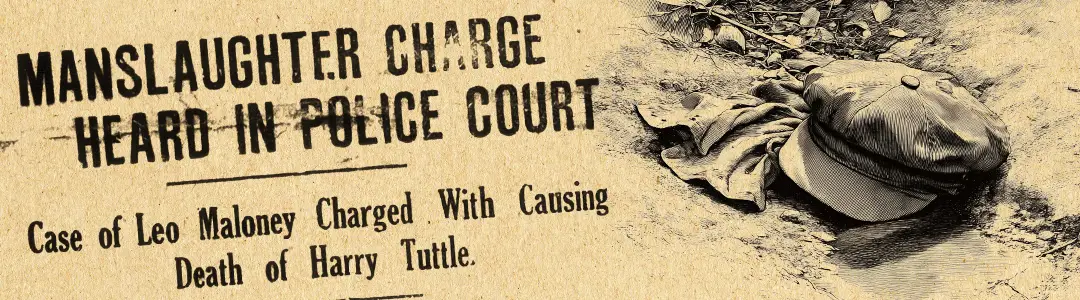
Investigators discovered Tuttle’s cap in the gutter where Maloney’s vehicle had first left the road. In addition, there appeared to be no visible damage either to the walnut tree or the post or any corresponding damage to the vehicle. Although Maloney insisted he had been traveling no more than 25 miles per hour, Charles Burnham and several others reportedly heard him comment, “Gee Whiz, I was going over 30”. Finally, several of the Dover officers and one or two by-standers at the scene reported the odor of alcohol on Maloney’s breath. All told, it was enough to have him placed under arrest and brought to the city jail to be charged with negligent operation and held without bail for a preliminary hearing. The Sanfacon brothers were released under personal bond to appear when called as witnesses.
There was a brief arraignment on Thursday, the 24th in the Dover District Court. The formal charge was manslaughter, City Solicitor Albert Sherry for the State, with “well known attorneys” Hurlburt and Jackson for the Defendant, who entered a plea of not guilty. Judge James McCabe approved a request for a hearing on Saturday, and Maloney’s bail “was secured without difficulty”, a petition having been filed in Superior Court on the 23rd seeking an order allowing his release. Fr. Lacroix signed the bond as surety. Also on Thursday afternoon was a funeral ceremony for Harry Tuttle, held in the “undertaking parlor” of Tasker & Chesley, then located on Third Street. Services were conducted by Rev. Frank Hooper, formerly pastor of the Advent Church, with burial in the family plot in Newmarket.
For some reason the preliminary hearing did not take place on the 26th. In the meantime was a report of a civil action having been filed on behalf of Harry Tuttle’s estate, naming Fr. Lacroix as the Defendant. The basis of the claim being that as owner of the car that struck Tuttle he allowed Maloney to operate it, and “that through the careless negligent manner by which the chauffeur operated the vehicle Tuttle lost his life”. It was not stated if the same “well-known attorneys” had also brought this suit.
And so the hearing on the criminal action was held on Oct. 1. In the colorful language of the time the charge was that Maloney “with force and arms upon one Harry Tuttle in a public highway then and there being, to wit: Dover Point Road, feloniously and willfully did make an assault…did force and drive…the said automobile against and upon the said Harry Tuttle…”.
Charles Pinkham led off by confirming he had worked with Tuttle that day at the Gage farm and had observed him leave for home approximately 5:15. Walter Roberts, The County Medical Referee, described an autopsy that he performed with the assistance of local physician George Tolman: head injuries, right knee badly crushed, spine not broken, “as at first assumed”. On cross-examination, he stated he had spoken with Maloney following the accident at the police station and “did not notice evidence of intoxication”, but added that undergoing “a sudden shock would have a tendency to sober up any man”.
(to be continued)
Read Part 3 of “Death on Dover Point Road: The Leo Maloney Trial” here.
Visit the Crimes Along the Cochecho for all stories released so far.
Anthony McManus is a Dover, New Hampshire historian whose column “Crimes Along the Cochecho” explores the darker chapters of local history. A Dover native and Boston College Law School graduate, McManus served as City Attorney for Dover (1967-1973) and held various public offices before practicing law until 2001. His extensive historical work includes the “Historically Speaking” column in Foster’s Daily Democrat and his 2023 book “Dover: Stories of Our Past,” released for the city’s 400th anniversary. Through research, writing, and public presentations, McManus continues to illuminate both significant events and lesser-known stories that enrich understanding of Dover’s colorful past.