
Missed Parts 1 through 3? Start here.
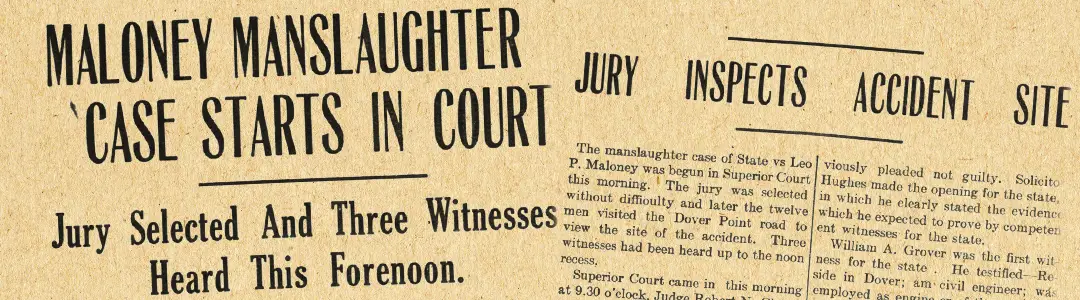
Almost the entire front page of Foster’s for Friday, Feb. 24, 1915 was given up to reports of proceedings before the Superior Court. The biggest headline was “Maloney Manslaughter Case Starts In Court”, but two additional matters, “Boullien Held Without Bail” — involving a case of armed robbery — and “Another Bag is Stolen” — theft of a woman’s bag from her person on Washington Street. A fourth item involved the report of a civil jury trial; in addition to covering the criminal docket, Foster’s regularly covered civil trials, often in as much detail as the criminal cases: names of jurors, opening and closing statements, witness testimony, the judge’s charge, and final results.
As for our case, the lawyers for the Defendant were the same as below, but here the prosecutor was County Solicitor George Hughes, and the judge was Robert N. Chamberlain, a resident of Berlin. An indictment had been returned by the Grand Jury, the charge similar to the original in the lower court, but with the addition of the words “recklessly, negligently, and criminally…did kill and slay…the said Harry Tuttle”.
A jury was chosen, with Thomas W. Wilkinson of Dover (Presumably no relation to the City’s former Deputy Marshall) as Foreman. The first order of business was a tour of the accident scene, followed by testimony from William A. Grover, the civil engineer, who revealed that he had actually been involved in the construction of Dover Point Road, and provided a full description of the immediate area of the accident…distances, location of buildings, trees, electric light poles. He produced a different plan from the one shown in District Court, showing a road width at the point of the accident of 36 feet, which would have allowed three vehicles to safely occupy the roadway.
Then Charles Pinkham, Harry Tuttle’s co-worker; Charles Burnham, who testified that Maloney’s vehicle never slowed from the time he passed on the left to the point he struck Tuttle, but later saw nothing to indicate that Maloney was intoxicated; Ella and Mildred Burnham, who pretty much substantiated Charles’ observations; Harry Horton, the photographer, whose pictures from the scene were marked as exhibits; a representative from the N.H. Secretary of State’s office, who said Maloney had no N.H. driver’s license, but a chauffeur’s license issued in 1912. (Maloney did have a Massachusetts license.)
George Tuttle testified to a conversation with Maloney where “he told contradictory stories of how the accident happened”, and although he appeared to be “walking all right” Tuttle felt he was “under the influence to the extent not capable of driving”. William Penn Tuttle followed, saying Maloney first said he did not see Harry Tuttle, then claimed that Tuttle had jumped out in front of his car. Under cross-examination he agreed Tuttle was not drunk but “more than under the influence”. William Gilman again spoke to the speed of the vehicle…”it was going like a flash”. And Lydia (not Lillian), Davis Clark, the lady in the hammock, repeated her testimony from the preliminary hearing.
The line-up of Dover officers — Brownell, Crowley, Lothrop — all testified as to their observations of the scene, and their opinions as to Maloney’s sobriety, not drunk, but all agreed he was under the influence to some degree. Chief of Police Edward Clark said that when he observed Maloney at the station, there was an odor of alcohol, and he appeared to be unsteady on his feet. All of this was offset to some degree by the testimony of Dr. Roberts, who after describing the post-mortem examination with Dr. Tolman, and certifying that the cause of death was the injuries sustained in the accident, said that he observed no signs of intoxication during his contacts with the Defendant. The final witness was John J. Carver, who identified himself as a car repairer. He gave a description of Maloney’s vehicle, the nature and extent of the damages, and gave an opinion that at normal speed the vehicle could have been brought to a stop in 3-4 car lengths, but felt it possible that particular make and model could reach a speed of 45 miles per hour. The State rested.
The defense began its case with Maloney himself, always a risk in a case like this. He offered some background: this was his third summer driving for Fr. Lacroix. No previous accidents. On the day in question he had three drinks, Somersworth and Dover, then headed to Portsmouth. On the way, they had tire trouble, which took about an hour to resolve. Left for the return to Rochester about 5:10, traveling between 20 and 25 miles per hour. He observed Burnham’s Ford ahead of him in the road, and in attempting to pass it got caught in the rut on the left and was having difficulty getting back on the roadway. He saw Tuttle ahead of him, and as Maloney went to make a turn to the right, Tuttle “turned sharp” in front of him. “Tuttle was in no danger until he jumped in front of the machine…did not see him when I struck him”. He denied that he was traveling 30 miles per hour — “I don’t know what made me say so.” He denied blowing the horn as he approached the Burnham vehicle.
In response to questions from the prosecution, he couldn’t say from past experience how many drinks it would take to affect his operation. “I think when I drank 10 or 12 glasses that I became intoxicated.” He revealed that there were two unopened quarts of liquor in the car which had been purchased in Portsmouth. He explained the braking system in the Jackson vehicle, acknowledged that he had used the emergency brake numerous times in the past. He said he was familiar with the Dover Point Rd. He claimed to have coasted as he came down the north side of Huckleberry Hill, but couldn’t say exactly when he “picked up the engine again”. At the time of the accident, “I pulled out into the road to avoid hitting the man”.
The idea seems to be to admit to having some beers, but limiting the number, and so here are two witnesses, Alfred Landry, who “ran a liquor place in Somersworth”, and Isadore Jacques, from Thomas Lamb’s saloon in Dover, the first to say that the Sanfacons and their companion each had two beers, the second recalled “one small glass of beer” each. Wilbur Jackson, a resident of Rochester, took the stand and, claiming to have been a chauffeur for seven years and familiar with the Jackson automobile, described its manner of operation and its capacity for speed. He was followed by Napoleon Labonte who was “in the auto business” and had been driving for close to 12 years. He had been to the scene of the accident and pointed out how driving any distance in a gutter would tend to slow the speed of any vehicle.
James Sanfacon confirmed that Maloney had consumed three beers. He and his brother had an additional beer in Portsmouth, but claimed that Maloney had not joined them. He stated that Maloney had blown the horn as they approached Burnham’s car from the rear, but denied that he had seen Tuttle before being struck or even at the time he was struck, saying that he was engaged in conversation with his brother when the vehicle went off into the gutter. The brother Joseph was next, and his testimony was consistent, except that he said that while in Portsmouth, he and his brother went looking for a friend, leaving Maloney by himself for a period of time in a local hotel.
Dover Police Officer Trask was called by the defense and testified about his response to the scene of the accident. From his observations, he was not able to say that Maloney was drunk. Finally, to wrap things up, Fr. Lacroix was called to testify as to Maloney’s good driving record over the previous three summers, and to his good overall character. All of this was completed by about 3:15 in the afternoon. There was no rebuttal on the part of the State. Attorney Jackson’s final argument for the Defendant took about 35 minutes; Solicitor Hughes took a bit more time, followed by the Judge’s charge to the jury, at which point an odd thing happened. A member of the jury spoke up, pointing out that no one had said anything about there being no sidewalk in that area, and “nothing has been said of his rights to be where he was”. The Judge replied that none of that should be considered as a factor in the case. (Solicitor Hughes apparently raised no issue at this point, though the juror’s question perhaps should have been cause for concern.) The jury began deliberation at 5:15.
The following morning the report was that the jury had considered the case all night without being able to reach a verdict. At some point on Friday, Judge Chamberlain had already left Dover to return to his home in Berlin. After a total of 22 and ¾ hours, Judge Robert Pike, who was a Dover resident, was called to receive a report from the Foreman that he didn’t think it possible that they would reach a verdict. Pike then dismissed the panel. The word from inside the jury room was that the final vote had been eight to four….to convict.
(To be continued….)
Read Part 5 of “Death on Dover Point Road: The Leo Maloney Trial” here.
Visit the Crimes Along the Cochecho for all stories released so far.
Anthony McManus is a Dover, New Hampshire historian whose column “Crimes Along the Cochecho” explores the darker chapters of local history. A Dover native and Boston College Law School graduate, McManus served as City Attorney for Dover (1967-1973) and held various public offices before practicing law until 2001. His extensive historical work includes the “Historically Speaking” column in Foster’s Daily Democrat and his 2023 book “Dover: Stories of Our Past,” released for the city’s 400th anniversary. Through research, writing, and public presentations, McManus continues to illuminate both significant events and lesser-known stories that enrich understanding of Dover’s colorful past.