
Missed Parts 1 through 5? Start here.
Leo Maloney took the stand and related what led up to the accident: he coasted down Huckleberry Hill, at some point reengaged the clutch, admitting for the first time that he had blown the horn “two or three times” as he approached the Burnham vehicle, “turned out to give them a good wide berth”, and saw Tuttle at the side of the road maybe 300 feet ahead. “The last I saw of Tuttle was when he jumped.” No recollection of having sideswiped the walnut tree.
One of the Sanfacons, James, testified to being in the back seat of Maloney’s vehicle, “heard a lady holler” and observed the three occupants of the Burnham car. He says he did not see Tuttle at any time until the accident. Maloney was not intoxicated.
There was a Robert Greenaway of Dover, “in the business of demonstrating and selling automobiles”. He had experience in driving a Jackson, and “gave expert testimony in relation to getting the car out of a rut.” And then something very unusual: “Ex-Judge James McCabe testified”. Keep in mind that this is the same James McCabe who presided over the preliminary hearing in this case in the District Court. There may not have been a specific written code of judicial conduct in place in those days, but appearing as a witness in these circumstances would not have been a common occurrence. Apparently, no objection was made, and so McCabe related his experience in having gone to the scene and seen some ruts at the side of the road, a recollection of a guard rail in the area.
There were several minor witnesses in support of Maloney’s good character. Dover police officer Crowley was recalled to describe Maloney’s conduct following the accident. According to his recollection, Maloney was smoking and whistling during the ride in the ambulance from the scene to the police station, and with that, the evidence for both sides wrapped up close to 4:30.
Final arguments were scheduled to begin when word was received that the mother of Luther E. Williams, who had been elected Foreman, had taken sick and was in critical condition, at which point the Judge suspended the trial and ordered resumption the following Monday at 9:30. On that day, however, the Court was informed that Mrs. Williams had died over the weekend, so a further postponement to the following day. (There was other news to keep the public occupied, however. Friday had been the opening game of the baseball World Series, Philadelphia Phillies vs the Boston Red Sox, with several games over the next few days…)
At last, we reach the end of the trial. Atty. John H. Bartlett from Portsmouth, who had not participated in the first trial, on behalf of the Defendant, “gave a clear, eloquent, and interesting review of the evidence”; one hour and fifteen minutes. Solicitor Albert Sherry for the State made his presentation “in a clear and intelligent manner”; 40 minutes. Judge Pike’s charge was “clear and impartial” (all three reviews courtesy of the Foster’s reporter…). The case went to the jury at 11:55.
And while they are beginning deliberations we can contemplate another tale of questionable motor vehicle operation which occurred this same week: It seems that Dover’s Fire Chief James Smith, “who has never had any experience handling a piece of motor apparatus” was behind the wheel of a brand new fire truck, attempting to turn the vehicle from Central Avenue onto Silver St, when it got caught first in the trolley tracks, “then in a rut close to the rail and caused the machine to change its course and plunge into a tree at the side of the road (faint echoes of the Maloney case here…). Minor damage resulted, but since there had yet to be a formal transfer of title from the manufacturer to the City, the repairs became the responsibility of the seller’s insurance company. (No indication what action, if any, was taken against the Chief…)
So, back to our case. Midway through the afternoon, the jury asked for instructions: a further explanation of the meaning of “culpable negligence” and the definition of “beyond a reasonable doubt”. Judge Pike responded, and the jury returned for further discussion. Then, after deliberating a total just short of five hours, a verdict was delivered: guilty as charged, but with an unusual request…”the jury is unanimous in asking the leniency of the court”. Foster’s reported: “Defendant is hard hit.” Maloney turned “deathly white”, and his mother, “who sat at his side during the entire trial, broke down and wept”. Maloney, who had been at liberty since the preliminary hearing, was taken into custody pending final sentencing.
A date was scheduled, then postponed. Defense counsel Paul Hurlburt filed a Motion for New Trial claiming that (1) the verdict was contrary to the evidence and (2)that the verdict was influenced by prejudice existing in the minds of certain jurors, which the respondent stands ready to prove”. He had asked for the additional time to produce affidavits from a juror who, he claimed, had admitted to a bias against Maloney. The request had been granted, but “for some reason or another he did not file them”, and the Court took no further action. And so, on Oct. 20, the parties appeared in Court for the final time. It was noted, however, that very few people were present beyond the Defendant and counsel, Maloney’s mother, and Fr. Lacroix.
Attorney John Bartlett spoke first, pointing out that the jury had made the rather unusual request that Maloney be treated with leniency, which he felt was some evidence of doubt, in spite of the actual verdict. “I have never been so strongly impressed with the innocence of a person that has been found guilty by a jury as I have in this case”, a rather remarkable statement on the part of any lawyer. (But Bartlett was a rather remarkable individual. Born in 1869, he graduated from Dartmouth in 1894, returned to Portsmouth as a teacher at the high school, became principal for several years, then entered politics and was elected Postmaster from 1899 to 1907. One term in the legislature led to a campaign for Governor and his election for a two-year term in 1919. This is notable because John Bartlett was a descendant of Josiah Bartlett, who was N.H.’s very first Governor, 1790-94; while in office, John Bartlett had the distinction of signing the bill into law which designated the purple lilac as N.H.’s State Flower.
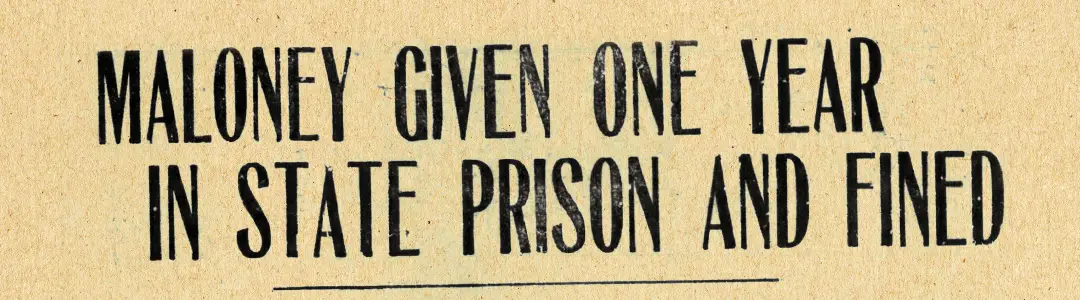
County Solicitor Sherry came close in his remarks:” …in my short life I never experienced a responsibility that rests upon us this morning”. He reported that he had received a personal visit from Harry Tuttle’s sister, who “desired the court to be as lenient as he could”. Judge Pike responded that it was “a very unpleasant task for the court to take away anyone’s personal liberties”. Yet he pointed out that Maloney had been found guilty, and that the charge was serious. “I must impose a sentence which I think the case warrants”. As the sentence was read — a year and a day to two years in N.H. State prison, with a fine of $250 — both the Defendant and his mother “broke down and wept”.
Sheriff Young accompanied Leo Maloney on the 10:50 train to Concord.
Visit the Crimes Along the Cochecho for all stories released so far.
Anthony McManus is a Dover, New Hampshire historian whose column “Crimes Along the Cochecho” explores the darker chapters of local history. A Dover native and Boston College Law School graduate, McManus served as City Attorney for Dover (1967-1973) and held various public offices before practicing law until 2001. His extensive historical work includes the “Historically Speaking” column in Foster’s Daily Democrat and his 2023 book “Dover: Stories of Our Past,” released for the city’s 400th anniversary. Through research, writing, and public presentations, McManus continues to illuminate both significant events and lesser-known stories that enrich understanding of Dover’s colorful past.