
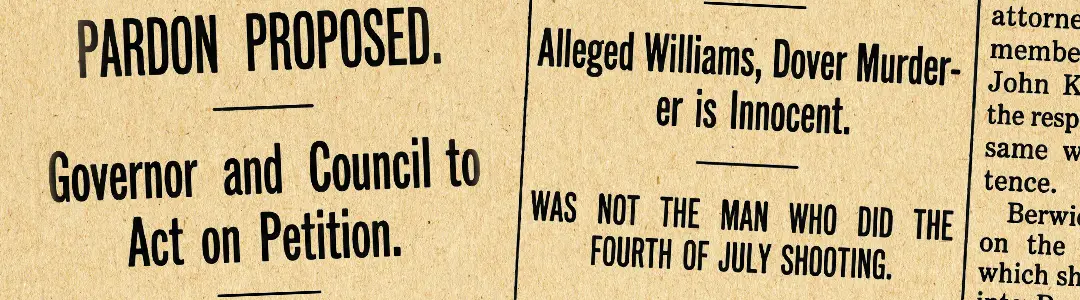
Remember John Williams? One of the “desperadoes” who shot up the town on the Fourth of July, 1900? If you recall the earlier story—or go back for another read—Williams was charged, tried, and convicted in the murder of Thomas Dobbins and John McNally. A number of witnesses testified at trial as to the activities of Williams and his cohorts over a period of several days, pretty clearly describing the mayhem, injuries and deaths which occurred. The evidence was extensive. The jury was obviously convinced. The judge responded to the verdict with a sentence that pretty much guaranteed Williams’ time in prison would be for the balance of his life. Yet in spite of all the testimony and the judgment of his peers, you may recall his statement at the conclusion of the trial: “I am innocent of the crime. I know nothing about it and have nothing further to say.” Unfortunately, as we have learned all too often over the years, innocent people have been convicted and sentenced to extended prison terms, some even put to death, for a crime they did not commit. So, how does this apply to John Williams?
It was in 1907 that a petition was filed with the NH Governor and Council alleging that Williams fell within this category. What made this even more noteworthy was the source of the claim.
On May 1 of that year, Dover Attorney John Kivel submitted a petition for a full pardon on the grounds that new evidence supported Williams’ position. The claim was as follows: One member of the July 4 gang was alleged to have been a Samuel Huddle, who was present during the shootings but who fled the scene, and had never been previously identified. (You may recall that John Brown, one of the known participants, had an alias of “Joseph Huddle”.) According to Kivel, Brown, and the others who had been involved in the Massachusetts brewery burglary prior to their arrival in Dover had been convicted and sentenced in Massachusetts to terms ranging between 12-15 years for Scott and Brown, to 10-12 years for Gold, and 8-10 years for Farrell. In conversations with one or more of these people, it was claimed that someone other than Williams did the shooting. (It was also learned that Williams was a fugitive from a prison break in Sherbrooke, Quebec, where he had been serving a 10-year sentence, and had also been a participant in the breaking and entering of a bank in Danville. Talk about your career criminal!)
The real surprise, however, is that the moving force behind the petition is Deputy Sheriff and Dover Police Commissioner Bert Wentworth. As pointed out in the news report of the filing, “its success depends largely upon his efforts to discredit the testimony of an officer of his own department”. That would have been George Smith, who was the first officer at the scene. He had provided a detailed statement following the incident and testified at both the preliminary hearing and the later trial of Williams in the Strafford County Supreme Court. What makes all of this even more interesting is that Smith is still a member of the Dover Police Department.
(more to come)
Read Part 2 here.
Visit the Crimes Along the Cochecho for all stories released so far.
Anthony McManus is a Dover, New Hampshire historian whose column “Crimes Along the Cochecho” explores the darker chapters of local history. A Dover native and Boston College Law School graduate, McManus served as City Attorney for Dover (1967-1973) and held various public offices before practicing law until 2001. His extensive historical work includes the “Historically Speaking” column in Foster’s Daily Democrat and his 2023 book “Dover: Stories of Our Past,” released for the city’s 400th anniversary. Through research, writing, and public presentations, McManus continues to illuminate both significant events and lesser-known stories that enrich understanding of Dover’s colorful past.