
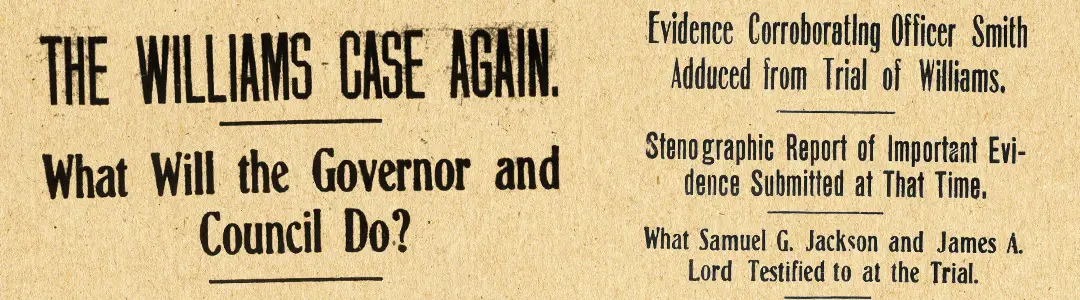
On Aug. 30: “Rumor Has it that Williams Will be Pardoned”. A decision is expected to be made at a Governor and Council meeting scheduled on Aug. 31, and should that happen he would be turned over to District Attorney Peters of Essex County, “though it is thought by some that they have a slim case and a fight will be made to get him off.” The reporter then makes a brief review of the claim that Smith was the only one to say that Williams did the shooting, while pointing out the number of witnesses who had testified to having seen Williams do the deed.
The rumor proves false. No action is taken at the meeting. Foster’s has an update of the matter in a long review of the case on Sept. 14, more of a statement in opposition to the pardon than a news article. The author of the article makes a valid point: since Williams was convicted on the basis of eyewitness testimony he should not be pardoned on the basis of hearsay. “The Court did not send this man to prison wrongfully. The Court does not do business that way. The courts are careful and considerate of a man’s rights and they do not jump at conclusions, but they weigh the matters carefully.” Perhaps an accurate description of the Williams case, but in view of information we now have about our system of justice—well over 3,000 innocent people exonerated since 1989—we know things are far from perfect.
Then nothing further on the case until an article of Dec. 15, 1908. An announcement that a “final” hearing was now scheduled for Dec. 18. This is followed by a brief summary of the facts of the case and then the exact same paragraph as described above: “The Court did not send this man…” etc. The Attorney General, Edwin Eastman, was in Dover on Dec. 14, preparing to offer the entire stenographic record of the trial, and gathering affidavits from 3 people who had not been called on to testify, but who have evidence to corroborate the case against Williams.
This article makes the point that the “main backer” of the pardon request is Bert Wentworth, and that although “it has been stated in the Boston Globe and other papers that the Hon. John Kivel of this city appeared before the Governor and Council for the prisoner, such is not the case. Mr. Kivel has never appeared before the Governor & Council in this matter…”. At the conclusion of the hearing the matter was taken under advisement yet again, “although it is generally understood that no further action will be taken by the Governor and Council”. Two people were present, however, hoping for a different result. Inspector O’Dowd, was there from Manchester, on behalf of the British Consul, with instructions to arrest Williams should he be released, and Hiram Moe had made a second unsuccessful trip from Sherbrooke, prepared to take him into custody in the event the pardon was granted.
What appears to be the final word—on Jan. 2, 1909—Governor Charles Floyd stated that he was refusing to consider a pardon for Horace E. Berwick…alias John Williams…” and the only avenue which is open to the latter is now a petition to the Superior Court”. It turns out that the Council actually had taken a vote, and that was 3-2 in Williams’ favor, to grant the petition. The final say, however, was with Governor Floyd who made the following statement: “I believe with the evidence discovered that he will have no difficulty in securing a new trial. I myself believe that he should have a new trial and, knowing that he has this avenue of escape open to him I believe that justice should be given him by the court and not by the Governor and Council”. (A prime example of passing the buck.)
In the midst of all of the above there appears a letter in Foster’s on Dec. 16: A Word From Mr. Wentworth. “Mr. Editor. I would like to take a little of your valuable space” to correct some prior misstatements. He claims that any prior reference to the “petition of Bert Wentworth is not accurate”. The petition was that of the mother of the accused, filed by Attorney John Kivel, prepared in his office and signed by the mother in Concord. “Your pages in the last nineteen months has published matter on this case…and has been so full of repeated misstatements, that it seems to me their origin could be founded on nothing but malice.” (A prime example of avoiding the facts.)
There seems to be no follow-up in terms of a petition to the Superior Court. Williams/Berwick remains at the State Prison, but he has not given up all hope of release. There is more to come, but we will have to wait another 6 years for another attempt at freedom.
Missed parts 1 through 3? Start here.
Visit the Crimes Along the Cochecho for all stories released so far.
Anthony McManus is a Dover, New Hampshire historian whose column “Crimes Along the Cochecho” explores the darker chapters of local history. A Dover native and Boston College Law School graduate, McManus served as City Attorney for Dover (1967-1973) and held various public offices before practicing law until 2001. His extensive historical work includes the “Historically Speaking” column in Foster’s Daily Democrat and his 2023 book “Dover: Stories of Our Past,” released for the city’s 400th anniversary. Through research, writing, and public presentations, McManus continues to illuminate both significant events and lesser-known stories that enrich understanding of Dover’s colorful past.