
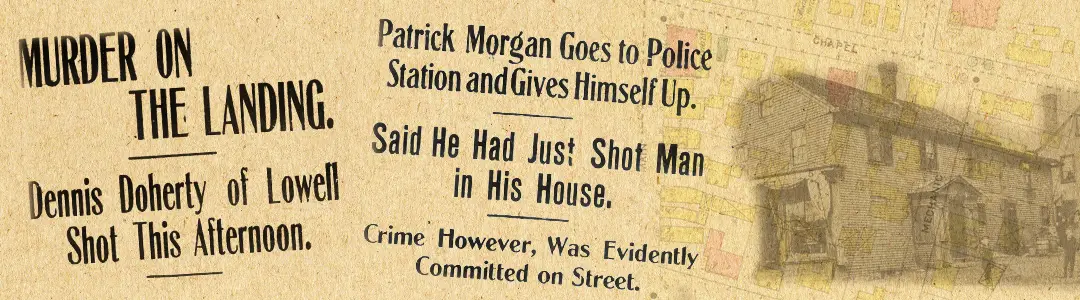
It was around 3 in the afternoon, Feb. 23, 1907. A man identifying himself as Patrick Morgan rushed into the Dover Police Station and “exclaimed in an excited manner” that he had just shot a man inside a house on Main Street. In the often colorful language of the Foster’s reporter: “Those who heard him were at first of the opinion that he was having an attack of Katzenjammer and didn’t know what he was talking about, but when he began to flourish a revolver which was cocked, things had a more serious aspect.” (I had to look it up, but “katzenjammer” back then often referred to a severe hangover or some kind of visible inner turmoil.) Morgan claimed that the victim “came into the house and was running things so that I could not stand it any longer.” He stated that the man was a stranger and he could not provide a name.
Officers were dispatched to the scene, and at or about the same time, a call was received at the station that a man had appeared to have had a fit on Main Street. Upon arrival, the officers found a male subject who “was breathing his last.” He was carried from that location to the store owned by Ruel Roux, at the corner of Main and Chapel streets, where he died. The cause of death appeared to be a wound to the face, presumably a gunshot at or about the upper lip with no obvious exit wound. The deceased was identified as one Dennis Doherty by a man in the area, Joseph McLinn, who recognized him as an employee in the machine room of the Cocheco Print Works, recently arrived from Lowell, Mass., with no known family locally.
Patrick Morgan, on the other hand, who was about 25 years of age, lived with his family at 39 Main St., his parents and two brothers. City Marshal McKone went to the address and spoke with Mrs. Morgan, who stated she doubted Patrick was in any way involved since he had left the home only a short time previously. Though an attempt to protect her son, the statement obviously contradicted his claim of self-defense within the house. By that time, Dover police officer Dickey, who had been in the area, came forward to say he had seen the event take place on the sidewalk in front of the Hughes home at 43 Main St. (now the only remaining residential building on the easterly side of the street). He observed that two shots had been fired, but “only one took effect.” Finally, “a young French Canadian girl” confirmed that the shooting had taken place on the sidewalk.
Further investigation showed that earlier in the day, the deceased had been drinking with Patrick Morgan’s brother, Charles, but later, Patrick and Doherty had been seen together, Morgan being described as “evidently the most intoxicated of the two men, and Doherty was assisting him home.” It was then learned that a short time before the shooting Patrick had purchased a revolver (at a cost of $1.50) plus ammunition at Eugene Smart’s store. This would have been the establishment of Smart & Mitchell, located at 459 Central Ave., a short distance north of Chapel and Main, which advertised “guns, rifles, fishing tackle, ammunition” but also “high-end bicycles.” By this point, based on the accumulated information, Marshal McKone had fully discounted Patrick Morgan’s original claim of self-defense. He also ordered the arrest of Charles Morgan as a possible accessory to the shooting.
At some point, Dover’s city physician, whose name was John O’Doherty, was notified of the death, and, no surprise, County Solicitor Dwight Hall was on the scene, meeting with the investigating officers and potential witnesses. There was a general feeling that Mrs. Morgan had not been as helpful as she could have been. Officer Dickey expanded on his earlier statement, explaining that he had observed Doherty take several steps along the sidewalk after having been shot and before falling to the ground. This was confirmed by observations of a short trail of bloodstains in the snow where the shooting took place.
The county medical examiner, Dr. John H. Neal, arrived from Rochester and viewed the body, then still at Roux’s Market, before ordering it moved to a local funeral home. Earlier, Dr. O’Doherty’s exam had determined a shot to the chest as the immediate cause of death; that had punctured a lung, causing extensive bleeding through the mouth, which originally led to the report of a second wound near the upper lip.
Back at the police station, the gun brandished by Morgan was unloaded and found to contain two empty shells. Markings on one or more of the remaining bullets indicated that they may have misfired. In the meantime, efforts had been made to properly identify the origins of the deceased, apparently a very recent arrival to the Dover area. Information was obtained that led to Providence, but in calls to law enforcement there it was learned that Doherty’s “native place” was Pawtucket. No immediate family other than a brother, John, who was described by Rhode Island authorities as a “worthless fellow who would not work,” with a slightly more positive description of the deceased as a “harmless fellow whose only fault was his love of intoxicating liquor.”
So Morgan is placed in formal custody and held on the charge of killing Doherty. Attorneys James Edgerly of Somersworth and Col. Walter W. Scott of Dover are contacted to represent his interests. Placed in a cell at the police station, Morgan is reported to be “acting rather queerly.” He refuses to answer any and all questions and is overheard making odd noises. The officers on duty “are of the opinion that he is trying to work the incapacity angle.”
On Monday, Feb. 25, he is arraigned in Dover’s police court, and as usual, “every inch of standing room being occupied.” The charge is murder in the first degree. Morgan’s response, said in a husky voice, is not guilty. His lawyers then ask for some additional time to prepare for the preliminary hearing. Solicitor Hall has no objection. Judge Frost continues the matter to March 8 and orders Morgan to be held without bail and remanded to the county jail. The following day, the autopsy report on Doherty’s death is made available, having been performed by county medical referee Neal and assisted by—as you might have guessed—Dover’s Dr. Miah Sullivan.
Then on March 1 there appears an odd news item in Foster’s, one perhaps more properly found on the editorial page, but there is no byline, so the source is unknowable, but as follows: “…a conspicuously disgraceful condition has been permitted to exist all this time on Main Street…a pool of blood on the sidewalk where the crimson stained snow and ice has been allowed to remain…” Noting the warm sun of the previous days “has caused the blood to run further down the sidewalk…and good citizens passing that way emphasize the opinion that it is up to some municipal department to…make the sidewalk…more presentable.”
(to be continued…)
Visit the Crimes Along the Cochecho for all stories released so far.
Anthony McManus is a Dover, New Hampshire historian whose column “Crimes Along the Cochecho” explores the darker chapters of local history. A Dover native and Boston College Law School graduate, McManus served as City Attorney for Dover (1967-1973) and held various public offices before practicing law until 2001. His extensive historical work includes the “Historically Speaking” column in Foster’s Daily Democrat and his 2023 book “Dover: Stories of Our Past,” released for the city’s 400th anniversary. Through research, writing, and public presentations, McManus continues to illuminate both significant events and lesser-known stories that enrich understanding of Dover’s colorful past.