
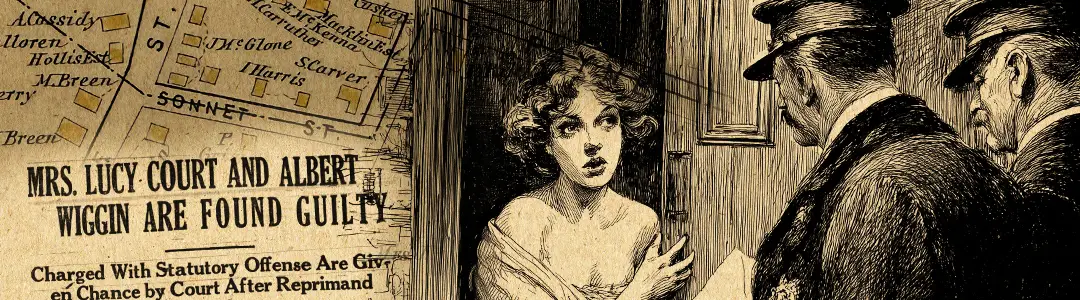
The first two months of 1922 were busy times for both the Dover District Court and Strafford Superior. The dockets contained some rather unusual cases, at least in terms of subject matter viewed from the passing of 100 years. It’s hard to know where to begin, so we will do it chronologically, which would bring us first to the district court on Jan. 14 for a hearing on charges filed against Mrs. Lucy Court and Albert Wiggin. Described in the headline only as a “Statutory Offense”, the charge, in fact, was a claim of adultery, although Foster’s Daily Democrat never once used that word in what was a fairly lengthy review of the proceedings.
The cast of characters involved a number of relative newcomers. The judge was Patrick W. Murphy. The City Solicitor was Everett J. Galloway, appearing for the prosecution, with Dover Attorney Francis J. McDonald for the Defendants. The two witnesses for the State were Dover Police Officer Brownell, who we have met in the past, and Asst. City Marshall John McDonough. Without explanation of how — or why — the matter had come to the attention of local law enforcement, the two testified that they had gone to Mrs. Court’s house around 1 a.m. Two voices could be heard from inside, but there were no interior lights. “After making considerable noise”, and having an arrest warrant for each, Mrs. Court finally came to the door. She was described as “wearing a wrapper”. Clothing of both parties was found in the downstairs living room. There was a rolled-up mattress on the floor. According to Officer Brownell, “I would say the mattress was warm and it had been occupied.” Wiggin stated he had been sleeping on the couch, but “there was no bedding on the couch”. Some testimony as to there being several children, with nothing as to the number or their ages, sleeping on cots on the upper level of the house. The State rested.
Mrs. Court took the stand. She lives on Sonnett Street and is the mother of eight. She stated that she does some work for her mother, but also received financial aid from the County. Mr. Wiggin “called on me last evening. We are friends; we are engaged to be married.” There was some confusion in her testimony as to whether she did or did not ask him to spend the night, but in any event, she testified that she had been sleeping on the mattress, with Wiggin on the couch. This was the very first time that he had stayed over: “he fell asleep and I did not want to disturb him.”
Mr. Wiggin testified that he resides at Mrs. Main’s on Court Street, a carpenter by trade, divorced, the father of two children. He met Mrs. Court at the Belknap Church the previous November and they are scheduled to be married on April 26, which is also his birthday. He also stated that this was the first time he had stayed overnight, but earlier Mrs. Court had described to him a concern she had about a dispute with her sister and her boyfriend and he “felt it was my duty to stay”. In response to questions from the judge Wiggin said that he was a member of the Orangemen, so he often returned home very late in the evening. He had no idea why the police were involved, and “could not see any harm in two church members occupying the same room”. “I am a church man and active in the church. I consider Mrs. Court to be a woman of good character”.
(more to come…)
Read Part 2 here.
Visit the Crimes Along the Cochecho for all stories released so far.
Anthony McManus is a Dover, New Hampshire historian whose column “Crimes Along the Cochecho” explores the darker chapters of local history. A Dover native and Boston College Law School graduate, McManus served as City Attorney for Dover (1967-1973) and held various public offices before practicing law until 2001. His extensive historical work includes the “Historically Speaking” column in Foster’s Daily Democrat and his 2023 book “Dover: Stories of Our Past,” released for the city’s 400th anniversary. Through research, writing, and public presentations, McManus continues to illuminate both significant events and lesser-known stories that enrich understanding of Dover’s colorful past.