
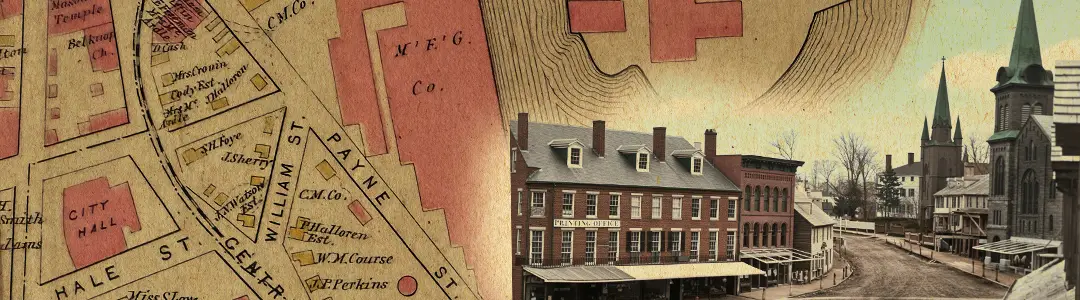
It might be helpful here to offer a little background related to the Court/Wiggin case. The Belknap Church, which apparently played a role in the parties’ lives, was located on Central Avenue, occupying the space just south of the present Sonny’s Tavern, now a municipal parking lot. Dating from the mid-1850s, it was a spin-off from the First Parish Church, likely in relatively friendly opposition to that church’s stand in favor of abolition. The building itself was somewhat unique, constructed so as to provide retail space on the street level, with the sanctuary and related spaces on a second level. The building was damaged on several occasions over the years when the Dover municipal building and then the Masonic Temple to the north were destroyed by fire. Over time, the congregation dwindled, and for many years in the late 1900s, the building remained empty and unused. (The Orangemen mentioned by Wiggin was one of the several fraternal groups in town, originally organized as a semi-religious Protestant organization, violently anti-Catholic in many places, but in Dover likely more a social organization independent of any one particular church.)
There is also an interesting story regarding Assistant Marshall John McDonough. He was born in England in 1874 and came to Dover with his family as a young teen. For several years, he was employed at the Sawyer Mills, then the Pacific Mills, then became a member of the Dover Fire Department, and was credited with helping to save the lives of several employees of Mill No. 1 attempting to escape the fire of 1907. He was hired by the Police Department in 1914 and promoted to the office of Assistant Marshall in 1921. McDonough died while on duty on June 14, 1923, lapsing into unconsciousness while speaking to a potential witness, not far from the police station itself, regarding the whereabouts of a missing child. He was the father of three children of his own, one of whom, Edward, had been hired as a patrolman in 1921 and remained a member of the Department for the next 25 years.
Back to the trial. At the conclusion of the evidence, Attorney McDonald asked the court, if there was to be a finding of guilty, to consider suspending any sentence to allow his clients to marry. Solicitor Galloway responded by pointing out that “the county is assisting this woman”, and if she is found guilty, “I hope that you will give her the limit, for if the county has got to support her, they might as well support her at the farm as to support her here”.
Judge Murphy issued findings of guilty as to both. “I should think that a woman who is the mother of eight children should have some decency”. He believed neither of their stories, felt both of them had lied, and both versions were unreasonable. And so they each received a sentence of six months in jail (plus costs), Mrs. Court to serve her time at the House of Correction—the County Farm—Mr. Wiggin to be held in the County jail. But…both sentences were suspended, and “If you intend to get married, you had better do so at once”. The two were then released with a warning: any further trouble and a mittimus would issue. Back in those days, Foster’s would often offer brief articles noting the marriage of local citizens, but there does not appear to be any follow-up report of a Court/Wiggin ceremony.
(The “Statutory Offense”….adultery as a crime…remained on the books until the mid-1970s, when formally repealed as part of a complete review and overhaul of New Hampshire’s Criminal Code.)
Visit the Crimes Along the Cochecho for all stories released so far.
Anthony McManus is a Dover, New Hampshire historian whose column “Crimes Along the Cochecho” explores the darker chapters of local history. A Dover native and Boston College Law School graduate, McManus served as City Attorney for Dover (1967-1973) and held various public offices before practicing law until 2001. His extensive historical work includes the “Historically Speaking” column in Foster’s Daily Democrat and his 2023 book “Dover: Stories of Our Past,” released for the city’s 400th anniversary. Through research, writing, and public presentations, McManus continues to illuminate both significant events and lesser-known stories that enrich understanding of Dover’s colorful past.