
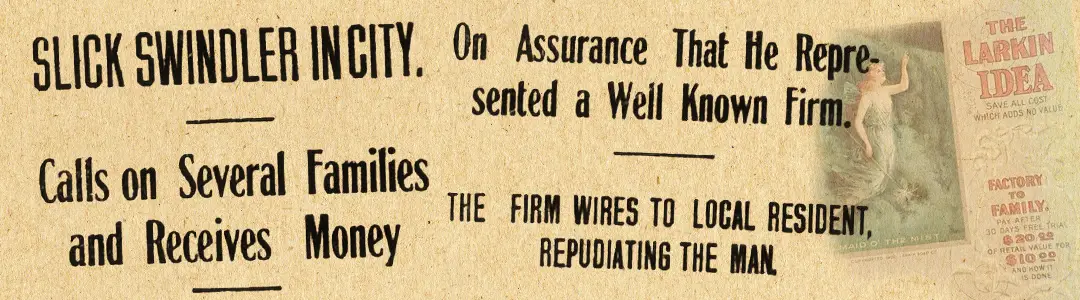
It wasn’t all murder and mayhem in Dover’s criminal history. Take, for example, the story found in Foster’s on Aug. 28, 1907, reporting that “another well-dressed and smooth-tongued swindler has struck town”.
Late in the morning on the 26th, a man introducing himself as Mr. Myers appeared at the home of Charles Tibbetts on New York Street. He was, he said, an adjuster of claims for the Larkin Soap Co., and wished to speak with Mrs. Tibbetts. She had been the moving force in organizing several Larkin Soap Clubs, whose members then became eligible for special discounts and direct delivery from the parent company.
Myers advised that Larkin was offering double premiums on any money that she may have collected, which he would forward directly to the company, thereby speeding up the transaction. Mrs. Tibbetts’ daughter, who was present, inquired about his actual position with the company and asked for some form of identification, which was not forthcoming. Mr. Tibbetts, “who had been a student of the law”, questioned some of Myers’ statements, and “the more the stranger talked, the more the Tibbetts family became suspicious, and…he took his departure”, saying he had scheduled stops in several other nearby cities. Myers, assuming that was his true name, was described by Mr. Tibbetts as “thick set, well dressed in a suit of gray mixture, about 50 years old, and one who had been favored with an oily tongue”.
At some point police learned that a male had appeared at a home on Payne Street (today’s Henry Law Avenue), making the same representations on behalf of Larkin Soap. This time, he had been able to extract $20 from the woman resident, advising that he would forward it to the company in the morning by means of a check issued through Strafford National Bank. It was later determined that no such check had ever been sought. (No name was provided for the victim in this case.) But then… more complaints. Two additional women, one identified as Mrs. James Jackson, apparently a resident of Monroe Street, had given $10 each to a man claiming to be H. Adams from Larkin Soap. Having some second thoughts, the following day, Mrs. Jackson telegraphed the company and was advised that no one of that name was an employee or authorized representative.
Even with a limited physical description, the Dover police had “hopes of apprehending the man”, but it appears that he had made a clean getaway with his take of $40. Well, you might say, that appears to be small change. But $40 in 1907 amounted to almost $2,800 in today’s money, so not at all a bad return for a relatively brief stopover in the Garrison City. There does not appear to have been any further news involving Mr. Myers/Adams.
And by way of background: the Larkin Soap Company was located in Buffalo, N.Y. Established in 1875 as a small operation, it hit the big time with the concept of the Soap Clubs, each consisting of 10, mostly female, members, and by the early part of the 20th century, this had propelled Larkin into becoming a multi-million-dollar business. Unfortunately, things did not go well during the Depression, and the company ended operations by the early 1940s.
And here we should take a break to give credit where credit is due.
None of these stories would see the light of day if it were not for Mike Gillis, who is the moving force behind the Made In Dover website. More than that, he has been my proofreader, and has written the summary and created the headline/photo visuals that precede each segment. It has been a major contribution to the final product.
Most of the information comes from back issues of Foster’s Daily Democrat. Copies of the paper have been digitized and indexed, but only up to 1923. I can go online, type in “John Williams”, for example, with beginning and end dates, and read the newspaper articles that are listed showing that name. After 1923, unfortunately, the paper is still on microfiche with no index, which means–unless I know a specific date in advance–slogging through the papers on a daily basis, which often results in getting badly sidetracked in reading headlines, court reports, death notices, city politics, etc., totally unrelated to the article that I am working on.
There are other sources. Several other newspapers had a limited existence, e.g The Enquirer, the Republican. They are on microfiche. There are old City Directories which list the names and addresses of individuals and businesses alphabetically. For a number of years, there was a section that listed residents by street, so you could tell who lived next door to whom. And finally, there are the Superior Court files, and here I owe a debt to Aline Gowen of the Clerk’s Office, who has been able to locate and retrieve the criminal and civil files that usually make up the final outcomes of all of our tales. There are limitations, however. The files in Dover all date from around the turn of the 20th century to the present. Prior files were moved some time back to the State Archives in Concord, where they all sit in cardboard boxes with no index as to case name.
So with the help of these good people, we have been able to come up with over 40 articles to date, all of which I hope have provided an interesting, if limited, view of Dover’s past. We will try to keep them coming, and some of the stories may try to come closer to the current day. We hope you will stay with us.
Visit the Crimes Along the Cochecho for all stories released so far.
Anthony McManus is a Dover, New Hampshire historian whose column “Crimes Along the Cochecho” explores the darker chapters of local history. A Dover native and Boston College Law School graduate, McManus served as City Attorney for Dover (1967-1973) and held various public offices before practicing law until 2001. His extensive historical work includes the “Historically Speaking” column in Foster’s Daily Democrat and his 2023 book “Dover: Stories of Our Past,” released for the city’s 400th anniversary. Through research, writing, and public presentations, McManus continues to illuminate both significant events and lesser-known stories that enrich understanding of Dover’s colorful past.