
You can find stories of major crimes throughout Dover’s history, but the vast majority of court appearances, then as now, involved relatively minor, but all too often recurring offenses such as public drunkenness, minor theft, and domestic abuse. As to the first, keep in mind that at or about the turn of the century Dover’s population was in the neighborhood of 12,000. During those years, the number of saloons listed in the City Directories was in the mid-to-upper 30s. That meant an awful lot of alcoholic beverages being consumed. And keep in mind also that very few people owned an automobile in those years, so most people traveled on foot or possibly by Dover’s public transportation system. So anyone heading home after “having had a few” at one or more of the many downtown establishments would likely be observed by one of the city’s law enforcement officers, who were also on foot, “walking the beat”.
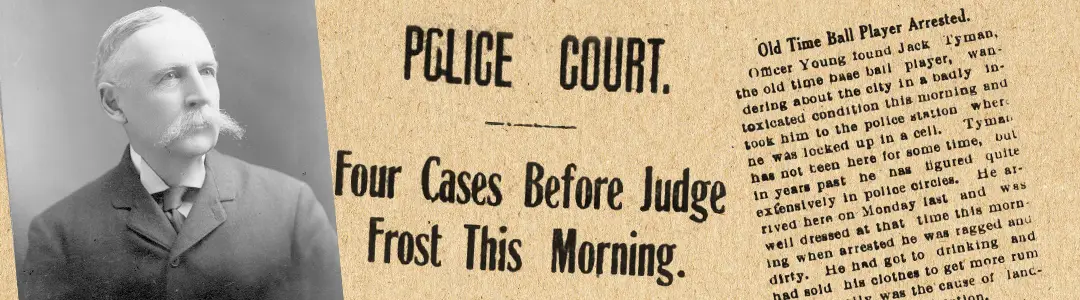
As an example, there is a report of a court appearance on August 30, 1907, which tells of one Jack Tyman, “an old-time baseball player,” who was observed wandering about the city in a “badly intoxicated condition.” Tyman had come to Dover the previous Monday, described at the time as “well-dressed,” but when arrested, he was “raggedy and dirty,” and it was later determined that he had sold his former attire to obtain money to buy a drink. The press reported that “Tyman had not been seen here for some time, but in years past, he has figured extensively in police circles.”
Four days later, three residents were before the court, each charged with drunkenness. Around 4 p.m. on Sunday, police received a complaint that Nelson Bailey, James McFadden, and William Craig “were holding a rum picnic instead of attending church.” Each pleaded guilty to the charge. They were fined and remained in custody pending receipt of payment. But one Israel Jandreault, charged with a similar offense, pleaded guilty and was allowed to leave the courtroom straightaway. According to our reporter, “Israel went down in his jeans and settled rather than take a course in Superintendent Handy’s Agricultural College.” (Supt. Handy being in charge of the County Farm, which became the temporary residence of Mssrs. Bailey, McFadden, and Caig until they either paid or “worked off” their fines.
At least one person didn’t follow the standard routine. Joseph McTighe had appeared before the court on the 17th of August, also on a charge of public drunkenness. As reported in the press he was observed by a Dover officer “who quickly had that gentleman under protective wing”. McTighe was facing an existing suspended sentence from a previous similar incident. That was brought forward and he was transported to the County Jail. However, as reported on the 30th, “he only remained at that institution a short time when he took leg bail and has since been at large.” (As our readers may have noticed from this and several of the previous articles, Foster’s reporter during this time….no byline or identification of the individual involved…had a colorful way of keeping the public informed.)
The person who presided at most of these District Court appearances was George Seward Frost. He was born in 1844 in the Frost Homestead in Durham. The name was originally spelled with two “Ffs”, and the building is said to be the oldest surviving residence in Durham, currently the home of the Three Chimneys Inn and Restaurant. George may well have been the first to spell the name with a single “f”. He graduated from Harvard in 1865, was an assistant to Judge Jeremiah Smith in Dover for 2 years, and then completed a degree at Harvard Law. His original plan was to remain in Boston, where, for a short time, he held several governmental positions. However, after experiencing some medical issues, he returned to Dover and established a law practice. In 1881, he was elected to the State Legislature, and the following year, he was appointed to the District Court, a position he held for the next 31 years. Judge Frost’s home was at 119 Locust St., at the southern corner of Nelson, an easy walk to his office and the Court. His wife was Martha Low, whose parents were Nathaniel Low and Mary Ann Hale. Mary Ann’s father was William Hale, a prominent Dover merchant, whose home was originally located where the City Hall (better known as the Opera House) sat and one would find George Frost’s court.
The District court generally met five mornings a week, but often on a Saturday if there was a crowded docket or a case of any consequence. As a result, you can expect to find the name of Judge George Frost often during the course of the reading of these reports.
But there was another Court in Dover and other Dover judges, such as Robert G. Pike. He lived at 56 Summer St. and was an Associate Justice of the Superior Court. For many years, judges at that level “rode circuit”, which means they more often presided in distant Counties rather than close to home. As we have seen in the Elmer Ryan trial, the presiding justice was Robert M. Wallace, who was from Milford. Occasionally, however, Pike sat locally, as in the matter of State v. Frank S. Brewer, on a charge that he did “at the hour of 11 in the nighttime” steal 16 hens “of the value of $5. Each of the goods and chattels of William S. Kimball”. Again, we find Dwight Hall of Dover as the prosecutor.
The alleged offense had occurred on the 18th of December,1905. A report of the incident in the Portsmouth Herald noted that Brewer had been apprehended just prior to boarding a train at the Boston and Maine railroad station just before Christmas. A trial was scheduled for February, but on the 20th of that month, he entered a plea of nolo contendere (“I do not contest the charges”) and was sentenced to a term of not less than one and a half nor more than three years in State Prison, plus costs.
In a disturbing side note to this case is the report that while still at the Strafford County jail — it’s not clear if this occurred before or after the sentencing — Brewer attempted to commit suicide, by cutting his own throat with a jack knife. We can assume from the report that he was not successful.
(more stories to come)
Visit the Crimes Along the Cochecho for all stories released so far.
Anthony McManus is a Dover, New Hampshire historian whose column “Crimes Along the Cochecho” explores the darker chapters of local history. A Dover native and Boston College Law School graduate, McManus served as City Attorney for Dover (1967-1973) and held various public offices before practicing law until 2001. His extensive historical work includes the “Historically Speaking” column in Foster’s Daily Democrat and his 2023 book “Dover: Stories of Our Past,” released for the city’s 400th anniversary. Through research, writing, and public presentations, McManus continues to illuminate both significant events and lesser-known stories that enrich understanding of Dover’s colorful past.