
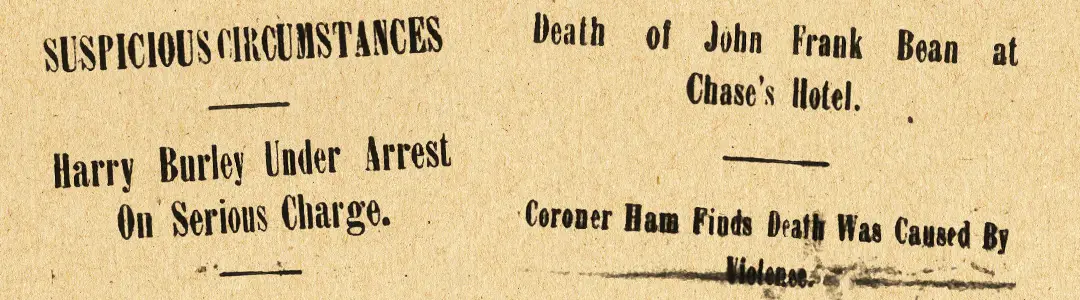
It was approximately 8 p.m., Saturday, April 23, 1899. John Frank Bean, lately a resident of Ossipee, arrived at Newhall’s saloon on Locust Street with his nephew, George Lewis. Bean, then 60 years of age, whose occupation was “shoe maker”, had recently moved to Dover, rented a room on Saint Thomas Street, and taken a job with D.L. Furber. His sister, George’s mother, lived on Littleworth Road. He and George stayed until close to 10 o’clock, having five drinks apiece, and chatting up various other clientele. This included one Harry Burley, who was there with several friends, Harry T. and John F. Kelley. At some point, Bean and Burley had a conversation about admiring each other’s hats, and a deal was struck whereby they would swap hats. However, there was some question later whether Bean might have agreed to pay Burley an additional $1.50 at some point.
In any event, come 10 o’clock, Bean and Lewis left, and Bean said he wanted to meet up with someone on the Upper Square. Burley and the Kelleys left at about the same time and followed the others, all ending up at Chase’s Hotel on Chapel Street. Bean and Lewis went into the office area, followed shortly by the others, where they were advised by a hotel employee that they could not enter the bar and were asked to leave. What happened next is not quite clear. Some words were exchanged between Burley and Bean. One of the Kelleys claimed that he thought Bean had taken a swipe at Burley, but all agreed that Burley headbutted Bean in the stomach area, causing him to fall to the floor. He followed up with a kick to the abdomen before the others stepped in and prevented any further contact. Bean got up and headed out of the building in the direction of the stables, but stopped short, complaining of severe pain. He advised Melvin Brewer, one of the hotel proprietors, that he had suffered a previous rupture, and asked if he could come back inside and rest. Burley and the Kelleys were no longer present.
It was clear that Bean was in some distress. A call was made to J.H. Mudgett, a local physician, who responded to the hotel, and after an examination, suggested that Bean be given a bed where he “pushed the rupture back in place.” He and Lewis stayed for several hours, at which point Bean appeared to be resting comfortably. Mudgett conducted a follow-up visit the next morning and contacted Dr. M.C. Lathrop, whose residence was nearby, to join him for a further examination. Bean continued to be in great pain. His condition worsened during the day, and he died that evening, Sunday, around 10 p.m.
The police were notified. Marshall Fogarty and Deputy Marshall Wilkinson responded, and it would appear that the reporter from Foster’s was present for some or all of the personal interviews. Dr. Mudgett gave them a fairly lengthy statement. He described his initial contact with Bean, his attempts to treat his condition, the extent of the pain, and his conclusion that Bean died, not from the rupture, but because of unrelated internal injuries. Based on this information, Wilkinson sent word to Dr. Ham, the local coroner. In the meantime, a representative of a funeral home had arrived at the hotel and had begun preparations for the burial. Dr. Ham called a halt and scheduled an autopsy for Monday morning. At some point, a man named Theodore Y. Young came forward with some additional information. Earlier that day, he had been contacted by George Lewis, who asked if he would check in on his uncle’s condition, describing what had occurred on the previous evening involving the assault by Burley. Dr. Lathrop reported that when he saw Bean, he found little to no pulse. He could not form any opinion as to the nature and extent of any internal injuries, but doubted that the pre-existing rupture could have been the cause of death.
The reporter then took himself to George Lewis’ home, actually woke him up, and was the first person to advise him of his uncle’s death. Lewis then gave him a full story of their time at Newhall’s saloon, the interaction with Burley, and what followed, all as described above. Having gathered all of this information, around 1 a.m. on Monday, Fogarty, Wilkinson, and an Officer Brownell, went to the home of George Nelson on Bellamy Road where Burley was staying, and placed him under arrest. He was brought to the station and retained until the morning. He admitted having been at Chase’s, but didn’t recall having had any difficulties with Bean.
Monday morning, Dr. Ham completed the autopsy, apparently still in the room at the hotel where Bean had died. His conclusion was that the death had been the result of a violent attack, but refused to offer any further information pending a hearing. The charge against Burley would be manslaughter.
A preliminary hearing was scheduled for Wednesday, April 26. The usual overflow crowd was in attendance in the courtroom and the outside corridor. Burley entered a plea of not guilty. He was represented by Dover attorney Frank F. Fernald, who requested a continued hearing on May 18, citing a full schedule prior to that time; Solicitor Scott had no objection. Burley was held without bail, returned to the County jail. Any potential witness was ordered to execute a personal bond for his appearance on the 18th.
The first witness called that day was Dr. Ham. Attorney Fernald objected to any testimony regarding the autopsy until a proper foundation had been laid tying his client to conduct that could possibly relate to the death. Dr. Ham stepped down, and George Lewis took the stand. He testified about the time at Newhall’s, the arrival of Burley, who came in with George Nelson and the Kelleys. There was some conversation about the swapping of hats, but he didn’t recall any quarrels, no apparent disagreements. They left, came into contact with Burley and the Kelleys on the way to Chase’s, normal conversation. Inside the hotel office, Bean and Burley “squared off” and Burley headbutted Bean in the stomach. They were told to leave. The others did but Bean was in great pain and Dr. Mudgett was called.
He returned he following morning. Attorney Fernald objected to the testimony of any conversations when his client was not present. Solicitor Scott argued the law regarding dying declarations. Lewis remembered him saying only that “unless he got relief, he would die” and asked to see his sister. Under cross-examination, he said he did not know the reason “for the striking of the blows. There were no words between Burley and Bean before the blows were struck.”
Dr. Mudgett was next. He received a call about 11 p.m. on the 22nd. He found Bean to be suffering from a hernia; reduced it; he complained of pain in his bowels. Stayed 2-3 hours. The following day, he seemed to be improving, but began vomiting in the evening, and he called Dr. Lathrop to offer an opinion. Dr. Ham then testified that he had been practicing medicine for 35 years, served as a surgeon in the Civil War, had appeared in previous cases as an expert witness, and had been requested to do so by the attorneys Kivel and Nason when they served as county prosecutors, acted as coroners investigating all sudden deaths, most recently for Solicitor Scott. He was called to Chase’s to view the body Sunday at 11, but no autopsy was performed until Monday morning. He found great inflammation of the abdominal lining, about a pint of straw-colored liquid matter, and determined the nature of the death to be rupture of the bowels and inflammation, shock to the nervous system brought about by violence, without a doubt caused by a blow. On cross-examination, he reaffirmed that death was not the result of natural causes. The Court recessed for the morning.
Harry T. Kelley was called. He related he events at Newhall’s, the walk from there to Chase’s where, once inside, there was no loud talk between Bean and Burley, but a bit of “squabbling”. He saw Burley strike Bean with his fist, and Bean retaliated with a punch to the face. Burley followed with two hits to Bean’s stomach. He heard Bean say, “I am hit,” and began to leave the office toward the outside stable area. An employee of the hotel then told them to leave. John F. Kelley’s testimony closely followed his brother’s version, but he deflected some of the set-to to Bean, who he said seemed to be walking normally as they left the building. The State then rested.
Attorney Fernald moved to dismiss the charge, arguing that there had been insufficient evidence to show that any blow administered by Burley was the proximate cause of death. Solicitor Scott responded with a brief review of the evidence and asked that Burley be held responsible. The judge agreed and found reasonable cause to hold Burley for trial, without bail, for the September term.
There is a brief mention in the press on Sept. 18 that certain criminal cases are to be brought before the grand jury, with one “important” matter being that of Harry Burley. (It is also noted that Judge Young, whom we have encountered in several of our past stories, is more than aptly named, being at the time the “youngest judge on the bench”….). (The “most important” case, in the opinion of the reporter, is that of Harry Hough, which we have covered previously, and was also on tap for review by the grand jury for the September term.)
The grand jury did meet, and they did issue an indictment, alleging that on April 22, 1899, Harry Burley “…did give to him the said, John F. Bean, a mortal wound of which mortal wound the said John F. Bean… languish and languishing did live… and feloniously did kill and slay…” and continuing for many detailed paragraphs. One copy of the indictment is handwritten and lengthy, using the flowery and repetitive legal language of the time; a second copy is typewritten, all the same language, but a noticeable paper-saving improvement and step forward toward the new century.
And so it was that on Oct. 2, Harry Burley appeared before the court. He retracted his earlier plea of not guilty, and Attorney Fernald, on behalf of his client, entered a plea of guilty to the charge, followed by a sentence from Judge Young of two years at hard labor in the New Hampshire State Prison in Concord. The newspaper report of the result is at the very end of a lengthy report of a substantial number of criminal cases disposed of that day, one small paragraph, hardly the coverage you might expect for an “important” case, and in sharp contrast to the extensive coverage of the event itself and the earlier hearing. The very narrow court file ends with a mittimus, showing Burley’s delivery to the prison two days later.
(to be continued)
Visit the Crimes Along the Cochecho for all stories released so far.
Anthony McManus is a Dover, New Hampshire historian whose column “Crimes Along the Cochecho” explores the darker chapters of local history. A Dover native and Boston College Law School graduate, McManus served as City Attorney for Dover (1967-1973) and held various public offices before practicing law until 2001. His extensive historical work includes the “Historically Speaking” column in Foster’s Daily Democrat and his 2023 book “Dover: Stories of Our Past,” released for the city’s 400th anniversary. Through research, writing, and public presentations, McManus continues to illuminate both significant events and lesser-known stories that enrich understanding of Dover’s colorful past.