
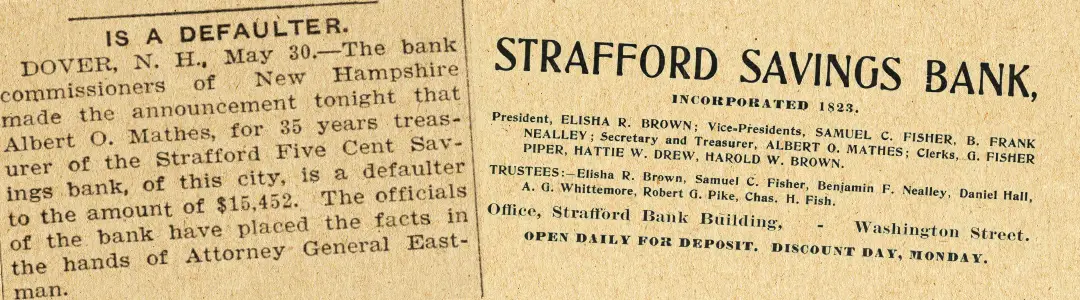
We now come to the tale of embezzler number three, one Albert O. Mathes. He is not a Dover boy, born and bred, but a native of Milton, New Hampshire. As a young man, he moved to Dover to obtain employment. In 1876, he is listed as a clerk at Strafford Savings, boarding at the American House on the Upper Square. A brother, Dana Mathes, also boarded there, and his occupation is listed as “hatter” in a store located across the Square in the Morrill Block. Sometime later, Dana moved permanently to California, and Albert Mathes spent several years with him before returning to resume a position at the Bank, working his way up in time to the position of Treasurer. By the time of his run-in with the law, he was married (his wife previously had worked at the bank as a “stenographer”), with a daughter, and living with his family at 56 Silver Street.
As with the earlier cases of bank theft, the matter came to a head following a visit by examiners from the New Hampshire Banking Commission, although the issue had come to light several weeks prior, following complaints from several individual depositors. This would have occurred in late April 1903, and Mathes was contacted by Elisha Brown, the President of the bank, to explain discrepancies between the amounts shown in the bank books and the actual cash in the accounts. I say “contacted” because at the time Mathes was to be found at his mother’s home in Milton, recovering from a recent incident in which he had received a serious injury that had occurred on April 29. (And here I must interrupt to make a confession: A brief telling of the Mathes story appears in one of my Historically Speaking articles in Foster’s, reprinted on page 203 of “Stories of the Past,” published at the time of Dover’s 400th celebration. I refer there to the injury having occurred on the day following the Bank Commissioner’s discovery of the loss, with a suggestion that it had been a convenient “accident” which later produced a $7,500 insurance settlement that Mathes then used to repay a portion of the missing funds. Later research, however, confirmed that the injury was indeed legitimate, having occurred six weeks or more prior to the formal confirmation of the theft. It had been reported that, for a time prior, Mathes had been experiencing fainting spells, and one apparently occurred at the train station in Milton when, on a visit to his family there, he somehow fell in the path of a moving train and received a serious wound to one leg, resulting shortly thereafter in an amputation. It does appear, however, that there was a subsequent insurance settlement, and the money, or perhaps a portion thereof, was used to square things with the bank. We return to our story… )
Following receipt of the depositor complaints, there was a notice published in Foster’s asking all other depositors to check their accounts. Elisha Brown traveled to Milton to discuss the matter with Mathes, who immediately made full disclosure and agreed to cooperate with the investigation. His story was this: sometime in 1890, he and a friend, now deceased, had made some investments that turned out to be bad investments, and he “borrowed” from one or more accounts in the bank to cover the loss, fully intending to repay the money. One bad deal had led to another, however, and over the years the amount had grown. He would take money from one account to cover a shortfall in another, probably involving no more than 10 accounts in total, and no “new” money had been taken for the past several years. All of this appeared to be confirmed by the Commissioner’s exam. With the audit complete, and Mathes’ admission in hand, the matter was referred to the Attorney General’s office for review.
The headlines were front page: “COMMUNITY SHOCKED. Trusted Citizen Reported as a Bank Defaulter”. Acknowledging that Mathes had been connected to the bank for 35 years, “many were loath to believe” that he had taken the money. It was also reported, with reference to his recent injury, that “Mr. Mathes is said to be a complete physical wreck and his condition is such at this time that his recovery is thought to be doubtful”.
On July 20, being the only case on the docket that day at the Police Court, Mathes was arraigned on a charge of embezzlement, with the usual cast of characters in attendance: Judge Frost, Solicitor Scott for the State, and John Kivel for the defendant. Mathes had come that morning from Milton by train, and prior to his appearance, he met briefly with Scott, Kivel, and Elisha Brown in the prosecutor’s office. Once in court, the reading of the charge was waived, a plea of not guilty was entered, and a formal hearing was also waived. Bail was set for $6,000, and a bond was signed on Mathes’ behalf by Amos M. Roberts of Milton and John T.W. Ham of Dover. He was then released, the Foster’s reporter noting that he was “far from enjoying good health but was able with much difficulty and with the assistance of crutches to go from the carriage to the courtroom and return”. Mathes was also able to take a late morning train back to Milton.
And here I digress for a bit. I was curious to know something about the two people who signed off on the Mathes bail bond, Amos Roberts and John Ham. As noted, the amount in question was $6,000, which in today’s money translates to something close to $215,000 —a substantial amount. Therefore, they must have been people of some standing.
It so happens that Amos Roberts was Albert Mathes’ brother-in-law, having married his sister, Clara. He was a resident of Milton and, for a brief time, lived in Farmington. In 1870, he was employed in a local shoe factory; by 1900, he was listed as a “storekeeper” or “grocer.” (It was also noted that he had “a fine tenor voice”.). In those days, Milton had its own newspaper, and a story in 1897 noted that Amos, Clara, Albert, and his wife had gone for a “two-week’s drive in the White Mountains”. Clearly, Amos had come up in the world from the shoe shop.
John T. W. Ham was the person known locally as “Ham the Hatter”, his store located in mid-town Central Avenue. Back then, a hat was an important item of clothing, and Ham had a successful business, creating original models of all types. (One of his very fancy black top hats is part of the collection at the NH Historical Society in Concord.) There may have been an early connection with the Mathes family here; recall that Albert Mathes’ brother’s early employment in town was as a “hatter”.
And while we’re at it, I took a look at Albert’s father, who was Robert Mathes. As noted, the family lived in Milton, and Robert was Town Clerk for 10 years starting in 1841. He was chosen to represent the town in the State legislature in 1850 and was a local Justice of the Peace from 1846 to 1866. In 1850, he is listed as a “trader” and is credited with owning some monetarily valuable property. Ten years later, he has become a “carpenter” (Albert is then 17 years of age). In 1870, the label is that of a “farm laborer”, but from 1875 to the time of his death, he served as the clerk of the Milton Congregational Church. So, it appears that the Mathes family, friends, and acquaintances are people of some standing in that community and in Dover, that is, until the Bank Commissioners completed their work in 1903.
(More to follow….)
Visit the Crimes Along the Cochecho for all stories released so far.
Anthony McManus is a Dover, New Hampshire historian whose column “Crimes Along the Cochecho” explores the darker chapters of local history. A Dover native and Boston College Law School graduate, McManus served as City Attorney for Dover (1967-1973) and held various public offices before practicing law until 2001. His extensive historical work includes the “Historically Speaking” column in Foster’s Daily Democrat and his 2023 book “Dover: Stories of Our Past,” released for the city’s 400th anniversary. Through research, writing, and public presentations, McManus continues to illuminate both significant events and lesser-known stories that enrich understanding of Dover’s colorful past.