
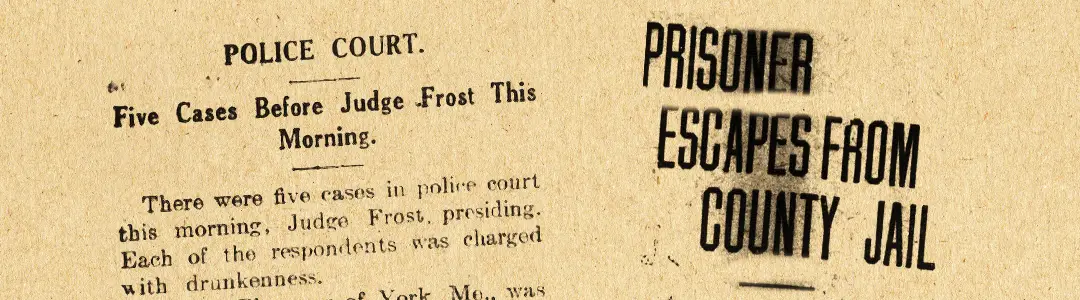
Scroll through old editions of Foster’s. Pick a day at random. Let’s say June 12, 1911. It’s a Monday. District Court is in session, Judge Frost presiding. There are five defendants before the court, all charged with “drunkeness”; it’s after the weekend, don’t you know.
The first is from York, Maine, arrested on Central Avenue. He said he made a mistake, it being his first offense. The second from Rochester, also claiming to be a first offender, found in an intoxicated condition at the B&M Depot. Number three from Haverhill, Massachusetts, another from Gonic, both taken into custody on Central Avenue. And finally, a local man, drunk on Payne Street, who begged the court “for a chance.”
All pleaded guilty. All found guilty. Each and every case “continued for sentence” and everyone released. Judge Frost was obviously in a forgiving mood.
No one sent to the county jail. But a man named Walter Libby had decided to voluntarily leave that facility and “took leg bail yesterday afternoon at about 4:30.” He had been assisting Turnkey Sanders “in the barn work … and he could not have disappeared more quickly had the ground opened up and swallowed him.” Local area police departments were notified. Dover police made a search of the freight yards to make sure he had not made it to that point and jumped a train. Libby was described as being 18 years of age, 5 feet 10 inches and “rather slim.” A resident of Farmington, he had been held at the County Farm since the latter part of April on a charge of breaking and entering, pending grand jury review during the September term.
But things evened up because about 10 a.m. on Monday, Dover Officers Young and Cornell came across William Cowan, an earlier escapee from the Farm. He had run off from an outside work crew several days previous. The reporter noted gratuitously that Cowan was not drunk when apprehended, and advised further that “Cowan will be given a special course at Willand’s agricultural college as a requisite to receiving a certificate of graduation some time next fall.” (You gotta love some of the reporter’s extra comments thrown in from time to time.) (Mr. Willand was the then superintendent of the County Farm.)
Then there is a report from the previous day that illustrates the variety of law enforcement experience back in these times. A tip was received that “a cocking main was going to be pulled off during the day at Back River but the time and place was not given.” (I looked it up: “cocking main” refers to a series of organized cockfights, some of which may last for a day or more.) In response, Assistant Marshal Wilkinson and four officers were detailed to investigate. Following a report of a sizable gathering of young men, the police traveled along Back River Road for approximately 3 miles, but “lost trace of them.” Stopping at the residence of Frank Meserve they found “a dozen or fifteen young men, but no evidence of any cock fights.” As soon as he learned the purpose of the police presence he gave permission to search the property, “as no-one had brought birds to his place …” “The officers gave up the search and returned home.”
Finally, there is an article reprinting what appears to be a notice from the Police Department dated May 5, 1911: “Automobilist Attention.” This is a warning of a law recently passed by the New Hampshire Legislature requiring all motor vehicles to be equipped with adequate brakes, a muffler, “a suitable and adequate bell, horn, or other device for signaling,” two lights on the front and one on the rear, with specified levels of illumination. Violation of the law would subject the owner to a fine of not less than $25 or more than $100. (Consider that to be a huge sum in today’s money: $850 to well over $3,000! The latter amount well beyond the purchase price of most cars at the time.) (And contrast that to the recent decision of the current New Hampshire Legislature to do away with any and all car inspections … just sayin’ …)
Oh, and then there was Walter Libby. On June 14, there is a short piece: “No Trace Of Libby,” with some indication he had left the area. Nothing further appears regarding his apprehension, but on Oct. 3 Libby appears before the Superior Court and enters a plea of guilty to the original charge of breaking and entering. He is represented by Attorney Galloway of Dover who tells the court that the defendant had been confined in the county jail for the past five months (apparently no mention of his being AWOL) and “he desired me to inform the court that he does not want to go back to jail again.” Unfortunately for Libby, the sentence was not less than three nor more than three years and six months in the New Hampshire State Prison.
Visit the Crimes Along the Cochecho for all stories released so far.
Anthony McManus is a Dover, New Hampshire historian whose column “Crimes Along the Cochecho” explores the darker chapters of local history. A Dover native and Boston College Law School graduate, McManus served as City Attorney for Dover (1967-1973) and held various public offices before practicing law until 2001. His extensive historical work includes the “Historically Speaking” column in Foster’s Daily Democrat and his 2023 book “Dover: Stories of Our Past,” released for the city’s 400th anniversary. Through research, writing, and public presentations, McManus continues to illuminate both significant events and lesser-known stories that enrich understanding of Dover’s colorful past.