
Haven’t read Parts 1 and 2? Start here first.
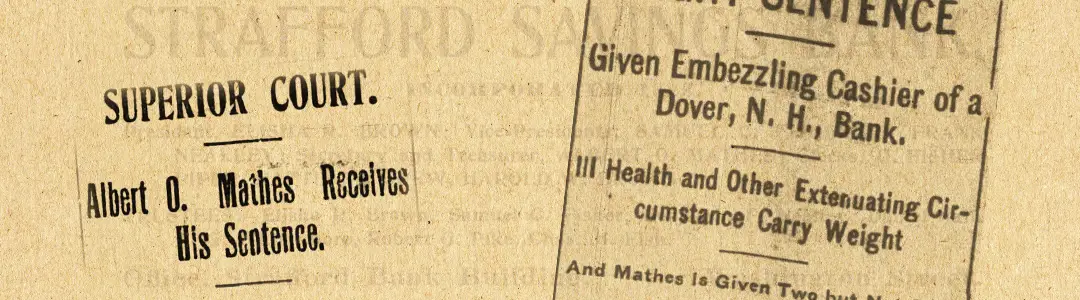
It is now Oct. 22, 1903. Justice moved quickly in those days — the first case of the morning in Superior Court involved two indictments against Albert O. Mathes, one involving the misappropriation of $10,000, the other of $ 1,600. It was Edwin Eastman of the Attorney General’s office and Solicitor Scott for the State, with John Kivel and “the Honorable J.S.H. Frink of Portsmouth” for the Defendant. Frink waived the reading of the first indictment, and Mathes entered a plea of guilty “in a clear tone of voice which could be distinctly heard in all sections of the room”. Attorney Frink then made an extended plea, stating that “the officers of the bank have no ill feelings against the respondent. There is no one in this community that wishes him to receive extreme punishment”. He speaks of Mathes’ loss of a limb and his poor health. According to Frink, Mathes has yet to advise his 86-year-old mother of his legal difficulties, hoping to spare her the shock of his impending conviction and sentencing. To this point, he has told her only that any upcoming absence from the family would be related to medical treatment and recovery from his earlier accident. Frink asks for the lightest possible sentence.
Attorney Kivel makes a brief statement, saying that he has known Mathes for many years, and no one was “of better character or was more respected”. Eastman, for the prosecution, said that it was not the desire of the State “to have extreme punishment administered”, but pointed out that Mathes had violated his position at the bank where “he had funds of widows, orphans, and wage earners in his custody”.
Judge Stone noted that this was “an unusually sad case” and passing sentence was “a painful duty.” He then ordered Mathes to serve a term of two to three years in the New Hampshire State Prison. (Any sentence at that time also included the words “at hard labor”.) By agreement of all parties, the second indictment was dismissed. Mathes was then taken into the custody of the sheriff, and they were able to depart the city on the 10:40 train to Concord.
Mathes did his time, although it must have been a difficult situation for him and the prison staff, given the extent of the nature of his injuries, at least initially. Upon completing the sentence, he returned to Dover; his mother still lived in Milton. His father, Robert Mathes, had passed away on July 31, 1894, long before any of the problems at the bank had surfaced.
On July 20, 1907, Foster’s carried a news item that “Albert Orlando Mathes, one of Dover’s best-known citizens, passed away at his residence, 6 Cushing St., about 7 o’clock this morning, after a brief illness, age 64 years, 11 months, and 20 days. Mr. Mathes was about town yesterday and last evening retired in his usual health.” The article then relates his birth in Milton, family background, early employment in Dover, “several years in California, then a clerkship at the bank, where he showed a marked ability and was steadily advanced to the office of Treasurer. He was connected with that institution for thirty-five years.” He was a member of one of the local Masonic Lodges, a Knight Templar. The article notes that he left a widow, a daughter, Miss Lura Mathes, an aged mother in Milton, and a brother in California. As was the custom in those days, the funeral service was scheduled to take place at his home, with burial in Milton. “Friends are requested not to send flowers.” There is no mention of any kind of legal difficulties.
Several interesting follow-up items: Mathes’ mother died less than a month later, on Sept. 8, at 90 years of age, from what was reported as “acute indigestion”. And by coincidence, Albert’s residence at the time of his death, at 6 Cushing St., was directly across the street from property later purchased by Valentine Mathes, another well-known and respected Dover resident, but a descendant of a Durham Mathes family, with no apparent connection to Albert and the folks in Milton.
Unlike the two previous bank embezzlement cases involving the Dover National and Cocheco banks, where the loss of funds led to the demise of the banks, the Strafford Bank continued to remain open for business and survived under that name well into the latter part of the last century. All of the depositors in this case were made whole, whether from Albert Mathes’ insurance settlement or other sources.
Visit the Crimes Along the Cochecho for all stories released so far.
Anthony McManus is a Dover, New Hampshire historian whose column “Crimes Along the Cochecho” explores the darker chapters of local history. A Dover native and Boston College Law School graduate, McManus served as City Attorney for Dover (1967-1973) and held various public offices before practicing law until 2001. His extensive historical work includes the “Historically Speaking” column in Foster’s Daily Democrat and his 2023 book “Dover: Stories of Our Past,” released for the city’s 400th anniversary. Through research, writing, and public presentations, McManus continues to illuminate both significant events and lesser-known stories that enrich understanding of Dover’s colorful past.