
Missed the introduction? Start here.
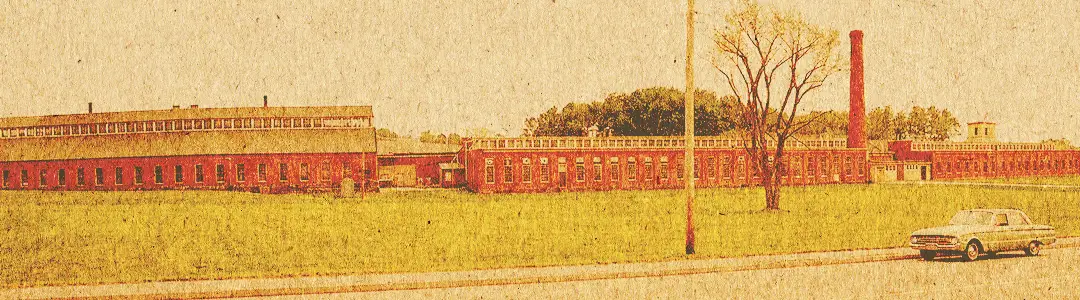
It was Saturday, Jan. 2, 1971. The morning after the holiday. Larry Elwell arrived at Kidder Press on Broadway around 6:30 to get an early start on his job. He approached one of the employee entrances and found it locked. He rang the bell. No one responded. Thinking that the regular night watchman was in a different part of the building, he returned to his car and turned on the heat while he waited, the outside temperature being quite low. At some point he was joined by another employee, John Smart, and they tried the door a second time, still locked and still no one responded to the bell.
Elwell began a circuit of the building, trying several other doors, all locked, and looking for a window that might be unlocked. He finally found one where he could gain entrance and headed for the door to admit Smart and other workers who had begun to arrive. It was then that Elwell and Smart found the body of the watchman, Robert Dodge, lying on his back, covered by a dark blue blanket, in a hallway leading to that outside door. Without disturbing the body — according to Smart, “We didn’t know what was wrong with him” — a call was made to the Dover PD.
Several officers were on outside duty that morning. Both received a call from the station to respond. One, Fred Gilpatrick, first came to the station to get the department ambulance. The other, Norm Gagnon, who was in the area of Sixth and Whittier streets, drove directly to the Broadway location. Gilpatrick arrived first; Gagnon was slowed because of the poor driving conditions that morning. Employees waiting at the entrance directed Gilpatrick to the body. He pulled the blanket back from the face area, checked one arm for a pulse, then asked if there was a phone nearby. Gagnon arrived, and the two officers wheeled a stretcher in from the ambulance parked outside the door.
Since there was no obvious sign of a wound, no obvious blood, several employees suggested that Dodge had been electrocuted, so the first thought was to get him to the hospital as soon as possible. Dodge was a good-sized person, and the officers asked for assistance in getting him moved. Several of the employees helped, and the stretcher was moved from the building to the waiting vehicle. Several things then happened in rapid succession. One of the men who helped move the body noticed he had blood on one hand. As Gilpatrick was moving the stretcher into the rear of the ambulance, he noticed a small amount of blood in the neck area, and opening the top of Dodge’s shirt, he observed a quantity of blood in the area of his chest. At about the same time, John Smart called the officers’ attention to an area within the building where Jack Kenney, a Kidder supervisor, had discovered a damaged cash machine, debris and some tools on the floor. Another employee noticed that there was a wallet or purse on the floor at a spot that would have been underneath the body, and that was turned over to one of the officers. At that point Gilpatrick made a second call to the station, asking that the department detectives and the medical examiner be notified.
James Rowe, one of the inspectors of the Dover PD, received a call at home, directed that the areas surrounding the evidence be roped off, and arrived at Kidder shortly afterward, approximately 7:50. Inspector Frank Redden arrived close to the same time. The location of the damaged cash machine, in what was an employee snack area, had been secured. Officer Gagnon showed Rowe where the body had been found, and that area was also closed off. Rowe noted “small quantities of a red substance” on the floor that appeared to be blood. Dodge’s flashlight, which had been found on top of one of the nearby machines, was secured. Patrolman John McKinnon came from the PD with additional equipment to process the scene, including a camera, and began taking photos of the two locations, the hallway where the body was found and the room where the cash machine had been dismantled.
Strafford County Sheriff Harold Knight arrived shortly after 8 a.m., then Deputy Sheriff Albert England, and within minutes Dr. Paul Young, a local pathologist and designated medical examiner, whose home was in Durham. He spoke with Larry Elwell, who described his efforts in gaining access to the building and finding the body, then went to the ambulance. It was “evident at this time that rigor mortis had set in”; some blood was observed on both hands, with considerable bloodstains on Dodge’s shirt. Photos were taken of the body while still in the ambulance. By this time, it had been determined that Dodge’s car was not in the Kidder parking lot. A brief examination was made for keys, both for the vehicle and for areas within the building, based on information that Dodge usually carried these in a leather pouch while on duty. Young found that the strap that held that pouch had been cut by some type of sharp instrument.
An APB was sent to other police agencies describing the Dodge vehicle, a 1965 Pontiac Catalina, four-door, light green, “believed stolen by a subject who murdered a Dover man last evening…operator may be armed.”
(to be continued)
Read Part 2 here.
Want to know when the next article is published? Sign up here to be notified.
Visit the Crimes Along the Cochecho for all stories released so far.
Anthony McManus is a Dover, New Hampshire historian whose column “Crimes Along the Cochecho” explores the darker chapters of local history. A Dover native and Boston College Law School graduate, McManus served as City Attorney for Dover (1967-1973) and held various public offices before practicing law until 2001. His extensive historical work includes the “Historically Speaking” column in Foster’s Daily Democrat and his 2023 book “Dover: Stories of Our Past,” released for the city’s 400th anniversary. Through research, writing, and public presentations, McManus continues to illuminate both significant events and lesser-known stories that enrich understanding of Dover’s colorful past.