
Missed the previous installments? Start here.
The investigation continued. On the 13th, as the result of an anonymous tip, officers approached a male resident of Farmington and asked him to take a lie detector test. He agreed. The test was administered by State Trooper Desjardins at the Dover PD. The person also owned a gun, which he voluntarily offered to turn over for testing. He and the gun both passed.
On Jan. 14, Dover Inspector Frank Redden and Chief Eastman from Rollinsford began a house-to-house survey in the area of the parking garage in Portsmouth, on Hanover, High and Market streets. Had anyone seen or heard anything that might be relevant in the early morning hours of Jan. 2? They came up with no information, but within a day or so Officers Cavanaugh and Emidy of the New Hampshire State Police made a second round of inquiries in the neighborhood. No one claimed to have knowledge of the vehicle or its occupant(s), but in one apartment, they came across a visitor, one Andrew Arthur, whom they described as “a suspect in the homicide works at Kidder Press,” without any further reference. Arthur “denied knowing anything of this incident.”
State Troopers Worthy and Wiggin interviewed the individuals who were working as drivers for Val’s Taxi and City Taxi in Portsmouth, on the chance that someone would have sought out alternate transportation after abandoning Dodge’s vehicle. Nothing was found to indicate a connection, but later, Troopers Hester and Sullivan obtained the actual passenger lists — names, times, pickup and delivery locations — and this information was checked against state prior-arrest records. On the 15th, several troopers visited the Kearsarge and Rockingham hotels and obtained resident records for the days just before and just after the vehicle was left. After reviewing this information and interviewing the hotel managers and staff, it appeared unlikely that anyone staying there was connected to the vehicle. (One interesting item: the number of elderly full-time residents listed in both locations.) On the 16th, a fellow employee at Kidder (and also a member of Dodge’s Class of ’56 at DHS), Ted Grondin, was interviewed by Dover officers. He confirmed that everyone at Kidder Press thought well of Dodge, and during the conversation, he made a comment that anyone who worked there would “know to some degree” of Bob’s duties within the building. (Maybe just a mention in passing, but in hindsight it had some significance.)
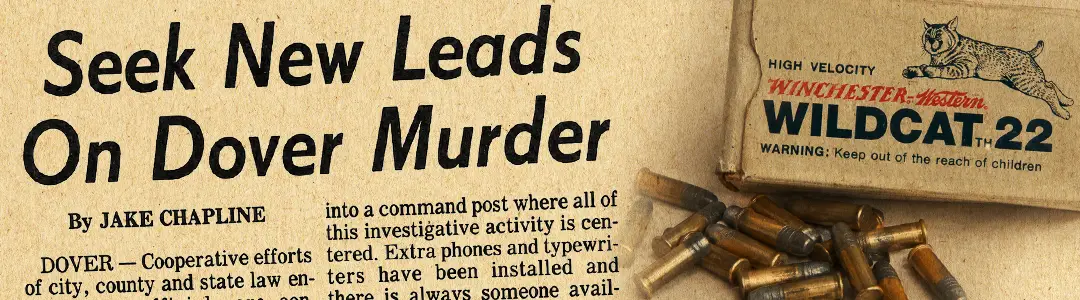
Businesses in Dover where guns or ammunition were sold (Seavey’s, Siegel’s, Western Auto and others) were contacted and a list created of buyers of .22-caliber ammunition within the prior year. Troopers Wiggin and Worthen followed up with interviews, producing some unexpected results. Their first contact acknowledged the purchase of a firearm but claimed it had been lost during a fishing trip to Maine. Upon further questioning, however, he admitted having sold the weapon to a person he had met at a pizza shop in Portsmouth, and then acknowledged that in making the initial buy, he had used a falsified military identification card. (Similar lists of sales and customers’ names were obtained from weapons and ammunition retailers in Portsmouth, Kittery, York and throughout the seacoast area.)
The sale of a second weapon sold locally was eventually traced to Malden, Massachusetts, where it had been purchased by the police department there during the course of an undercover operation. This led to a series of interviews by Dover police, one with a former Dover resident and convicted felon now living in Massachusetts, people he had visited here during several return trips to the area, and an acknowledgment that, although there was no connection to the Dodge murder, there had been involvement in a Rochester burglary; charges were filed and the individual arrested.
(to be continued)
Read Part 6 here.
Want to know when the next article is published? Sign up here to be notified.
Visit the Crimes Along the Cochecho for all stories released so far.
Anthony McManus is a Dover, New Hampshire historian whose column “Crimes Along the Cochecho” explores the darker chapters of local history. A Dover native and Boston College Law School graduate, McManus served as City Attorney for Dover (1967-1973) and held various public offices before practicing law until 2001. His extensive historical work includes the “Historically Speaking” column in Foster’s Daily Democrat and his 2023 book “Dover: Stories of Our Past,” released for the city’s 400th anniversary. Through research, writing, and public presentations, McManus continues to illuminate both significant events and lesser-known stories that enrich understanding of Dover’s colorful past.