
Missed the previous installments? Start here.
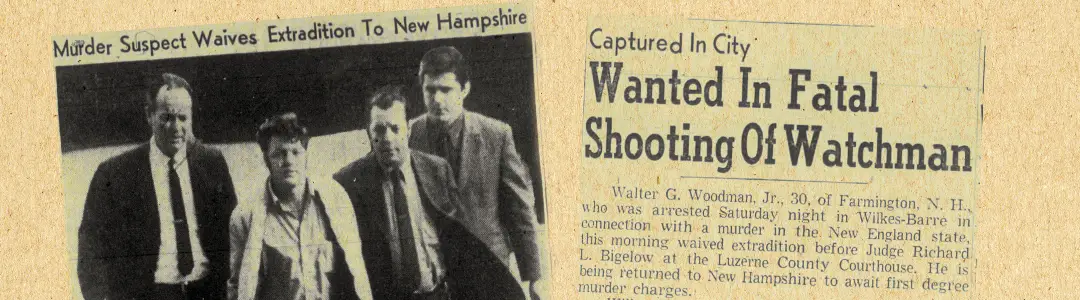
There is a cover letter, dated May 1, from Inspector Rowe to John W. Ruddick, chief of police in Wilkes-Barre, that included a certified copy of the arrest warrant issued by the Dover court. This included a warning that Walter might be armed. The following day, Rowe, Worster and Sheriff’s Deputy Robert Keniston set out for Pennsylvania. Prior to their arrival, authorities there had located and arrested Walter Woodman, advising him of his rights on two separate occasions, and placing him in custody at the Luzerne County Prison. The story merited coverage in the local Wilkes-Barre press, noting a previous arrest for Woodman when he was caught burglarizing a local confectionery store. According to this report, Woodman attempted to flee the Levelle residence when the officers arrived and was arrested at gunpoint. Still on probation from the previous arrest, he is identified as working as a groom at nearby Pocono Downs.
Rowe and Worster questioned him at the county facility, and following Miranda warning number three, Woodman agreed to talk and signed a waiver. He told them he had previously read the warrant from New Hampshire and was aware of the charge. He then volunteered that he was also wanted by the Salem, New Hampshire, police on an outstanding charge involving a rape in that community. Neither Rowe nor Worster had any knowledge of this, but Woodman had a newspaper article in his possession that referred to the alleged offense.
The first questions posed to him, however, related to the burglary at the Ajax Garage. Walter admitted that he, along with David, who had said he needed the money, had stolen the chainsaws, which he had then sold to a friend in Salem, New Hampshire, for $170, with a promise of an additional future payment. He also admitted the theft of a vehicle used to transport the goods, but said that David did not accompany him on the trip to Salem. The next question related to a breaking and entering of the residence of Steven King, but Walter denied any knowledge. When told that police felt they had located the gun taken from the home, “he denied this, but with less firmness.” He went on to claim that at one point David had wanted to rob the owner of a gas station located opposite Kidder Press in Dover, claiming he knew the owner and he always had cash on his person. According to Walter, he declined the suggestion because he was still on probation in Pennsylvania, but “everything we did this winter was David’s idea.” The questions then moved on to the circumstances surrounding the killing of Robert Dodge.
When it came to answering questions about the incident at Kidder Press, Walter Woodman was reluctant to talk without knowing what information had been provided by David. He was interested, perhaps, in making a deal, claiming that “David set Kidder Press up.” Inspector Rowe indicated that David had identified Walter as the shooter. He denied it. “Ask Kathy what David said about shooting Mr. Dodge after they got in bed.” He claimed that at a later date Kathy and David had an argument, and David had admitted again that he had killed Dodge, but then announced he would make no further statements about Kidder Press until he had talked to a lawyer.
He acknowledged his prior arrests: Rochester, Wilkes-Barre, and one in East Boston, involving a charge of assault with intent to rape, for which he had served nine months in the Concord Reformatory. He agreed to take a lie detector test. And then made a statement to the effect that it was David, on his own, who took Dodge’s car from the company parking lot, drove it to Portsmouth, and then hitchhiked back to Farmington. That was the end of any further conversation.
(to be continued)
Read Part 13 here.
Want to know when the next article is published? Sign up here to be notified.
Visit the Crimes Along the Cochecho for all stories released so far.
Anthony McManus is a Dover, New Hampshire historian whose column “Crimes Along the Cochecho” explores the darker chapters of local history. A Dover native and Boston College Law School graduate, McManus served as City Attorney for Dover (1967-1973) and held various public offices before practicing law until 2001. His extensive historical work includes the “Historically Speaking” column in Foster’s Daily Democrat and his 2023 book “Dover: Stories of Our Past,” released for the city’s 400th anniversary. Through research, writing, and public presentations, McManus continues to illuminate both significant events and lesser-known stories that enrich understanding of Dover’s colorful past.