
Missed the previous installments? Start here.
It is now the September term of the Superior Court. Two indictments are brought against each of the Woodmans. One is the charge of murder. A second alleges that on March 28, 1971, they entered the dwelling house of Howard McIntire, in the city of Rochester, and stole personal property, including a portable radio and a TV set. (There does not appear to be any indictment with regard to the alleged burglary of the King home in Farmington, mentioned previously as the source of the gun used in the Dodge murder.) Arraignment takes place on Sept. 24, and pleas of not guilty are entered on all counts. As noted previously, the lawyers for both defendants had asked for mental examinations, and at some point both were transported to the State Hospital in Concord. The report on David confirms his IQ to be 75, but states that he is not impaired to the extent that he would not have understood Miranda warnings prior to any questioning, or that he is incapable of participating in the pending court proceedings. The report, signed by Christos Koutras, acting superintendent of the State Hospital, states that there is no evidence to support a finding of present insanity. It is noted, however, that he “refused to discuss the episode that led to his arrest. Therefore, it is difficult to form an opinion as to his condition at the time of the alleged criminal act…we can speculate that he is very easily led….”
The court file also contains a report regarding Walter from Eli Perry, a local probation officer. Such reports were standard in all major criminal cases. By way of background, he notes that Walter left school at age 15. He married in July 1961, became the father of four children, and was divorced in 1969. He has been employed over the years as a groom at different racetracks, and appears to be a compulsive gambler. He had a juvenile record based on an incident in July 1957 where he stole a pistol from a shop in Milton. Sent to the State Industrial School, at some point making an escape, but located the following day and returned. In October 1959, he was arrested in Revere, Massachusetts, on a charge of assault with intent to commit rape, ending up with a five-year jail term from the Suffolk County Superior Court. He also notes the July 1970 arrest in Wilkes-Barre for burglary. There is some additional information regarding David generated by a psychological exam: his mother died of cancer in 1964, at age 40. His father has had “a long-standing drinking problem,” and “worked spasmodically as a woodsman.” In addition to the seven existing siblings, it is noted that three others died in infancy. One brother has done some time in prison. With regard to David, Perry noted that he had been rejected for military service. His only asset of any value was his residence, but he was behind on the mortgage, and his only steady income was working two days a week for the town. At or about the time of the incidents described in the two indictments, his wife was ill and was facing the possibility of several operations. David was in need of money.
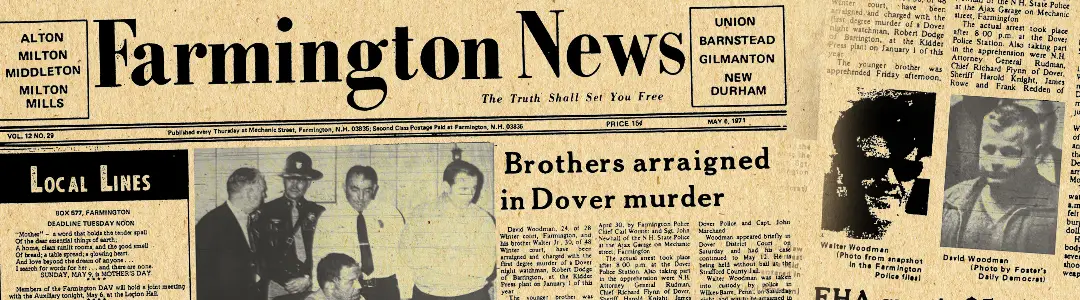
Foster’s is not the only paper with news of the Dodge story. Closer to home, and until the late 1970s, Farmington had its own newspaper, The Farmington News, published every Thursday, with its masthead slogan: “The Truth Shall Set You Free.” It provided articles and advertisements for eight additional communities to the north in both Strafford and Belknap counties.
The front page of the paper on May 6, 1971, had reported on the arrest of both Woodman brothers, with a small photo of Walter “from the Farmington Police Files,” a photo of David, and one other of the top law enforcement officials involved (Rudman, Knight, Worster, Flynn, Newhall), the latter two borrowed from Foster’s. On May 20, there is a report of “a tedious seven-hour court session,” referring to the preliminary hearing held in the Dover District Court (the judge’s name is erroneously spelled as “Nettle”).
From that point on, however, there doesn’t seem to be any further coverage of what anyone would expect to be important local news. No additional background on the Woodmans, Worster, or any of the ongoing investigations. Nothing about the pleas and sentencing. Not a word about Walter’s later difficulties at the State Prison. It is as if the story no longer existed, or perhaps a decision was made, in view of the ongoing coverage in Foster’s and other media, that it should not continue to be a reminder to the family and the community of what had occurred. (In contrast, there is an earlier article in The News, on March 4, 1971, reporting on “a poor turnout” for a recent local Red Cross blood drawing. Listed among the first-time donors are David and Walter Woodman. One of the returnees is identified as Theresa Woodman; that could have been Theresa Buckley, signing in as Walter’s significant other.)
(to be continued)
Read Part 18 here.
Want to know when the next article is published? Sign up here to be notified.
Visit the Crimes Along the Cochecho for all stories released so far.
Anthony McManus is a Dover, New Hampshire historian whose column “Crimes Along the Cochecho” explores the darker chapters of local history. A Dover native and Boston College Law School graduate, McManus served as City Attorney for Dover (1967-1973) and held various public offices before practicing law until 2001. His extensive historical work includes the “Historically Speaking” column in Foster’s Daily Democrat and his 2023 book “Dover: Stories of Our Past,” released for the city’s 400th anniversary. Through research, writing, and public presentations, McManus continues to illuminate both significant events and lesser-known stories that enrich understanding of Dover’s colorful past.