
Missed the previous installments? Start here.
On the evening of the murder, Dover police Officer Wendell Huse had responded to a call in the Dover Point area around 9 p.m., and on his way back into town he had picked up two young men hitchhiking. Huse reported this contact and provided descriptions. One said he was coming from Portsmouth, and they were coming to Dover to visit some friends. Given this information, contact was made with Detective Mortimer at the Portsmouth PD, and he provided photos from Portsmouth High School that were then reviewed by Huse. There was a possible identification, and he was interviewed by Inspector Rowe and Chief Eastman from Rollinsford. The second individual was identified as a student at St. Thomas Aquinas. He was interviewed at his home by State Troopers George Hester and Sheldon Sullivan, followed up by talks with the principal and a teacher at the school. Witnesses were contacted who confirmed the whereabouts of the two following their contact with Huse. (One of the pair was asked to take a lie detector test on a matter totally unrelated to the Dodge case. He agreed and passed the test.)
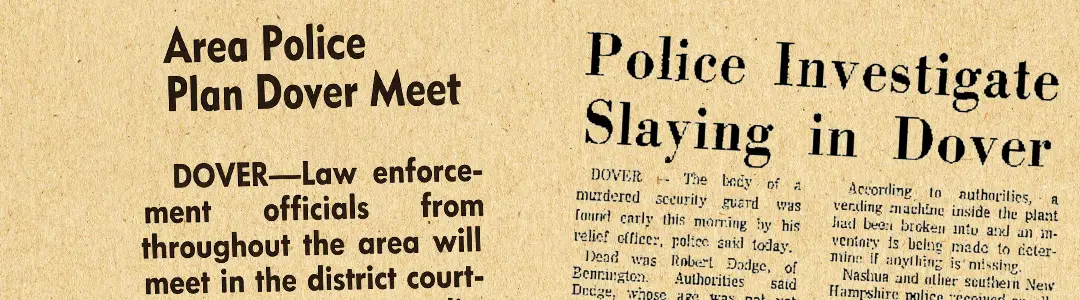
On Jan. 7, there was a meeting of various law enforcement agencies held at the Dover PD, representatives from numerous departments who might be able to assist in pursuing the investigation. Dover Chief Richard Flynn issued a statement suggesting that this incident may be related to other area crimes “because evidence indicates that it was carried out in a cool, professional manner.” Twenty-eight people, including six from the New Hampshire State Police, two from the Maine State Police, two from the Strafford County Sheriff’s Office, one from the Rockingham Sheriff, the Dover city attorney, Strafford County Attorney T. Casey Moher, and chiefs from South Berwick, Somersworth, Rollinsford, Rochester, Farmington and Exeter, Henry Spaloss from the AG’s office, and the medical examiner, Paul Young. All of the evidence to date was reviewed, suggestions made as to the next steps in tracking down the person or persons responsible for Dodge’s death. (There is a front-page photo in Foster’s showing many of the participants of the gathering.)
Flynn said the case “warrants the fullest possible attention and concern of the police.” In that context, within the next few weeks numerous leads were followed. According to Inspector Rowe, “enough information is coming in to keep 12 men working full time, seven days a week, checking clues and investigative reports.” The officers’ lounge at the Dover police station was turned into a command post, and the chief of police in Rollinsford, Robert Eastman, “practically lived in Dover for weeks while working on this case.”
Some examples of leads followed up: New Hampshire State Trooper Arthur Wiggin met with Rochester Police Chief Nelson Goodfield and an individual in custody who had recently purchased a gun, appeared to be intoxicated and despondent, and who had indicated “he would feel no remorse in killing anyone.” The conversation took place after he had sobered up, and he voluntarily turned in the gun. Wiggin also spoke with several people at Exeter Hospital who were being treated for injuries received under suspicious circumstances. Another individual held in the York County jail was interviewed. He was AWOL from military service and had been identified as involved in an incident involving threats and/or weapons. Local police followed up on a tip involving a stolen weapon, contacted the employer of the company involved and located a gun but determined it was legally owned. No story was ignored, no matter how vague: in Dover, one person filed a report that a second person had claimed that a third person was seen in possession of a gun at or about the date of the murder, and all three were contacted, but no credible evidence was found to support the original report. All of the above took considerable time, regular hours and overtime, “working without holidays,” but for the next few months all efforts produced no useful information toward solving the crime.
There was one interesting wrinkle that appears in the police file. Joseph Gingras, an employee at Kidder Press, gave a statement on Jan. 13, where he reported that about two weeks prior to the murder, Dodge had reported to work wearing “a holstered handgun.” “I was friendly with him and we used to talk about hunting and fishing. I approached Bob a few nights after he started carrying the gun and asked him why…” He said, “‘we’re having trouble here, but I can’t tell you about it, but we’re going to get em’… He said it was for his own protection… He was always a very pleasant and a quiet fellow. I never saw him get mad or even horse around.” Someone may have followed up on this, but there is nothing in the file that would explain the reason for Dodge’s concerns. (There is nothing in any of the files or reports of the case to indicate that he was armed or had access to a weapon on the night of his murder.)
One other interesting item: within a week of the murder, there is a headline: “Kidder Employees Start Dodge Fund.” Carol F. Bemis, chair of the committee that was created, stated that the purpose was to raise money to benefit his children, the oldest being but 9 years of age. Dodge’s brother, Frederick, was designated trustee of the funds. In just over a week, the group had collected $3,000 (over $23,000 in today’s money), with additional contributions received in the weeks following.
(to be continued)
Read Part 4 here.
Want to know when the next article is published? Sign up here to be notified.
Visit the Crimes Along the Cochecho for all stories released so far.
Anthony McManus is a Dover, New Hampshire historian whose column “Crimes Along the Cochecho” explores the darker chapters of local history. A Dover native and Boston College Law School graduate, McManus served as City Attorney for Dover (1967-1973) and held various public offices before practicing law until 2001. His extensive historical work includes the “Historically Speaking” column in Foster’s Daily Democrat and his 2023 book “Dover: Stories of Our Past,” released for the city’s 400th anniversary. Through research, writing, and public presentations, McManus continues to illuminate both significant events and lesser-known stories that enrich understanding of Dover’s colorful past.