
Missed the previous installments? Start here.
With all the trial preparation, State Hospital examinations and calendar conflicts with other cases, the charges against the Woodmans do not get scheduled before the end of the year. It is not until early spring that there is any further activity. On March 6, 1972, a motion is filed asking that attorney Richard Leonard from Nashua be appointed to represent Walter Woodman. That is approved by the court, but the record indicates that Koromilas remains as co-counsel. No specific reason is given, but it may be that Leonard has had more experience handling serious criminal matters. {There is an odd mix-up that occurs here. At a later date, Koromilas submitted a request to the court for payment of a bill from a physician who, with the court’s approval, had examined Walter, and a second charge representing Koromilas’ own legal services. The former was approved. The latter was denied, with a notation from the court that there was “no record of you ever having been appointed….” (The record being what it was, it’s more than likely that Koromilas ultimately received a check.)
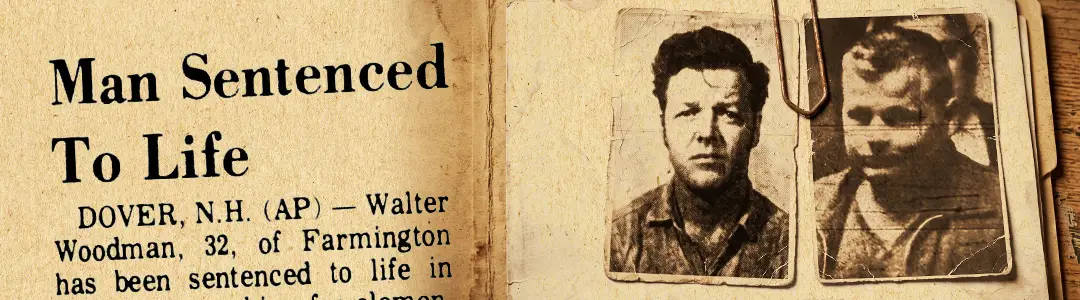
And so it was that on April 10, with a front-page photo and a byline, this time by a Burt Keimach, a report that Walter Woodman had appeared and “astounded the rather sparsely attended proceeding” by changing his plea to guilty to a charge of first-degree murder. The judge that day was John King, previously New Hampshire’s governor, and later chief justice of the New Hampshire Supreme Court. Both Leonard and Koromilas were present, with the former arguing, regarding the issue of premeditation, that Walter had been drinking just prior to the incident at Kidder Press, which may have affected his judgment and the action taken against Dodge. Leonard also made reference to what is known as the “murder-felony” rule, which is often applied in cases in which all those involved are considered to be equally culpable. Although the article doesn’t specifically say this, it’s likely Leonard’s intent was to suggest that, given the facts of this particular case, the rule should not be applied to David.
This seems to be the case because King then asked Walter directly if he had anything to add. “After a brief hesitation,” he admitted that he had committed “a terrible crime,” and asked the court to show mercy to his brother, and not place any extra blame on him because “of my drunken stupidity.” King then issued a sentence: “no more than, nor less than the rest of your natural life.”
David’s case appears on the docket on May 12. King is still presiding. Henry Spaloss, from the AG’s office, represents the state. The Fishers, father and son, Lewis and Robert, appear on David’s behalf. Both sides say they want to offer testimony regarding the sentencing. (King takes an unexplained 45-minute recess, possibly to hold a chambers conference with counsel, though this is not noted.)
The population of Farmington in the early 1970s was approximately 3,500, a community where most residents knew, or knew of, each other, and there were few secrets. It’s interesting, in that context, that despite the seriousness of the offense, there were people willing to come forward and be heard, trying to offer a picture of David and what may have led him to this point.
The first witness on his behalf was Beatrice Parshley, a well-regarded Farmington school teacher, now retired after 30 years of service. She described David’s final day in the eighth grade: he was upset and crying because he was fearful of being asked to read in front of the class. According to Parshley, he was not ready for the eighth grade. “He could not do things others could do…never a discipline problem. Always a follower.” In later years, she would see him frequently. He had jobs sweeping the streets and cleaning in a local restaurant, and he was good at what he did. He played the role of Santa Claus during the Christmas holidays. After his marriage, he came to her and asked her to teach him how to read. She gave him some books and advice to his wife on how to help, but honestly felt that it was probably beyond his ability. Based on all of her contacts with him over the years, she would have said that he was incapable of an act of violence.
Izola Batchelder, a Farmington teacher for 42 years, had David in her fifth-grade class, though she felt he was probably about two grades behind. It was known that the Woodmans’ father was a serious drinker, and she felt that likely had a negative effect on both of the brothers.
The next witness, surprisingly, was Carl Worster, Farmington’s chief of police, who had played such a key role in the criminal investigation. His was a small-town department, and Worster was as much a peace officer and member of the community as the town’s enforcer of the law. His testimony was that he had known David well over the years and had never known him to be in trouble. He worked hard for people — mowing lawns, washing windows, whatever he could get for work. He agreed with the previous witnesses that David was “backwards to a certain extent.” Worster said that at one point he asked David about the murder, and David “broke down,” said he went along with it because he was afraid “his brother might turn on him so he didn’t dare do anything.” He expressed his belief that David would not be a threat to anyone if released.
There was some cross-examination by Spaloss, and Worster acknowledged that it was David, as an employee at Kidder, who had known Dodge and, as a result, had been able to gain access to the building. Further, that although the gun had belonged to Walter, it was found in David’s house after the fact. But, Worster pointed out, it was David who deliberately disabled the weapon because his brother was threatening to use it again, and it was David who ultimately told the authorities where it could be found. Following his testimony, defense counsel submitted a copy of a written report from the New Hampshire State Hospital, and Spaloss offered correspondence received by his office from the hospital relating to David’s examination and review at that facility.
One brief final witness was Joseph Zaroumskis, a 36-year veteran of the Rochester Police Department. He stated that at the request of Lewis Fisher, he had spoken with Walter on an earlier date and had learned of threats he had made to a local business owner, presumably an attempt to point out that Walter had been more of a potential threat than David, should the latter be returned to the community.
Spaloss then offered testimony from Inspector Rowe, who provided a summary of the case: Elwell’s arrival at Kidder Press and his failure to gain access to the building, the initial phone call to Rowe at his home, the arrival at the scene of Officers Gilpatrick and Gagnon, the discovery of the body, then the broken cash machine, at which point Fisher objected, stating that it had little or no relevance “and just bears out the stupidity of this entire occurrence.” King overruled the objection, with the comment, “Then I think it would help in your plea for clemency.”
Rowe described the autopsy at the funeral home and the preliminary findings by Young. The completed autopsy report was then offered into evidence. He described the information from Bruce Roy that led them to seeking out David for questioning, and the threat to do “just like they shot the watchman at Kidder Press.” Under cross-examination by David’s counsel, Rowe agreed that it had been Walter, not David, who made the threat, and agreed also that it had been David who had given them most of the information that led to the final arrests. Rowe acknowledged David’s low level of intelligence, but “It is my opinion he knows right from wrong.”
Spaloss then called upon Theresa Buckley, who was reluctant to provide much support to the state’s case, acknowledging that at some point she and Walter had become formally engaged.
Having completed his presentation, Spaloss made his recommendation as to David’s sentence: life. No matter how limited David’s intelligence, he speculated that both Walter and David must have known before going there that they would have to kill Dodge to avoid any later identification, because it was obvious that David knew Dodge, and Dodge knew David. It was David who had the information about the location of the cash machines, the real reason they were there. Thus, his responsibility was of the highest degree. Fisher’s final comment: Walter “was the hardened criminal and David was the follower.”
King then enters his sentence: six years to life. It could mean a long time in prison, but it also gives David a chance to earn a relatively early release. Acknowledging that this had been a difficult case for everyone, he felt the sentence was fair.
And so, the Woodman brothers are transported to the New Hampshire prison, David with the potential of returning to his family and the community, assuming a period of good behavior over the intended minimum; Walter, on the other hand, facing a long-term residency, quite likely for the balance of his life. Except…Walter doesn’t see it that way, and in the years to come is the subject of a series of headline events, including a nationwide search following a well-planned escape from the Concord facility, several contested internal disciplinary hearings, and two cases before the New Hampshire Supreme Court. All of this will be the subject of a future article.
* * *
The Woodman story doesn’t end with their pleas and sentencing.
David arrived at the New Hampshire State Prison on May 12, 1972. It is noted that, with good time, he could possibly be released as early as Nov. 1, 1975; at the opposite end, should things not go well, is “life.” His age is listed as 27. His height is 5 feet 4 inches; his weight is 223 pounds.
Shortly after his arrival, a decision was made to transfer him to the state prison in Vermont, perhaps to avoid any contact with Walter, although no specific reason is given in the record. There is a letter in the file dated Aug. 8 acknowledging David’s arrival, and $44.62 is transferred to his account. This doesn’t last very long, however. On Sept. 25, there is correspondence from Vermont to Joseph Vitek, now the warden at the New Hampshire State Prison: the folks in Vermont are in the process of rehabilitating the facility there, and there is a need to relocate some of the prisoners. Would New Hampshire be willing to take David back, even on a temporary basis? The letter offers assurance that the request is not the result “of any misbehavior on the part of either man” (there’s a second inmate involved) as both have made good adjustments at that institution, and “their records upon return to your facility should not reflect anything derogatory against them.”
So David is back in New Hampshire, but on Sept. 25, 1974, there is a certificate of transfer to the state of Maine, no reason given. That lasts until June 25, 1975, with a transfer back to New Hampshire, and on July 21, a certificate of parole with specific conditions:
a. I am being paroled to the State of Maine and I am not to enter the State of NH at any time without the written consent of the NH Parole Dept.
b. I will continue individual therapy programs with Dr. David Hasson…or a mental health clinic approved by my parole officer.
c. I shall not remarry without first obtaining permission from my parole officer and seek his advice regarding financial matters. (It would appear from this that there has been a divorce decree subsequent to David’s conviction.)
d. Upon my release from parole, I agree to accept and follow through in the residential program arranged for me…relating to the Goodwill Organization in Portland where I will receive evaluation and training.
It’s not immediately known what takes place with David from this point on. Further investigation might give us some insight, but hopefully he lives a life free of further contacts with the law. The same cannot be said of Walter, however, who did not remain idle while serving his time in the State Prison in Concord. His exploits will be covered in later episodes. Stay tuned.
Want to know when the next article is published? Sign up here to be notified.
Visit the Crimes Along the Cochecho for all stories released so far.
Anthony McManus is a Dover, New Hampshire historian whose column “Crimes Along the Cochecho” explores the darker chapters of local history. A Dover native and Boston College Law School graduate, McManus served as City Attorney for Dover (1967-1973) and held various public offices before practicing law until 2001. His extensive historical work includes the “Historically Speaking” column in Foster’s Daily Democrat and his 2023 book “Dover: Stories of Our Past,” released for the city’s 400th anniversary. Through research, writing, and public presentations, McManus continues to illuminate both significant events and lesser-known stories that enrich understanding of Dover’s colorful past.