
Missed the previous installments? Start here.
Inspector Rowe’s ongoing investigation into Dodge’s background included a meeting with his widow, Enola. She related the history of their meeting, marriage and family activities. She had received a degree in nursing, and for a time had worked at Wentworth-Douglass, but as noted earlier, had an overnight job with the Strafford County Nursing Home at the time of the murder. She and Bob would often call each other early mornings just to check in, but his failure to call on the morning of the 2nd had not given her any specific concern. Rowe also made a point of interviewing the two ministers who participated in Dodge’s funeral ceremony. They both described him as regularly attending church services with his family, a quiet personality.
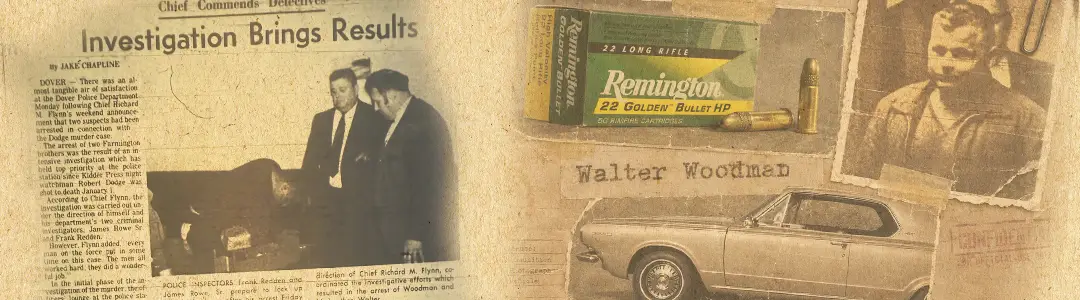
He also conducted some investigation into Walter Woodman’s background. School Department records showed him to be an average student, completing the eighth grade and two years of high school. Over the years, he had been employed at a number of racetracks, short-term stays depending on the racing season: Rockingham Park in Salem, New Hampshire, but also locations in Massachusetts, Pennsylvania, Maryland, Florida and New York. His hobby, as described by Walter himself, was betting on the horses. Being in a position to pick up on some hints or tips, he would often get a fairly large win, at which point he would quit his job “and live off the money for a period of time.”
Rowe was able to confirm Walter’s marriage in 1961; he was 19, and his wife, who was the daughter of an owner of horses that ran at one of the tracks, was 17. They divorced in September 1970, but by then they were the parents of four children. She told Rowe that her last physical contact with Walter had been during Christmas 1969, but there were occasional telephone calls, some letters, two of which had been written subsequent to his arrest and sent from the Strafford County jail. She described what she felt had been a drinking problem, and several occasions when he had been physically abusive of her and the children. But she related further that Walter had been involved in a serious motor vehicle accident in April or May 1964, which resulted in hospitalization and a long recovery. She felt that somehow there had been a personality change following this incident.
He was also able to interview Walter Woodman Sr., who was living at the time with David’s wife, Kathy. Woodman commented that he had been surprised that David had been involved in the Dodge murder, but said that “he had trouble with Walter ever since he was a boy.” He reluctantly agreed that it was David who had been able to obtain access to Kidder Press on the night of the murder, but as to his involvement in other incidents in the Farmington/Rochester area, he felt “Walter put David up to an awful lot of those burglaries.” He was aware that David had a .22 revolver, but David told him he had purchased it. Walter Sr. said he didn’t really believe him and had a feeling that it had been stolen during the course of the burglary of the King residence. He described an incident in December 1970, where David was “playing” with the gun and dropped it. The gun fired, and the bullet “went by the little girl’s head and struck into the floor.” From that point on, he believed that David had kept it unloaded.
One other interesting interview was with John Drew, who was an employee at Kidder Press and, for a time prior to the murder, had been the driver of a carpool to and from the plant that included David Woodman. Drew’s daughter had become friendly with Kathy Woodman when both, for a time, had worked at the Corner Spa in Farmington. Drew said he noticed a change in David in the time following Dodge’s murder, though he hadn’t made any connection between the two; “his attitude had definitely changed.” At one point he said that he had loaned David his car to attend a family funeral in Dover, maybe sometime in mid-December 1970. He later suspected that David had used this opportunity to make a copy of the car key and later used it to take the car following the theft at the Ajax Garage, because he ended up having to go to Salem, New Hampshire, to recover the vehicle, with tools worth over $150 missing from the trunk. Shortly after that incident, he observed that David seemed to have some ready cash, which he used to buy his own vehicle, a 1964 Dodge.
The investigation continued in other areas. Sgt. Eugene Reed of the Farmington police made a canvass of all of the possible sources in the Farmington area for ammunition used in the Dodge killing. Two locations proved negative. The third had a record of selling David three boxes of .22 Remington Long Rifle ammunition on Nov. 27, 1970, the only Remington ammo sale recorded that year. This did not appear to coincide with the ammunition recovered during the autopsy.
(to be continued)
Read Part 15 here.
Want to know when the next article is published? Sign up here to be notified.
Visit the Crimes Along the Cochecho for all stories released so far.
Anthony McManus is a Dover, New Hampshire historian whose column “Crimes Along the Cochecho” explores the darker chapters of local history. A Dover native and Boston College Law School graduate, McManus served as City Attorney for Dover (1967-1973) and held various public offices before practicing law until 2001. His extensive historical work includes the “Historically Speaking” column in Foster’s Daily Democrat and his 2023 book “Dover: Stories of Our Past,” released for the city’s 400th anniversary. Through research, writing, and public presentations, McManus continues to illuminate both significant events and lesser-known stories that enrich understanding of Dover’s colorful past.