
Missed the previous installments? Start here.
As noted, Walter Woodman had been returned without delay from Pennsylvania. A front-page photo in Foster’s showed him entering Dover District Court in the custody of Sheriff Knight during the day on the 4th. A brief arraignment followed, with attorney Lewis Fisher entering a plea of not guilty, after which he was detained at the Dover PD while the possibility of holding him at the Rockingham County Jail was explored, possibly to ensure no contact with his brother pending further court appearances. There may have been an ulterior motive, however, because almost immediately a petition for injunction was filed by Lewis Fisher in the Superior Court alleging that the prosecution “was unlawfully attempting to intimidate, coerce and force the said David Woodman to make further statements and confessions.”
A hearing was held on the afternoon of the 5th before Judge Martin Loughlin. Chief Flynn testified that the intent was to bring the two brothers to the Dover PD in an attempt to have them clarify previous conflicting statements, and the lawyers had all been notified in advance. Despite Flynn’s testimony that “He had no plans to question the suspects without the presence of the attorneys,” Loughlin granted the petition.
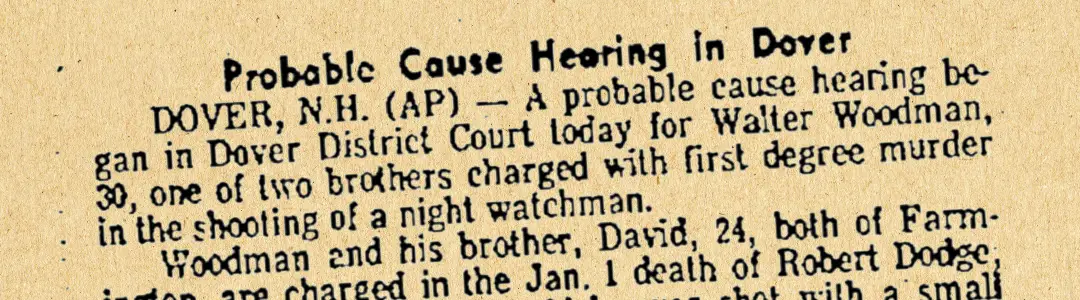
And so it was, with both Woodmans now in custody, that a preliminary hearing was held in the Dover District Court on May 13. There is another byline in the next day’s Foster’s, this time just that of Jake Chapline. The judge is Joseph Nadeau, sitting in from the Durham District Court. Walter Woodman was now represented by Dover attorney James Koromilas; David by the Fishers, father and son, Lewis and Robert, assisted by Harold Moran, another attorney in the Fisher firm. Deputy AG Henry Spaloss and Strafford County Attorney T. Casey Moher appeared for the state.
Walter’s case was the first to be called, and the proceeding took most of the morning. Testimony was provided by Inspector Rowe, Dr. Paul Young, and Theresa Buckley, and the information generally corresponded to the facts and findings described in previous articles. There was one new name, that of Nathan King, “who gave police information leading to the arrest of the brothers,” quite possibly relating to the residential break-in that resulted in the theft of the gun used in Dodge’s killing.
During the afternoon session, which related to the charge against David, Theresa Buckley appeared with an attorney, Hamilton Krans of Dover, who objected to her being asked to testify on the grounds of possible self-incrimination. Nadeau denied this, ruling that nothing had been suggested by the state that would implicate her in any criminal activity. She then answered “all the questions that were posed.” Additional witnesses were the victim’s widow, Elona, who introduced photos of the Dodge vehicle taken by the brothers from the Kidder parking lot. She was followed by Inspector Frank Redden and Trooper John Newhall. David Woodman was called to the stand by his attorney “to answer certain questions about his background” and about conversations that took place immediately after his arrest. At the conclusion of the evidence, Nadeau found probable cause to hold both defendants for the Superior Court, and they were returned to jail.
(to be continued)
Read Part 16 here.
Want to know when the next article is published? Sign up here to be notified.
Visit the Crimes Along the Cochecho for all stories released so far.
Anthony McManus is a Dover, New Hampshire historian whose column “Crimes Along the Cochecho” explores the darker chapters of local history. A Dover native and Boston College Law School graduate, McManus served as City Attorney for Dover (1967-1973) and held various public offices before practicing law until 2001. His extensive historical work includes the “Historically Speaking” column in Foster’s Daily Democrat and his 2023 book “Dover: Stories of Our Past,” released for the city’s 400th anniversary. Through research, writing, and public presentations, McManus continues to illuminate both significant events and lesser-known stories that enrich understanding of Dover’s colorful past.