
Missed the previous installments? Start here.
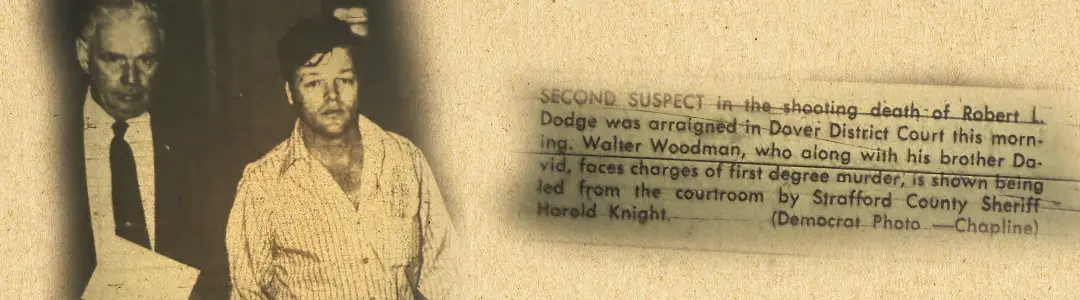
Prior to the interview with Walter, Rowe and Worster had met with Cheryl Levelle. She identified herself as Walter’s “common-law wife,” the mother of his child. He had been at her home for the three days prior to his arrest, and she confirmed that he had made the call back to Farmington to determine what had happened with David. She claimed, however, that prior to that time she had no knowledge of the Dodge murder. Walter had never mentioned it, and she learned of it only when the police showed up at the house. When they left, she went out and found a newspaper article about the incident and Walter’s alleged participation. She also stated that she was “still in love with him and was very happy to see him come back to her after dropping Terry.” (It would appear from this that Cheryl either did not know of, or was ignoring, Walter’s court petition seeking to marry Buckley.)
On May 3, Walter Woodman waived extradition and was returned to Dover.
The following day, Rowe and Worster, having accompanied Walter back to New Hampshire, interviewed Leona Faulkner, whose husband, Samuel, was Kathy Woodman’s twin brother. The Faulkners lived in Portsmouth, and early on the morning of Jan. 1, they heard a knock at their door. They did not respond, but within minutes their phone rang, and she answered. The call was from Walter and David, saying that they were at a pay phone near the cinema in Portsmouth and needed a ride back to Farmington. Their story was that they had been on their way back from having visited relatives in Massachusetts and had missed the bus out of Portsmouth. By the time she and her husband got up and dressed, there was another knock on the door — Walter and David came in and “simply walked down the hallway and out the back door to where Sam had his car parked.” Sam Faulkner also gave a statement: it had been David on the phone, and he had offered to pay Sam $5 for gas if he would drive them back. David paid him in cash.
As noted previously, one aspect of this case that stands out is the amount of time numerous law enforcement personnel spent following up on leads, interviewing potential witnesses, searching for and gathering evidence, and recording their observations. One interesting example of this is a fairly lengthy summary, prepared by Inspector Rowe and dated May 20, entitled “background information” on David Lee Woodman. It is noted that he is 24 years of age, born in Farmington, 5 feet 4 inches tall, weighs 165 pounds, has blond hair, blue eyes, a ruddy complexion, a rugged build, no physical defects, and no prior medical problems. His father is Walter R. Woodman Sr., age 54. His mother died in 1954. He has seven siblings, the oldest 32, the youngest 9. His wife is Kathleen, age 22. They have one child, 17 months. He attends the 1st Baptist Church in Farmington; hobbies are fishing, roller skating and bowling.
Rowe notes that David attended the eighth grade and was 17 when he left school: “he states that he can read and write very poorly.” School records confirm that, although he does “quite well in a subject such as drawing.” His attendance rate was very high. There is an indication in the file that he returned and tried to repeat the eighth grade, but quit after a short time. IQ test results ranged from 71 to 84; his conduct while in school was rated average. He was passed over for the military draft, having failed mental testing. He had no criminal record to date, according to the Farmington PD, but was presently bound over on a charge of burglarizing a residence in Rochester on March 28.
Rowe went as far back as 1968, starting with a shoe shop in Pittsfield, no longer in business, where both David and Kathy had worked for a brief period of time. Reports on both were positive, and the reason for their leaving their jobs was lack of transportation. David had been employed at Davidson Rubber in Farmington from April to July 1968, with nothing in the record to account for his leaving. This was followed by a short stint as a night watchman at Selbern Shoe (owned by Weiss-Lawrence), with good reports as to his performance. He left that job in February 1970, when he was hired as a janitor at Kidder Press. On his own, he did odd jobs; he had a pickup truck and would go around town and solicit work. On two consecutive Christmases, he was hired by local merchants to appear as Santa Claus, and the reports on his performance were positive. In August 1970, he was approved to serve as a member of the Farmington Volunteer Fire Department (pay was $200 a year), and he was described as “a willing worker.” Rowe even did a credit check, and found one or two minor problems, but nothing of note. Good references from Selbern Shoe. Positive reports from those contacted regarding the state of David’s marriage. Inspector Redden also made contact with Weiss-Lawrence and learned he had been good at his machine work, with very few absences. No reason was given why he left the first time, and he was rehired in January 1969. “Once in a while he would sing too loud and they would have to quiet him down,” but “All the people at Weiss-Lawrence spoke well of David.” Would they be willing to rehire him? The answer was “yes.”
(to be continued)
Read Part 14 here.
Want to know when the next article is published? Sign up here to be notified.
Visit the Crimes Along the Cochecho for all stories released so far.
Anthony McManus is a Dover, New Hampshire historian whose column “Crimes Along the Cochecho” explores the darker chapters of local history. A Dover native and Boston College Law School graduate, McManus served as City Attorney for Dover (1967-1973) and held various public offices before practicing law until 2001. His extensive historical work includes the “Historically Speaking” column in Foster’s Daily Democrat and his 2023 book “Dover: Stories of Our Past,” released for the city’s 400th anniversary. Through research, writing, and public presentations, McManus continues to illuminate both significant events and lesser-known stories that enrich understanding of Dover’s colorful past.