
Missed Part 1? Read it here.
March 8 arrived, the date set for the preliminary hearing. Once again there was a crowded courtroom, but once again the matter was postponed, this time due to the unavailability of Attorney Edgerly. Solicitor Hall had no objection, and the case was put off for one more week. It was noted that at some time during the interim Morgan had been transported from the jail to the A.P. Davis Photography Studio, located at 412 Central Ave., where his picture was taken and his measurements recorded.
Finally, on March 15, Morgan appeared in the Dover police court where he was “pleasantly greeted with a shake of the hand by his senior counsel, Hon. James A. Edgerly.” Entering the courtroom, the defendant greeted a number of his friends “with a smile and the nod of the head.” He “gave no evidence of his three weeks’ jail confinement.”
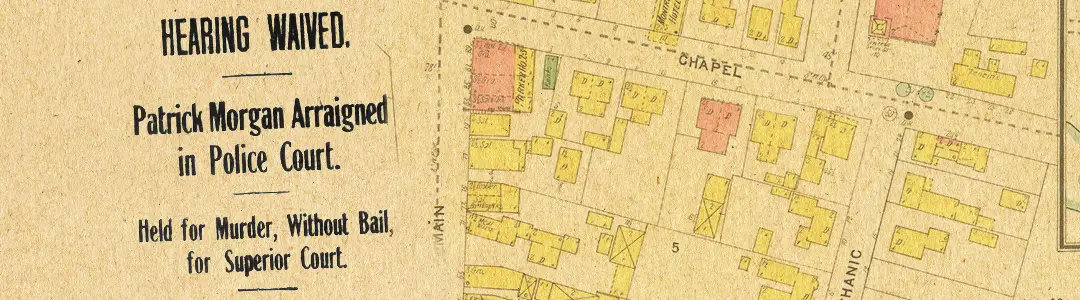
But once again, those present were denied a proper show as Attorney Edgerly waived a hearing. Solicitor Hall “had no speaking part in the case this morning.” Judge Frost promptly found probable cause and ordered Morgan bound over without bail to await the action of the grand jury in the September term. Before that occurred, however, defense counsel filed a motion with the Superior Court, advising that they intended to file a plea of insanity and asking that the defendant be placed “in the care and custody of the Superintendent of the State Hospital for the Insane to be detained and observed…at the expense of the State.” Dwight Hall, as state prosecutor, joined in the request, and it was approved by Judge Pike “until further order of the Court that the truth or falsity of the plea may be ascertained.” Morgan was transferred to Concord on or about Aug. 5.
It took several months for a report to be generated. In the meantime, a formal indictment was issued by the grand jury, charging that “with a leaden bullet…the left side of the breast of him, the said Dennis Doherty…of which said mortal wound…did languish and languishing did live, on which the same 23rd day of February aforesaid, he, the said Dennis Doherty of said mortal wound died.” Then in January 1908, a letter from the State Hospital Superintendent C.P. Bancroft addressed to County Solicitor Hall stated: “Patient is undersized and his history shows a young man of limited intelligence, education meagre and early habits irregular…would indicate feeble power of application, a weak will power and a low grade of moral and intellectual ability. He has an organic heart murmur and rapid pulse… Observation confirms the diagnosis of chronic dementia grafted on an original condition of congenital weak-mindedness. Patient undoubtedly has a structural brain defect which will lead to further dementia as he gets older…I believe him to be quite irresponsible for his crime and undoubtedly an unsafe person ever to be at large.” (The reference to “undersized” is curious, but may explain why his “measurements” were taken along with his photo back in March. Nothing further appears in the press or court records to explain the significance.)
Based on the above, there seems to have been general agreement as to the ultimate disposition of the case. On Feb. 27, Bancroft’s letter is filed with the court, and Morgan appears to be arraigned. A formal reading of the charge is waived, and an insanity plea is entered. This is accepted, the presiding justice stating that “the Court is of the opinion that it will be dangerous for you to be at large, and orders you to be committed to the Asylum for the Insane, there to remain until discharged by the due course of law.”
Patrick Morgan Jr.’s name still appears as a resident at the family home at 39 Main Street in the Dover Directory of 1909, although it is unlikely that he would have been released and returned so soon following his commitment. Beyond that, there doesn’t appear to be any record to indicate what his future may have been.
Visit the Crimes Along the Cochecho for all stories released so far.
Anthony McManus is a Dover, New Hampshire historian whose column “Crimes Along the Cochecho” explores the darker chapters of local history. A Dover native and Boston College Law School graduate, McManus served as City Attorney for Dover (1967-1973) and held various public offices before practicing law until 2001. His extensive historical work includes the “Historically Speaking” column in Foster’s Daily Democrat and his 2023 book “Dover: Stories of Our Past,” released for the city’s 400th anniversary. Through research, writing, and public presentations, McManus continues to illuminate both significant events and lesser-known stories that enrich understanding of Dover’s colorful past.