
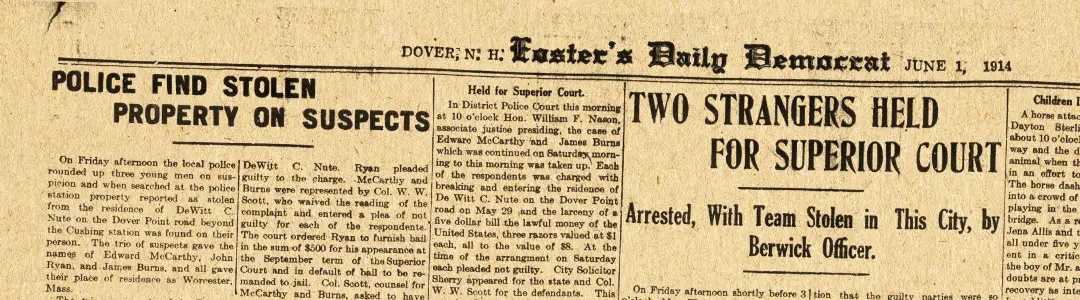
Friday, the 29th of May 1914, was a busy day for the Dover constabulary.
There was a call regarding a break-in at the home of DeWitt C. Nute on the Dover Point Road “beyond the Cushing Station”. Missing items appeared to be limited to a five-dollar bill and three razors valued at a dollar apiece. Not what you would consider a major theft. It was reported that “local police rounded up three men on suspicion” — no mention of where or why — and upon being searched, the stolen items were recovered. The perps were identified as Edward McCarty, John Ryan, and James Burns, all claiming to be from Worcester, Mass. (The arresting officer was said to be Daniel Murray, a point of note because there was another Daniel Murray on the Dover police force for a number of years in mid-1900s, very likely a son following in his father’s footsteps.)
In mid-afternoon of the same day, Officer Cornell was approached by Mrs. Walter H. Smith, a resident of Barrington, to report that her horse and wagon, which had been parked on Washington Street, were no longer where she had left them approximately 15 minutes previously. Witnesses came forward to describe two men thought to be involved. Based on that information, officers put names to the suspects since “it was thought they had spent the night before at the police station as lodgers”. An all-points bulletin was sent to nearby communities with a description of the missing men and their mode of transportation. Word was received that the team had been headed in the direction of Granite State Park, north of the city. An automobile “was quickly ordered from McShane’s Garage,” and Officers Cornell and Trask set out in pursuit. Upon arrival in the vicinity of the Park they were advised that the thieves were heading in the direction of Maine, so notice was given to the Chief of Police in Somersworth, who in turn notified the Chief in Berwick, “who quickly gave chase with an automobile and overhauled the team” on the road to Lebanon. The two men were, in fact, the two who had spent the previous night as guests of the Dover PD, where they had identified themselves as James Carson and James Connors, both stating they were from Weymouth, Mass.
And here, a bit of general background: for a goodly number of years, it was not unheard of for individuals to voluntarily seek overnight shelter at the police station. As with Carson and Connors, perhaps just arrived in town, no family or friends here, and not familiar with or able to afford a hotel or boarding house. It was likewise not unknown to have someone who had overindulged in spiritous liquors to turn themselves in and ask to sleep it off until morning. The service was not advertised, and cell space not always available, but a certain segment of the population was aware that it was an option.
Another item for consideration: the year is 1914, but it is clear that there are still folks who travel by horse and wagon, in this case, all the way from Barrington, and there are still available parking places on downtown streets. It also appears that the Dover PD is not yet fully mechanized, for in order to pursue the stolen team a vehicle had to be requisitioned from the local REO automobile dealer, McShane’s Garage, located at 17-19 St. Thomas St. (we’ll see in a future story, however, that the Department was not totally without motorized transport…)
With Carson and Connors now in custody, the police received a second report, this by Frank W. Hanson, that just prior to making off with Mrs. Smith’s horse and wagon, the two had attempted to steal Delto, his “pacing gelding”, which had been tied to a post on First Street. Mr. A.E. Tibbetts, who operated a motorcycle repair shop at 14 First St., had observed a man trying to unhitch the horse, but was having difficulty transferring the rope from the post to a proper position around the horse’s head and neck. Thinking “the game had gone far enough,” Tibbets approached, and after a brief conversation, the man moved away in the direction of Central Avenue. Tibbett’s description fit that of Carson, and a second individual nearby who appeared to be “cross-eyed” fit that of Connors.
All of this activity made for a busy Saturday, the following morning, in the Dover District Court, Associate Justice William F. Nason presiding. James Ryan pleaded guilty to the break-in at the Nute residence. He was ordered to be held on $500 bail, to be referred to the September Term of the Superior Court. Attorney W.W. Scott appeared for the two co-defendants, McCarty and Burns, and asked for a continuance. In the absence of the regular prosecutor, Chief of Police Clark agreed, the cases put over to the following Monday. The “trio was photographed and their measurements taken after which they were taken to jail”.
The case against James Carson was also on the docket, charged with stealing a horse, a harness, and a carriage, all to the value of $200, considerably more than the $8 involved in the previous matter. Carson appeared without counsel and entered a plea of no contest. Chief Clark asked for a continuance, saying that the State wasn’t ready to proceed with a hearing, but Judge Nason pointed out that there was no need for evidence since Carson had just admitted his guilt. That being the case, he was also ordered held on bail pending the Grand Jury proceedings in September.
The complaint against James Connors was then called, Chief Clark asking that he be held as a material witness on the principal case against Carson. This provoked an outburst from the latter, described by the reporter as “about the slickest person that has been seen in the police court for a long time”. Carson objected to having Connors held as a witness since he had already pleaded and been bound over. Judge Nason explained that Connor’s testimony would be needed for future proceedings on the case, and approved the request that he post a bond guaranteeing his appearance. The two men were then put through the photo and measurement routine and were carted off to jail.
A good place for them, as it turns out, for within a day or so Chief Clark had identified Carson as a career criminal, dating all the way back to 1878 with a conviction for breaking and entering, leading to a five-year sentence in the Massachusetts State Prison, followed by a similar sentence for embezzlement, a sentence in 1887 of 25 years as an habitual offender, and a more recent shorter term from Essex County for larceny. No indication of what may have drawn him to Dover.
(More on courts, crime, and the administration of justice to follow…)
Read Part 2 here.
Visit the Crimes Along the Cochecho for all stories released so far.
Anthony McManus is a Dover, New Hampshire historian whose column “Crimes Along the Cochecho” explores the darker chapters of local history. A Dover native and Boston College Law School graduate, McManus served as City Attorney for Dover (1967-1973) and held various public offices before practicing law until 2001. His extensive historical work includes the “Historically Speaking” column in Foster’s Daily Democrat and his 2023 book “Dover: Stories of Our Past,” released for the city’s 400th anniversary. Through research, writing, and public presentations, McManus continues to illuminate both significant events and lesser-known stories that enrich understanding of Dover’s colorful past.