
Missed Part 1? Start here.
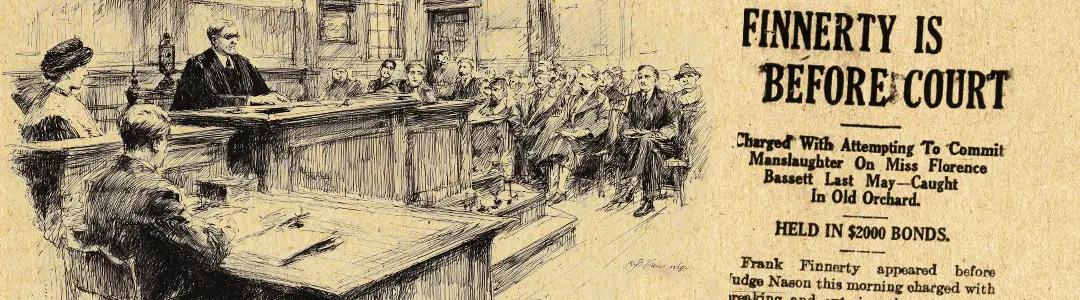
Aug. 18, 1915, and Frank Finnerty is represented by local counsel, ex-District Court Judge James McCabe. The hearing continued until shortly after noon. First up was Mrs. Mary Bassett, the mother of Florence, who confirmed the fairly long-term prior relationship between her daughter and the defendant. At first she said she did not object, “but after he had caused a black and blue mark on her arm during one of their walks, she refused to allow another meeting.” She claimed that Florence then had threatened to leave home. The next witness was a William Hayes, who said he had observed Finnerty run away from the Bassett residence with a revolver in his hand. Hayes claimed that Finnerty said, in passing, “Did you see Florence Bassett? I want her.”
George Smart, one of the owners of the guns and ammunition store just north of Main Street (we have met Mr. Smart previously with regard to the July Fourth street shootings) testified to having sold Finnerty a revolver and some cartridges the day prior to the incident at the Bassett residence. Finnerty had stated at the time that he was aiming to shoot some ducks. Deputy Sheriff Goodwin related a conversation with Finnerty who claimed he had been “nervous and excited when he went to the Bassett house, that he was a fool, and that he did not know why he did it.” Then Edward Goggin, a messenger boy at Western Union, told of a message he took from Finnerty to Florence about an hour before the incident occurred at her home, asking that she agree to meet with him. No reply message was ever received.
Next it was Miss Florence herself, and here was the inside story. The Saturday before all this happened, the two went for a walk and Finnerty wanted to follow the railroad track from Washington Street north across the bridge. She refused, at which point he “took hold of her arm roughly” and caused the bruising described earlier by her mother. They then walked back down Washington St. and ended up at McShane’s Garage (of which we have heard previously in other cases), where “an auto appeared and she was forced into it, and held, and driven to Portsmouth.” She stated that Finnerty had taken possession of her pocketbook to prevent her from leaving, and they ultimately returned to Dover.
The following Monday she received the message from him through Western Union, but made no reply. At some point she heard a noise in the cellar, then in the kitchen, the warning from her mother, at which point she fled upstairs. “She admitted she loved Finnerty and that he was very kind and attentive.” She believed he loved her although they had had some “love spats” at different times. Next was John Carver, employed as a driver at McShane’s, who said he had been hired to take Finnerty and Miss Bassett to Portsmouth. She had objected to riding at night and did not want to go, but on the whole he supposed the arrangements had been made “by mutual consent.”
Several witnesses were then called by the defense to attest to Finnerty’s good character. The first of these was Mrs. Helen C. Grant, who identified herself as Finnerty’s mother. She testified that although he was “easily excited and impulsive,” he had a kind heart at all times. He had not been in any kind of previous trouble. But on cross-examination, she revealed that her son was in fact a married man, with one child. There had been a separation and “they would not accept support from him,” but he had “been her main support for years.” (Nowhere in the reporting of the story was there any mention of when … or if … the Bassetts had been aware of Finnerty’s marital status …)
At the conclusion of all the evidence, Judge Nason issued a finding of probable cause to hold the defendant for the next term of the Superior Court. Bail was set at $1,000.
(To be continued …)
Visit the Crimes Along the Cochecho for all stories released so far.
Anthony McManus is a Dover, New Hampshire historian whose column “Crimes Along the Cochecho” explores the darker chapters of local history. A Dover native and Boston College Law School graduate, McManus served as City Attorney for Dover (1967-1973) and held various public offices before practicing law until 2001. His extensive historical work includes the “Historically Speaking” column in Foster’s Daily Democrat and his 2023 book “Dover: Stories of Our Past,” released for the city’s 400th anniversary. Through research, writing, and public presentations, McManus continues to illuminate both significant events and lesser-known stories that enrich understanding of Dover’s colorful past.