
Missed Parts 1 and 2? Start here.
Several days following Finnerty’s first appearance in District Court there appeared an article in Foster’s detailing a very different kind of “spat” than that mentioned by Florence Bassett, an apparent falling-out between local law enforcement. It was reported that Deputy Sheriff Goodwin “takes exception” to the earlier news report that he had gone to Old Orchard Beach in search of Finnerty based on information provided by the Dover Police Department. According to Goodwin, following the event at the Bassett home he, based on information he had uncovered, had contacted the police in Portland and Old Orchard, and then, at his own expense, traveled to Old Orchard on the previous Sunday “to see what was being done,” and as a result of his inquiries Finnerty was apprehended. “Goodwin says that the local police department are not entitled to any credit for the arrest of Finnerty as they in no way furnished him any information in relation to the matter.” So there!
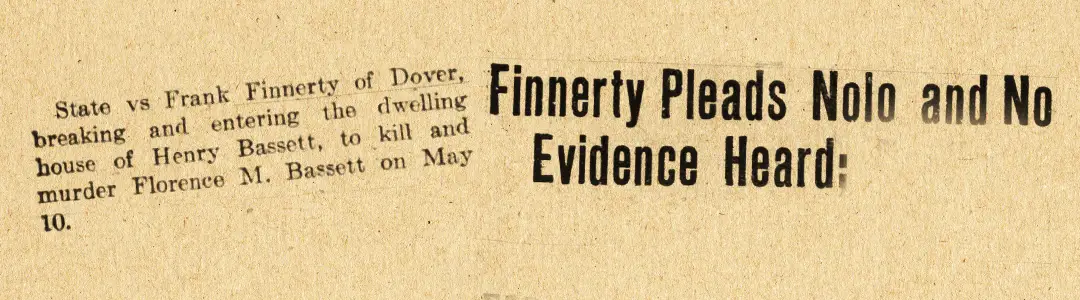
The formal charge in Superior Court was that on May 10, 1915, Finnerty “did break and enter the dwelling house of one Henry Bassett with intent upon Florence M. Bassett … with a loaded revolver in his right hand then and there held to make an assault, with an intention her the said Florence M. Bassett then and there with the loaded revolver aforesaid, feloniously, willfully, and of his malice aforethought to kill and murder. …” (You have to admit the wording back then was pretty great.) The county solicitor at the time was Albert Sherry. A petition was filed by the defendant to have Dover’s James McCabe appointed to represent him and that was approved. On Sept. 10, he was arraigned and entered a plea of not guilty.
But then, on the 27th, he appeared, retracted his plea, and entered a plea of no contest. Dover resident Judge Robert Pike then issued a sentence of not less than a year and a day nor more than three years in New Hampshire State Prison. Finnerty was transported to Concord that same day. Attorney McCabe submitted a bill for $15 for his legal services on the case, which was approved.
There are several odd aspects to the case. For someone who had been keeping company with Miss Bassett for nearly two years, were the Bassetts still not aware of Finnerty’s marital status? Does it not seem strange that he would choose to make his entry into the house by smashing a window in the cellar, which was the basis of the “break and enter” portion of this indictment? Even if no longer a favorite of Florence’s mother, it seems he could have at least tried the front door as a means of entry. And then, although there’s no question he was armed, and must have had something in mind when he purchased the weapon on the day previous, it was clear that he never came into contact with Florence, never physically threatened her, never even saw her before she made her way to the neighbor’s apartment. He then almost immediately fled the scene and quickly disposed of the weapon. He was certainly guilty of something, but assault with intent to commit manslaughter might go a bit beyond the known facts.
But he agreed to the plea of “no contest,” and with Finnerty safely behind bars he disappears from the scene. There is no further news of Florence Bassett, except for a listing as “milliner” in the Dover Directory for 1917, still residing at 269 Central Ave.
Visit the Crimes Along the Cochecho for all stories released so far.
Anthony McManus is a Dover, New Hampshire historian whose column “Crimes Along the Cochecho” explores the darker chapters of local history. A Dover native and Boston College Law School graduate, McManus served as City Attorney for Dover (1967-1973) and held various public offices before practicing law until 2001. His extensive historical work includes the “Historically Speaking” column in Foster’s Daily Democrat and his 2023 book “Dover: Stories of Our Past,” released for the city’s 400th anniversary. Through research, writing, and public presentations, McManus continues to illuminate both significant events and lesser-known stories that enrich understanding of Dover’s colorful past.