
Missed Parts 1 and 2? Start here.
Given the relatively short time between the date of the accident and the hearing, the State seems to have done its homework. The next witness was William A. Grover, a civil engineer. He submitted and testified to a plan of the area, explaining relative distances, visibility, location of the ruts at the side of the road. The plan was created two days after the accident. This presentation was followed by testimony of Harry C. Horton, a professional photographer, who provided photos of the scene.
The Burnham family testified, Charles saying that Maloney had passed him on the left after blowing his horn, moving at a high rate of speed. Tuttle was walking in the gutter of the road to the left. He saw him being struck, tossed in the air, and then the vehicle crossed the road toward the gutter on the right. On cross-examination, he said that he could see Tuttle some distance ahead before the accident occurred. From his observations of Maloney at the scene, he could not say that he was intoxicated. Ella and Mildred both testified, consistent with Charles’ observations. Both could smell liquor on Maloney’s breath, but no reason to think he was intoxicated.
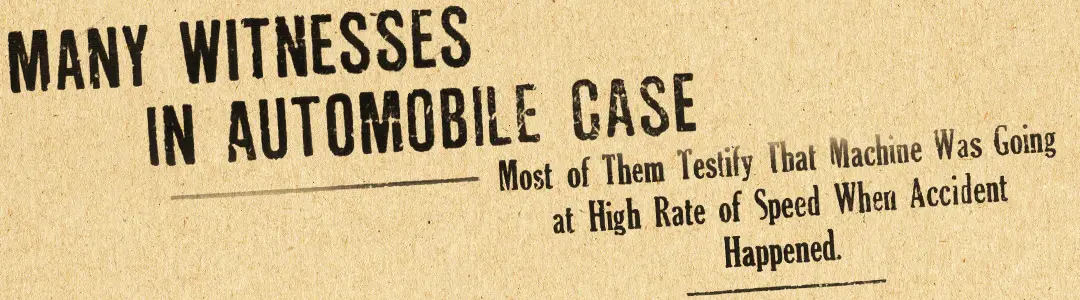
Investigators had also turned up a number of eyewitnesses, two being of the Tuttle Farm family. George Tuttle came to the scene, observed several other people there, saw Harry Tuttle’s body in the ditch at the side of the road, and saw the damage to Maloney’s vehicle. He asked Maloney if that had been caused by striking Tuttle, who replied that it was from hitting the post. The witness said he saw no markings on the post but did see that some bark had been removed from the walnut tree. From his observations, he “assumed that Maloney was in an intoxicated condition”. He was “talking foolish and contradicting his statements repeatedly”. This was supported by testimony from William Penn Tuttle, George’s son, who also came to the scene following the accident, and described the damage to the vehicle and Maloney’s breath having an odor of beer, “his voice thick and his eyes glassy”. William Gilman, who identified himself as another farmer along the Dover Point Road, had known Harry Tuttle since July. He “saw the car going like the wind, one side of the road to the other like a flash”. Gilman told the judge he felt Maloney was intoxicated.
There was Lillian Clark, who testified she was from Boston, but had been staying as a guest with the Tuttles. She was resting in a hammock on the adjacent property, heard the sound of a crash, and looking up observed a vehicle moving at a fast rate and a body being tossed into the air. Next was Irving Morton, who said he had been driving south on the road, saw a car with three men going at what he estimated to be between 30 and 50 miles an hour. Attorney Hurlburt objected to this, likely on the basis of it being conjecture, and Judge McCabe sustained the objection. There was testimony from several officers: Officer Crowley felt Maloney was under the influence “to a considerable extent”. Officer Brownell, the motorcycle cop who arrived early on the scene, agreed. Officer Lathrop testified that he had a conversation with Maloney, who admitted to having consumed three beers, but could not fully explain how the accident happened. Police Chief Clark was called and expressed his opinion that Maloney “had an awful breath which could not have come from three beers”. Medical Examiner Roberts was recalled to the stand and conceded that even though Maloney had admitted to having had several beers his condition and conduct following the accident might have resulted from fright and not actual intoxication.
Upon consideration of all of the above, Judge McCabe found sufficient cause to hold the Defendant for the upcoming Term of the Superior Court, bail set in the amount of $5,000. That was paid, and Maloney was released. There is also a receipt for payment of a fee to each of the civilian witnesses for their appearance, in the amount of $1.01 (about $32 at the current rate).
(more to come…)
Read Part 4 of “Death on Dover Point Road: The Leo Maloney Trial” here.
Visit the Crimes Along the Cochecho for all stories released so far.
Anthony McManus is a Dover, New Hampshire historian whose column “Crimes Along the Cochecho” explores the darker chapters of local history. A Dover native and Boston College Law School graduate, McManus served as City Attorney for Dover (1967-1973) and held various public offices before practicing law until 2001. His extensive historical work includes the “Historically Speaking” column in Foster’s Daily Democrat and his 2023 book “Dover: Stories of Our Past,” released for the city’s 400th anniversary. Through research, writing, and public presentations, McManus continues to illuminate both significant events and lesser-known stories that enrich understanding of Dover’s colorful past.