
Missed Parts 1 through 4? Start here.
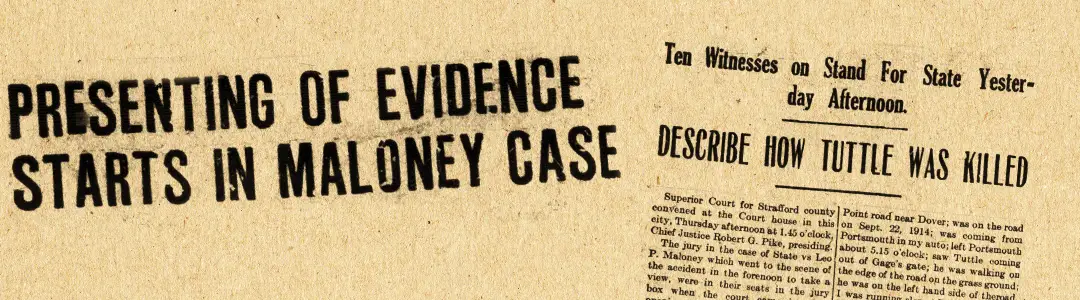
The Leo Maloney retrial began on Sept. 31. The presiding justice on this occasion was Dover’s own Robert Pike. Testimony began in the afternoon after the jury had an in-person morning tour of the accident scene. Once again, the opening witness was the civil engineer, William A. Grover, who provided some interesting history on the construction of the road itself. It was built in 1910, with a width of 21 feet, but not “oiled” until 1914, maintained by “road agents” in the meantime. Using a map, he showed the location of the Gage farm, where Harry Tuttle started his walk north, the distance from the bottom of Huckleberry Hill to the Tuttle farm, and the point where Maloney’s vehicle would have gone off the road to the left. (It’s interesting to make a contemporary visit of the approximate area of the accident. There is now pavement, of course, but there also what anyone would call…then or now…gullies or ditches on both sides of the road.)
Grover was followed by Charles Pinkham, Tuttle’s co-worker at the Gage farm, then Charles Burnham, now identified as a “candy salesman”, who repeated his testimony from the earlier trial regarding the speed of the Maloney vehicle: “I did not notice that the car diminished its speed from the time it passed me until I saw it strike Tuttle.” Burnham’s wife and daughter also testified, and responded to questions about their observations of his sobriety, both saying they noted nothing to suggest he was under the influence. Everett L. Chapman, the County physician, described the injuries, which he felt were caused “by coming into contact with a fast moving auto”. Under cross-examination by defense counsel, John H. Bartlett, he felt “contact with the bumper broke his leg…the cut on his head was caused by the radiator..”. He was shown a photo of the damaged vehicle, which was then entered into evidence.
Next was William Gilman, then George Tuttle, the latter spoke of what he had seen immediately after the accident and described what he observed as the track of the vehicle from when it left the roadway. At which point the court recessed for the day.
Friday morning George Tuttle was still on the witness stand and he raised an interesting point. He disagreed with the testimony from the civil engineer as to the location of the ruts and the cause thereof. It was George Tuttle’s theory that the ruts had been caused, to a large extent, by the vehicle itself, showing Maloney’s attempts to get the car back onto the hard surface of the road. Once again he related Maloney’s contradictory remarks…”crazy statements”…that he would not have hit Tuttle if he hadn’t jumped in front of him, but also claiming he hadn’t seen him until after the impact. George was followed to the stand by his son, William Penn Tuttle, who said he spoke with Maloney for 5-10 minutes and confirmed that he offered two different versions of what had occurred.
The Dover police officers who responded to the scene were next. William Brownell, Charles C. Crowley, and then now-ex Police Chief Clark all gave their opinion, as had the Tuttle father and son, that Maloney appeared to be under the influence. Two final witnesses: Thomas Agnew, a Dover resident and in the “auto business” for 6 years, and John J. Carver, “machinist and chauffeur”, both testified to the proper operation of a motor vehicle. Keep in mind this was still 1915, and members of the jury may never have been behind the wheel of a car. Carver explained that he had been an employee of the McShane Garage on the day of the accident and had driven the ambulance to the scene (which answers my speculation early on regarding the propulsion status of that vehicle). McShane’s was situated on Kirkland St., so a location convenient to the police headquarters.
At this point the State rested. Attorney Hurlburt gave an opening argument on behalf of the Defendant. The Court recessed for the noon hour.
The opening of the afternoon session was the reading, by agreement, of the testimony from the first trial of the County Medical Examiner Roberts, “the witness being unable to appear here at this time”. This was followed by Lottie Goodman, a resident of Rochester, who was in Dover attending classes at a business school on the day of the accident. She knew Maloney and saw him sitting in the car in front of the Lothrop-Farnham store on Central Ave. at approximately 3 p.m. (the Sanfacons were inside making a purchase.). She spoke with him for about 5 minutes and observed nothing to indicate that he was under the influence of alcohol.
Henry Vachon, who identified himself as a Rochester resident and “shoemaker”, stated he had been driving cars for 3 years, was a friend of Maloney’s, and had also driven Fr. Lacroix’s vehicle. He said he had never known Maloney to take a drink. He testified at some length about his experience as a driver and his observations of Maloney’s manner of operation, but on cross-examination agreed that if he had observed someone in the road 80 feet ahead, he would have hit the brake and stopped. Then Fr. Lacroix reiterated his earlier testimony that Maloney had extensive experience driving as his chauffeur for the past three years, and never had an accident, but had to acknowledge that he had no idea what had occurred on the day of the accident.
Next up — the Defendant, Leo Maloney.
(more to come)
Read Part 6 here.
Visit the Crimes Along the Cochecho for all stories released so far.
Anthony McManus is a Dover, New Hampshire historian whose column “Crimes Along the Cochecho” explores the darker chapters of local history. A Dover native and Boston College Law School graduate, McManus served as City Attorney for Dover (1967-1973) and held various public offices before practicing law until 2001. His extensive historical work includes the “Historically Speaking” column in Foster’s Daily Democrat and his 2023 book “Dover: Stories of Our Past,” released for the city’s 400th anniversary. Through research, writing, and public presentations, McManus continues to illuminate both significant events and lesser-known stories that enrich understanding of Dover’s colorful past.