
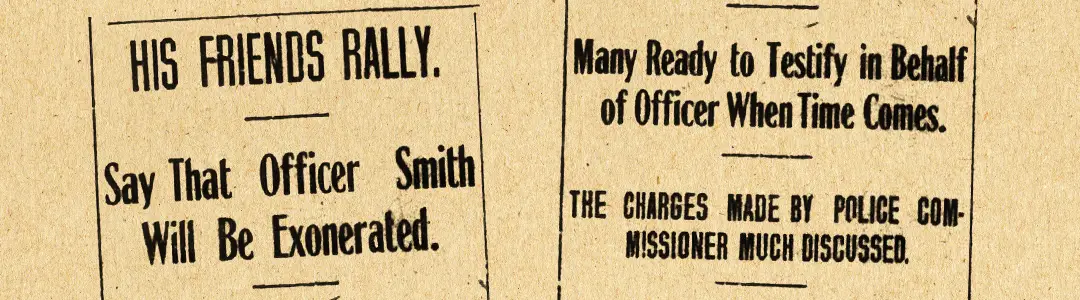
A hearing on the petition to pardon convicted killer John Williams is held before the Governor and Council. According to the report of this proceeding, published on May 10, it was alleged that Officer Smith had testified at the trial “that he saw Williams do the shooting which resulted in the deaths of John McNally and Thomas Dobbins, and the serious wounding of Joseph Gagnon and Arthur Russell, but the police commissioner told the Governor that he had heard that the officer was at a distance at the time and knew nothing about the men being shot until he was notified by a citizen…”. One of the Councilors inquired, if you have a man you believe to be untruthful why don’t you get rid of him? “We are waiting to see what you will do in this case”, was the reply. County Solicitor Dwight Hall, who had been City Solicitor at the time of the shooting, declared his support for Smith’s honesty, relating an earlier situation when he had been charged with use of excessive force—”needlessly clubbing a person”—and was advised by counsel to claim he had acted in self-defense. Smith had refused to say this “and accepted punishment for his roughness”.
Wentworth explained his position: (1) he had found that there were seven men in the gang and two of them had not been identified at the time; (2) one of those he now knew to have been a William Dowd, presently serving time in a prison in Canada; (3) the name of the other is still not known, but described by several witnesses as being a six-footer with reddish hair; (4) it was thought by some that his name was Sam Huddle, but that person is known to be dead. He believes the missing man was the murderer because a number of the actual witnesses at the time had described the shooter as being the “big man” of the group, and Williams is under 5’8″. He now believes Williams was an accessory, but “no more guilty than the four yeggs who were acquitted”.
Wentworth said he had no intent in the case beyond “a sense of justice and his belief in Williams’ innocence”. He had been to Canada to interview Dowd. He had gone to Haverhill to meet with the “Cold Spring Brewery burglars”. He had spoken with an individual in Portland “whom he intimated had some important knowledge in the case”, though he would not at this point disclose a name or actual connection to the case. “I had to see this man at night” he said, and indicated that the Governor and Council would have to do the same. The latter “did not indicate any desire for midnight trysts with a stranger of such mysterious surroundings, and the subject was dropped”. At the conclusion of the presentation the petition was taken under advisement.
The May 24 edition of Foster’s reprinted an item from the Somersworth Free Press which you almost have to take as an editorial comment without actually saying so: “A Dangerous Movement in Part. It is the privilege of Deputy Sheriff Wentworth to follow any fantastic clues, or work out any ingenious theories he may care to, but it is the duty of all good citizens to do their utmost to see that the solemn decrees of law are maintained, and that the just punishment provided by statute are not defeated”.
By mid-July the petition seems to be in limbo; no word from the Governor and Council. But two things take place in Dover. One, during a meeting of the Police Commission a resolution submitted by Atty. Kivel is unanimously adopted: “no member of this board having made charges against Smith in regard to his testimony at the preliminary hearing and two trials, Smith may withdraw his petition”. It’s not entirely clear what this refers to, but may have been a request by Smith to resign from the Department.
The second item is a one-on-one interview of Wentworth by an unnamed Foster’s reporter about what was behind the pardon request to the Governor and Council, and Wentworth made it clear that he would have explained the entire matter in detail well prior had anyone asked him. “My attention was called to the case last September when Williams’ sister contacted Kivel regarding her brother’s imprisonment”. He was then contacted in his role as Deputy Sheriff to review the evidence as to who did the shooting. He did some investigation, obtained affidavits, and submitted those to Concord. “He says he made no personal reference to Smith or to the correctness of his testimony at trial.” In response to an inquiry from a Councilor “If an officer should testify that he was present and saw the shooting, and in fact was not present, what would you call it?” I replied be perjury, but I did not state that Smith had done that. “I make this statement in justice to myself and to Mr. Smith and to correct the false impression that has been circulated”. If this was meant to clarify Wentworth’s position as to the basis for filing the petition on Williams’ behalf it seems to fall far short of the mark.
(to be continued…)
Read Part 3 here.
Visit the Crimes Along the Cochecho for all stories released so far.
Anthony McManus is a Dover, New Hampshire historian whose column “Crimes Along the Cochecho” explores the darker chapters of local history. A Dover native and Boston College Law School graduate, McManus served as City Attorney for Dover (1967-1973) and held various public offices before practicing law until 2001. His extensive historical work includes the “Historically Speaking” column in Foster’s Daily Democrat and his 2023 book “Dover: Stories of Our Past,” released for the city’s 400th anniversary. Through research, writing, and public presentations, McManus continues to illuminate both significant events and lesser-known stories that enrich understanding of Dover’s colorful past.