
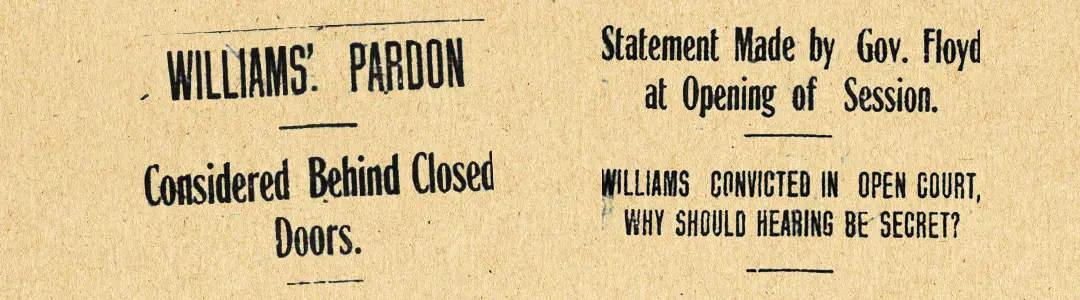
On Aug. 22, there is another hearing before the Governor and Council. Those in attendance include Wentworth, Police Commissioner Thomas Dearborn, local attorney Col. W.W. Scott, County Solicitor Dwight Hall, Officer George Smith, George I. Leighton, William Gouin, Eugene Cote, Patrick W. Murphy, Celestra Bushard and James Broadbent—the last two witnesses who say they observed Officer Smith on the scene when the fatal shots were fired. And the result? According to Dwight Hall it had been “a secret session”, and this provoked a rather personal response from the Foster’s reporter: “There does not appear to be any reason for holding a secret session on a petition for his pardon.” Once again, the matter has been tabled, to be reviewed at a subsequent meeting of the Governor and Council.
Another reprint, this time from the Manchester Union Leader: this reports on the visit locally of one Hiram Moe, identified as the high constable of St. Francis District, Sherbrooke, Canada. The reason for his visit to NH “was to look up John Williams”. Even though he had traveled a considerable distance to attend the Governor & Council meeting he was denied admittance, and he was allowed what was described as only “a glimpse” of Williams during a stop at the state prison. “Despite being turned aside Moe insisted that he will make a fight to bring Williams back to the Sherbrooke prison, from which he escaped seven years ago while awaiting trial on a bank burglary”. Moe claimed that he had spoken with Bert Wentworth who had advised that if the pardon petition was successful Williams was scheduled to be turned over to Massachusetts authorities in connection with his role in the Cold Spring Brewery matter, and further “that if Mr. Moe would not bother with Williams he would give him information as to the whereabouts of John Moore who also escaped with Williams and whom nothing has been heard since that time”. Wentworth’s actions on Williams’ behalf do raise some interesting questions.
(to be continued)
Missed parts 1 and 2? Start here.
Visit the Crimes Along the Cochecho for all stories released so far.
Anthony McManus is a Dover, New Hampshire historian whose column “Crimes Along the Cochecho” explores the darker chapters of local history. A Dover native and Boston College Law School graduate, McManus served as City Attorney for Dover (1967-1973) and held various public offices before practicing law until 2001. His extensive historical work includes the “Historically Speaking” column in Foster’s Daily Democrat and his 2023 book “Dover: Stories of Our Past,” released for the city’s 400th anniversary. Through research, writing, and public presentations, McManus continues to illuminate both significant events and lesser-known stories that enrich understanding of Dover’s colorful past.