
Missed Parts 1 and 2? Start here.
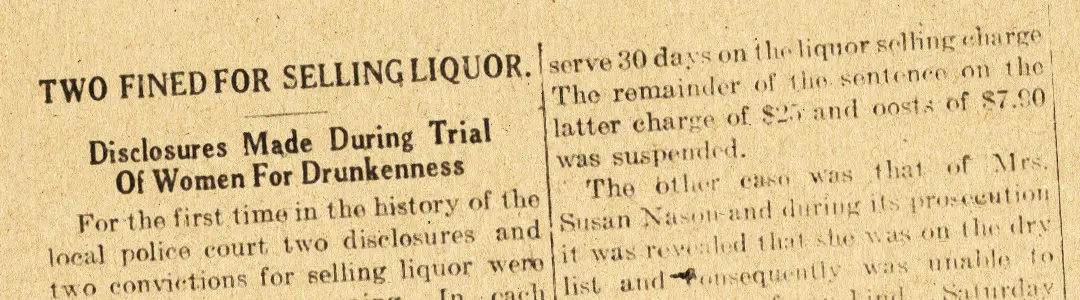
Case number two on the 25th of May 1915 involved Mrs. Susan Nason, and “it was revealed that she was on the dry list and consequently was unable to procure liquor of any kind”. The previous Saturday she had asked a neighbor, one Charles Joseph, to buy her a half pint of whiskey. He did so, not being aware that she was on the list. Upon his return, he was confronted by Mr. Nason, who advised him not to give her the goods, “but he paid no attention to the warning of the husband”, and delivery was made. Mrs. Nason followed her husband to the witness stand, and her testimony was consistent. Mr. Joseph was found guilty, sentenced to 30 days in the House of Correction and a $25 fine, with the jail sentence to be suspended upon payment of the fine and costs. His attorney, Walter W. Scott, filed an appeal. Nothing is reported about any consequence for Mrs. Nason, who was clearly in violation of her position on the list. (The article fails to refer to the judge who was sitting that day, but a separate article on a different case heard that day reports that it was Judge Nason. No indication of any relation between him and the lady Defendant.)
The other case heard that day involved “an alleged larceny of considerable money, a revolver, and a watch from Albert C. Larey, the defendant being one Albert F. Reynolds. The event is alleged to have occurred almost 2 years prior. On July 24, 1913, the two men visited one of the local saloons. Larey had some kind of physical reaction to whatever they were drinking, and Reynolds offered to accompany him to a local hotel, The Central House, and get him a room for the night. (This likely refers to the Central Park Inn, close to the Somersworth line.) Once settled Reynolds left and Larey “turned in with no memory of being disturbed by anyone entering the room during the night”. When he went for breakfast in the morning, however, he found he had “but a 50-cent piece left of his belongings, which meant a loss of $80 in bills, a $5 gold piece, a handgun, and his gold watch.”
There’s no indication of how Reynolds was apprehended, but he was obviously in custody and in court on the 25th of May 1915. One witness testified the value of the stolen watch to be $40. He was followed by Frank Howard, “a Boston tattooer for Barnum & Bailey”. He said that on July 26, 1913, he was approached by Reynolds, who asked to borrow $6, offering a pawn ticket for a gold watch as security. He gave him the cash. Howard was later contacted by a police inspector who was accompanied by Reynolds, with the news that the watch was stolen goods. Based on this testimony, Judge Nason found probable cause to hold the Defendant for the September Term and set bail at $1,000. “Slight chances of procuring bail are entertained by his counsel Ex-Judge James McCabe”. (Chances are good that he was correct. $1,000 in 1915 would be well in excess of $32,000 in today’s money.)
There was no explanation of the delay in bringing this case before the Court. But here’s something quite unusual about the Foster’s report. First, the Defendant’s first name was not “Albert” Reynolds; it was Gilbert. And the victim’s last name was not “Larey” but “Leary”, and later documents indicate he is from Brownfield, Maine. In all of the cases I’ve read up to this point, the reporting has been quite accurate. This time, not so good.
The case of Gilbert Reynolds was taken up by the Superior Court on the 25th of June in the form of a petition signed by the Defendant, notarized by Atty. McCabe, stating that he is unable to make bail, “that he is in ill health and suffering from tuberculosis”. He is asking that he be discharged from custody “upon such terms as may be just”. There is a handwritten ruling issued by Judge Pike on the 29th, somewhat difficult to read in full, but it appears that the request was granted “pending further action of the September Term”. Reynolds signed a personal bond for the $1,000 bail.
There is an indictment issued in September, but there is no marking of any kind in the file. No appearance, no plea, no final disposition. No further reference to Reynolds could be found in the newspaper index following that date, so chances are that the TB did him in.
Visit the Crimes Along the Cochecho for all stories released so far.
Anthony McManus is a Dover, New Hampshire historian whose column “Crimes Along the Cochecho” explores the darker chapters of local history. A Dover native and Boston College Law School graduate, McManus served as City Attorney for Dover (1967-1973) and held various public offices before practicing law until 2001. His extensive historical work includes the “Historically Speaking” column in Foster’s Daily Democrat and his 2023 book “Dover: Stories of Our Past,” released for the city’s 400th anniversary. Through research, writing, and public presentations, McManus continues to illuminate both significant events and lesser-known stories that enrich understanding of Dover’s colorful past.