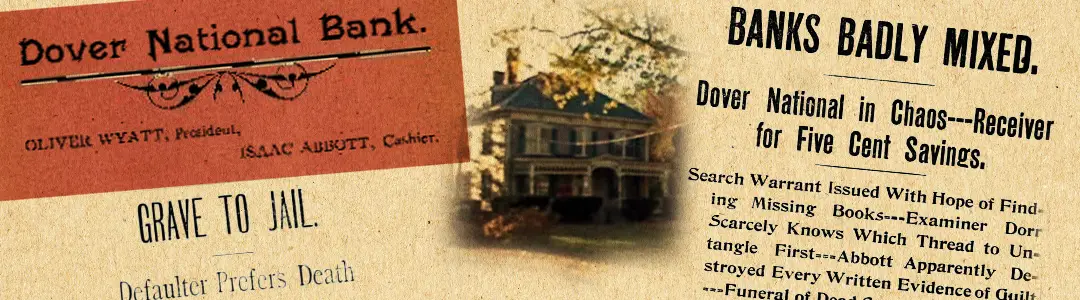
Serious crime in Dover has not been limited to incidents involving firearms, shootings, and serious injuries or death — family members and/or complete strangers who happened to be in the wrong place at the wrong time. There was a period of years, from mid-1895 to mid-1903, when Dover might have been called the embezzlement capital of New Hampshire. Three relatively prominent locals, all trusted employees of a local bank, decided to help themselves to some of the money close at hand. All different stories with different results.
The first to get his name in the headlines was Isaac Abbott. Not only local headlines but also large print, front page, above-the-fold, in the New York Times: “BANK LOOTER AND SUICIDE, City Treasurer Abbott of Dover, NH, proves to be both”. But let’s start at the beginning.
Isaac was born in Dover on Nov. 1, 1842, son of Elisha and Harriet Tate Abbott. He married Elizabeth Jane Cushman in Bath, Maine on Oct. 10, 1867. They had three sons, one of whom died at age 10, and one daughter. Isaac began his employment with one of the Lothrop family enterprises, then was hired as a clerk by the Dover National Bank, where he worked his way up to Cashier as of 1875. A respected figure in the community, he was an active member of the Dover Baptist Church (then, as now, located on Washington Street), and just one week prior to the events that produced the headlines, he had been elected a director of the bank. As noted above, he filled the position of Treasurer for the City.
In 1887 Isaac and Harriet built a house at 10 Arch St., a large residence and carriage house that still exists, though now accommodating several apartments.
The house itself was impressive, but the interior was reported to be very elegant, with expensive fixtures and furnishings. There were questions by some at the time as to how all of that could be accomplished on Isaac’s bank employee income, but he identified the source as being Tate family money. Sadly, Elizabeth passed away in 1892, leaving Isaac responsible for their three surviving children, ages 15 to 21.
During the years in question banking and its various transactions were all done on paper, no computers, electronic transfers, ATMs. Today, we recognize a “cashier” as the young person behind the counter, but in Isaac’s time, the cashier was the equivalent of the chief financial officer, with full and unrestricted supervision of all bank records. There might be a Board of Directors, but they were not part of the day-to-day operation, and all being local men of some consequence, there was a high level of trust for someone who held the position for close to 20 years. So, likely little or no real direct oversight. There were bank examiners, however, at the federal level for national banks, and state agents for state-chartered institutions. As it happened, on Friday, Jan. 11, 1895, there were folks in town to check on the books of the Dover National.
They found some discrepancies and sought some answers from Isaac Abbott, but he had left work early for home. He acknowledged to a local reporter that there appeared to be missing funds, “you may say $100,000”, and promised to meet with the examiners the following day to respond to their inquiries. The next morning, the officials found that the safe, which contained many of the bank records, could not be opened, and Abbott failed to appear. Located at his home, he advised that he would meet with all concerned on Monday morning. In view of his response, or lack thereof, federal prosecutors were put on notice with a request for Abbott’s arrest. While he remained at his home on Sunday, Dover’s Chief of Police James Fogarty assigned local officers to maintain surveillance. Abbott did not appear at the bank on Monday but advised that he had set the mechanism on the vault to open at 9 a.m., which he felt would give him enough time to fully explain the situation to his children before the true extent of the problem became public knowledge.
So on Monday, the 14th, Abbott was still at his home on Arch Street. By mid-morning, he was made aware that US Marshals were en route to place him under arrest. Upon their arrival, they were met at the door by Isaac’s brother, John Wiggin Abbott, and as they entered the home, they were greeted with the report of a pistol on the upper floor. Rushing to Isaac’s bedroom, they “found him lying on the floor with his face shattered and covered with blood. Life was extinct.”
Meanwhile, business at the bank also ceased when the vault was finally opened and the actual amount of the damage became apparent. Members of the New Hampshire State Bank Commission arrived on the scene. Despite the suspension of business, the directors issued a statement that the overall condition of the bank was good since Abbott had a $20,000 personal bond, and the bank’s own Guarantee Company had been notified. At some point, Abbott had left information with his brother, who originally had agreed to make it public, but he later changed his mind. An unnamed source inside the bank suggested the amount in question might be in the neighborhood of $80,000.
Initial public reaction to all this news was mixed. Some said that Abbott was “not a thief in the common sense of the word” but had started taking money to assist a friend. In support of this, a promissory note was found, for $10,000, signed by an M. Nelson, believed to be Abbott’s “young housekeeper, Miss Mertie Nelson”. “Abbott was not considered to be extravagant …never known to gamble”.
But the immediate impact locally was serious. “The entire available funds of the City are tied up; no more checks could be issued.” School Board and Water Board funds were also held by the bank and temporarily put on hold pending a final outcome of the investigation. This was slowed when officials found that the daily balance ledger, of which Abbott had been the custodian, was missing. Nothing was found to point to its location, leading to an early determination that it had been destroyed.
There followed a period of two weeks during which no further details of the theft were made public. Reportedly, state and local officials are still trying to determine the extent of the loss. Part of the delay relates to the unavailability of Joshua Hall, local attorney and counsel to the bank, supposedly recovering at his home (117 Silver St.) from an undisclosed illness. At some point, an editorial in Foster’s suggested that perhaps the directors could assemble at Hall’s home, and this was done, followed by an informal and unofficial gathering of shareholders. The news was then made public that the amount in question was $97,595.50, equivalent in today’s dollars to nearly $3 million.
An inquiry was made of the US Comptroller’s office regarding a reopening of the bank. The response was that Dover National no longer had access to sufficient capital to continue operation. The directors then decided to close permanently.
As noted, Abbott had, as a condition of his employment, posted a bond. A claim was made against his estate, but there was very little of value that was not otherwise encumbered. With any remaining funds in the bank and any payment from the bank’s insurance, the ultimate payout to depositors was fifty to sixty cents on the dollar.
An interesting story comes out of the process that led to the bank’s final demise. A meeting of the stockholders was held on Feb. 6, called to bring everyone up to date on the investigation and to formally designate Joshua Hall as the Receiver for the bank’s assets. One person objected on the basis of Hall’s prior close relationship with the institution. This was reported in the press to be a Mrs. Ricker, who put forward the name of Laura Demeritt, then the treasurer of the Dover Baptist Church, and a not-too-distant neighbor of Hall at 133 Silver St.
It is more than likely that this motion would have been made by Dover’s nationally recognized advocate for women’s rights, Marilla Ricker, then a resident of Summer Street. The report of the meeting did not provide any specifics on the discussion that followed — if there was any — but Joshua Hall was approved for the position and oversaw the final days of the bank’s existence.
(More to come…)