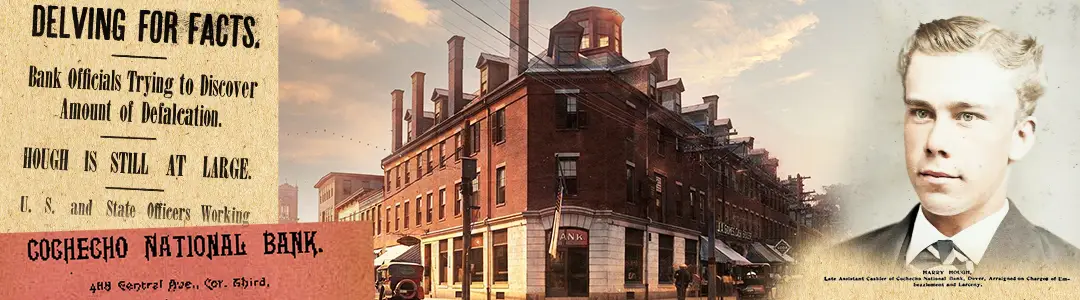
The story of embezzlement No. 2 also made it into the pages of the New York Times, but in a relatively small article, this time only making it to page 5. It started pretty much the same way as the Isaac Abbott affair. Bank examiners showed up at the end of the first week of June 1899, for what was likely a routine review of the records of the Cocheco Savings Bank, then located at the northerly corner of Third Street and Central Avenue. The initial exam turned up some discrepancies, and answers were sought from Harrison Haley, who was the Cashier, and Harry Hough, his assistant. But before the matter was resolved, on the morning of Sunday, June 4, Harry boarded the 6:30 a.m. train for Boston, along with $3,500 of cash from the bank, and disappeared to parts unknown. Realizing that Harry had absconded, a Directors’ meeting was called for early Monday morning, at which time his wife appeared unannounced with a check for the full amount drawn on a Strafford Bank account.
There is no word of or from Harry, except that at some point, he is in touch with our old friend, Attorney John Kivel. Arrangements are made long-distance, and on June 19, he meets up with Kivel and US Marshal Nute at Boston’s Park Street Station. That afternoon, Foster’s carries the following: “EXTRA. Harry Hough in Custody”. The three then take the train from Boston to Portsmouth, but Hough is still not in formal custody until they cross the state line. Upon arrival, there is a “three-minute” arraignment and bail hearing at the Customs House. Bail is set at $10,000. One report has it that Harry spent the night in the Portsmouth jail, but it appears that he actually had what must have been fairly comfortable accommodations, sharing a room with Nute at the Kearsarge House, including dinner during which he provided a lengthy interview to a reporter from Foster’s, who described Hough as being “very cool and collected”.
It turns out Hough had spent the previous two weeks visiting Baltimore for a week, several days in Wilmington, Delaware, with a brief stop in Philadelphia on his way to New York City. Somewhere in his travels, he made contact with Attorney Kivel and the plan was put in place for his voluntary surrender. One more train ride, this time from Portsmouth to Dover, with Hough, Kivel, Nute, and “a small army of newspapermen” on board. Word had gotten out, and in order to avoid what they knew to be a large crowd waiting at the railroad station on Third Street, the parties made a quick exit at the station then located at Sawyer’s, and Hough was transported from there to his home at 537 Central Ave. Of the cash he had taken prior to his departure, he had spent little more than $200; the balance was restored to the bank.
From that point on, Hough cooperated fully with bank officials and the federal investigators to determine the extent of the damage. The evidence indicated that he had been misusing funds for a number of years, and it became obvious that others had known of such misconduct but had kept it under wraps. Harrison Haley, the Chief Cashier, admitted knowing that Hough had been “speculating” and that “there were worthless checks in the bank with no collateral behind them”. Haley claimed that he had brought these matters to Hough’s attention, apparently to little or no effect. The President of the bank, James E. Lothrop, said only that “it was a great surprise to him that the business had been conducted so loosely.”
Looking back at this response, it appears that we are seeing an example of Dover’s Good-Old-Boys Network in action. Hough’s comment regarding his two week’s disappearance was, “I had a very pleasant time. I got away from the turmoil and had a rest”. Harrison Haley and J.E. Lothrop both said they were very glad that Hough had returned, far short of any condemnation for having caused the collapse of the bank. We should thus take note of who all was involved.
First and foremost is Harry’s father, Ralph Hough, who just happens to be one of the directors of the bank. Over a space of 45 years, he had worked his way up from being an apprentice at the Cocheco Printworks to the position of foreman. He had been a member of Dover’s Common Council for seven years, elected to the State legislature in 1884, and Chairman of the County Commissioners for the two years following. At some point, he became involved in local real estate development, and today’s Hough Street bears his name.
Harrison Haley was no mere bank employee. He was the equivalent in rank at the Cocheco Bank to Isaac Abbott’s position at Dover National, in effect, the Chief Financial Officer. But he was much more: in 1880, he was a joint purchaser of land at the top of Garrison Hill, where he built a restaurant, a roller-skating rink, and a tower for which he charged 10 cents for a climb to the top. Two years later, he was the moving force and a financial investor in the Dover Horse Railroad Company that ran from Sawyer’s to a point that provided access to his attractions at the top of the hill. (One of the directors of the Railroad Company was the President of the bank, James E. Lothrop.) Haley was active in the creation of the Wentworth Home, just north of the Haley homestead, then at 575 Central Ave., and he played a role in establishing the Dover Children’s Home. He served a term on Dover’s Board of Education, and was a Trustee of St. John’s Methodist Church. A true pillar of the community.
As was James E. Lothrop. He had a medical degree, but a short career as a practicing physician. Going into business and making money took over, and he was involved in a wide variety of local enterprises. There was Lothrop & Pinkham, druggists; J.E. Lothrop, furniture, sewing machines, musical instruments; one of the principals of the clothing store that eventually became Lothrop & Farnham’s. In addition to serving as president of the Cocheco Bank, he was involved in a number of local projects beyond the Horse Railroad, including serving as a member of the Board — along with Harrison Haley — of the Dover Chorus Society.
So it would seem that things went relatively easy on Harry Hough, at least initially. He was on bail, living at home with his family, and apparently was not restricted from attending the bank. Then, on Sept. 3, the Strafford County Grand Jury issued two indictments relating to his misconduct. The first alleged that on May 16 he did “receive and take into his possession certain money to a large amount, that is to say, to the amount of $3500… from Martin McManus…” {the name is handwritten in an otherwise typed document}…this being a check from A.O. Mathes drawn on the Strafford National Bank… and on the same date a second indictment charging larceny of a $100 bill, a silver certificate for $100, other bills and certificates in varying amounts, and several gold coins, “all to the value of $5500”. (That would amount to something in the neighborhood of $200,000 in today’s money, not an inconsiderable sum…).
(More to come.)