
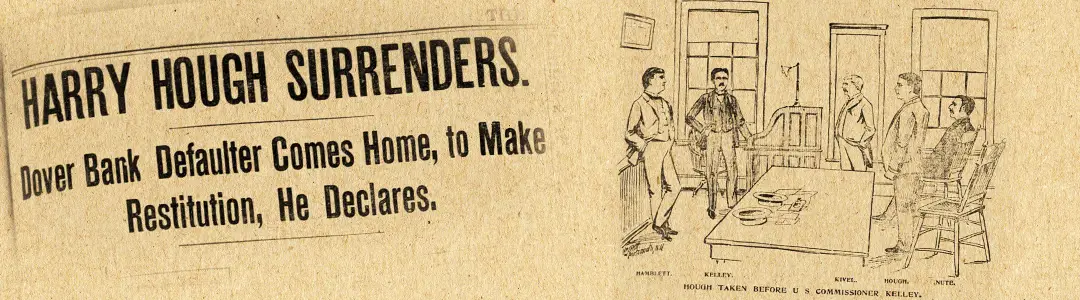
A capias for the arrest of Harry Hough on these state charges was issued on Sept. 22, and he was arrested that day by Deputy Sheriff W.W. Cashman. He appeared before the Court on the 2nd of October, but “he was not arraigned in the courtroom, but in the judge’s private room”. There are two bail receipts, one for $10,000 signed by Harry, Sarah Hough, and Almira J. Morrill; another for $3,500, endorsed by Harry, Almira, and Hiram W. Sanborn. “No time has been set for his trial, the bond reading ‘when called for’”. These are the last items in the Superior Court file. No arraignment, no plea, no trial, no sentence, no mittimus, but also, no dismissal. In theory, you might say that the file is still open, and the charges still pending.
But let’s digress for a moment to offer some background on the folks who came forward to provide Harry’s bail. Sarah Hough is Harry’s Mom, wife of Ralph. Almira Morrill is Harry’s mother-in-law. Hiram Sanborn is a local businessperson who is apparently willing to come forward for a friend in a time of need. For many years, he was a harness maker. Remember, this was still a time when there were few or no motorized vehicles, so a good harness maker was an important part of the community. It is clear that this friendship lasted, despite Harry’s serious criminal past: on Sept. 2, 1916, Hiram executed a will, and one of the witnesses was Harry Hough.
(And an interesting aside, which has absolutely no bearing on the Harry Hough story. In the early 1900s, there is a short entry in the Portsmouth Herald noting that Hiram Sanborn and his wife “are preparing to leave here Thursday for Florida, where they will spend the winter, as has been their custom during the past few years…”. There were snowbirds even back then.)
The explanation for the lack of action in Superior Court would be that when Harry first turned himself in, with the assistance of Attorney Kivel, it was to the US Marshal, one of the thefts having involved the National Bank side of the enterprise. And so, on Oct. 10, with little or no prior publicity, he entered a plea of guilty to charges in the Federal District Court, then in Manchester. The charge was not embezzlement or theft, however, but falsification of records, something that at least sounds less serious. The sentence was five years in jail, but with an unusual provision: the first year was to be served in Dover, the balance at the federal facility. The reason given was to make Harry more readily available to the people still involved in wrapping up the affairs of the two banks. Another reason offered for not proceeding on the state charges was that Harry had cooperated fully with the investigation, had made full disclosure regarding his wrongdoing, had accounted for all of the money, and full restitution had been made to the bank.
Following the sentencing, Harry, his wife, and Attorney Kivel returned to Dover by train. Once again, word had gotten out, and there was a large crowd waiting at the Central Station, hoping for a view of the now-convicted Harry. The train pulled in. There was a delay. Then Attorney Kivel stepped out on the platform unaccompanied by his client. As everyone was focused on the lawyer, Harry and his wife exited on the opposite side of the railway car and into a waiting vehicle that first transported Mrs. Hough to the family home, then delivered Harry to the County Jail.
Harry did his time, and upon his release in 1905, he returned to his home and family in Dover. This remained his residence, and for a number of years following, he is listed as engaged in a brokerage business in Boston. He died on Jan. 19, 1917, and the Dartmouth Alumni Magazine carried an obituary, even though Harry had left the college during his sophomore year. As noted, he was the son of Ralph and Sarah Jane (Delaney) Hough, born in Dover on Feb. 7, 1854. He “fitted” for college at Dover High School. Served as assistant cashier at Cocheco National for 27 years, the past 13 years a stockbroker in Boston. A member of the School Board 1882-1885, and several years as Treasurer of Strafford County. On Dec. 10, 1885, he married Carrie B. Morrill. A member of the Odd Fellows and the Knights Templar, and a member of the vestry and a warden of St. Thomas Episcopal Church. Two years before his death, he suffered a nervous breakdown, followed by heart trouble. In December 1916, he entered a Boston hospital, then transferred to the Polyclinic Hospital in New York City, where he died. (Although the article did not mention it, all three of the sons of Harry and Carrie attended and graduated from Dartmouth.)
No mention of any of the bad times at the bank, and perhaps in an obituary, that’s the way it should be. Despite what appears to have been an uneventful return to the community, his previous actions had serious consequences. Depositors may have been repaid in full, but the two banks never reopened, leaving he city at the turn of the century with one remaining financial institution, The Strafford Bank. This should have been an ideal situation, a virtual monopoly of the local area banking business, but, as we shall see, no immunity from the bad conduct of a trusted employee.
(Stay tuned.)
Visit the Crimes Along the Cochecho for all stories released so far.
Anthony McManus is a Dover, New Hampshire historian whose column “Crimes Along the Cochecho” explores the darker chapters of local history. A Dover native and Boston College Law School graduate, McManus served as City Attorney for Dover (1967-1973) and held various public offices before practicing law until 2001. His extensive historical work includes the “Historically Speaking” column in Foster’s Daily Democrat and his 2023 book “Dover: Stories of Our Past,” released for the city’s 400th anniversary. Through research, writing, and public presentations, McManus continues to illuminate both significant events and lesser-known stories that enrich understanding of Dover’s colorful past.