Upon returning to the courtroom on the 30th of July, Attorney Kivel asked to recall Samuel Jackson to clarify one point. Had he observed John Brown at the point near Chapel Street where he saw Williams and the others exchange the blanks for bullets? The response was in the negative.
Peter Durant, another Dover resident, then took the stand. He had been hanging out with James Lord on the 4th. Late afternoon he saw Williams, Gold, and Brown. Two of the three had guns, and one of them… he could not say who… fired a shot. Later that evening, around 10:30, he was on Main Street and watched the confrontation with Russell. He heard two shots, but again, was not in a position to see who pulled the trigger. Williams heading south on Main Street. On cross-examination, he was positive that the three he saw in the afternoon were as above. The row in the evening seemed to start over comment made to several young women on the sidewalk. He can say that Williams, who appeared to be intoxicated, was there, but not certain as to the others.
George Hogan was next. On the evening of the 4th he was sitting on steps near David McFadden’s store, and had a brief conversation with Williams and Gold. They wanted to know, “If I knew where there were any women.” The two then moved further along the street to the house where Dobbins and McNally were sitting with two women. He could not overhear what was said, but he had a clear view when Dobbins was shot, and it was Williams who did it. He saw him take a revolver from his hip pocket. He did hear a second shot, but at that point he was making a quick exit from the area. On cross-examination by Kivel, he said he had not seen either Farrell or Scott with Williams at the time.
And then we come to Kitty Scanlon, who said she had been sitting on the steps of 14 Young St., which was her residence, for quite some time. Dobbins and McNally joined her, then Ida Donahue. Several fellows approached, one of whom was Williams, who asked to join them on the steps, but was advised by one or more of them that “they did not care to have him sit there.” Williams appeared to put his hands behind him, there was a report of a revolver, and Dobbins was shot. She took off into the building, heard other shots, but did not see McNally get hit. She kept moving and went to contact Dr. Lathrop. On her cross-examination, she was certain it was Williams who fired the shot. Neither Scott nor Farrell was there, and she could not identify either Gold or Brown. Dobbins did not appear to be angry over what she characterized as “indecent” remarks made by Williams, but simply told him to move on. She agreed that she never actually saw a gun in William’s hands, but only heard the shot, and realized Dobbins had been hit.
It was then Ida Donahue’s turn. She saw Scanlon, Dobbins, and McNally sitting on the stairs at 14 Young St. and was invited to join them. A short time later, a group of maybe 5 to 6 men came in their direction. She identified Williams and Farrell as being in the group and said that both had revolvers. Kitty Scanlon told them to go away. She thought it was Williams who fired the first shot as Dobbins was standing up, with McNally heading for the hallway of the house. Scanlon also moved toward the building, and Dobbins seemed to be following, when she heard several more shots, and Dobbins said, “I am shot through the stomach… run for a doctor”. She returned to the front of the building and observed “one of the men” shoot at Officer Smith, who returned fire.
During her cross-examination by Kivel, she stated that she was certain there were 5 or 6 in the group, “the whole party perfect strangers.” Williams said something to Scanlon, but she didn’t hear any comments from any of the others. Dobbins stood up with his hands out, but “did not square away” or hit anyone. At first, she simply thought the men were fooling, but something made her frightened, and then she saw both Williams and Farrell with revolvers. Williams fired his, but she cannot say that Farrell did.
The final witness for the day was Officer Smith. Someone told him there had been trouble in the area of Main Street, and as he approached Young Street, he witnessed Williams shooting at McNally. He observed Farrell “in the crowd”, standing next to the steps beside the building. At that point, he assumed they must be firing blanks “and were careless”. As he got nearer, Farrell turned and went down Young St. Williams headed toward Portland St., at one point turning and threatening to shoot Smith, who claims he replied, “Let it come, old man”. Williams then fired one shot as he ran, and Smith returned fire before turning and heading north on Main Street to the location where Russell and Gagnon had been shot, then back to Young Street, where he realized that Dobbins and McNally had been victims of an actual shooting.
In response to Kivel’s cross-examination, Smith explained that earlier in the evening, he had been making his usual rounds in the area of The Landing, then checking doorways up and down Main Street. At one point, he had stopped for a quick bite at Curtis’s, then was heading back up Main when he saw Williams take the shot at McNally. He couldn’t say that he saw either Scanlon or Donahue, but he would say he was within 15-20 feet of Williams and approximately the same distance from Farrell, who almost immediately turned and ran. He saw George Hogan, who appeared to have been drinking, but not “very badly”. At which point the Court recessed the hearing until 8 a.m. the following morning.
Here we take another break to help set the scene along Main Street, which, in 1900, was quite different from today. Previously, we’ve mentioned several stores… Chicoine’s and McFadden’s. And Officer Smith had stopped off at Curtis’s, a popular spot for a quick meal. But according to the City Directory, there were at least 10 “groceries” and three saloons along that stretch of street, and there may have been more unlisted “unofficial” premises where one could buy an alcoholic beverage. The area from Chapel Street to Washington Street and the river was densely populated with residences at that time, so it was not uncommon, even on non-holidays, to find a large number of people on the street.
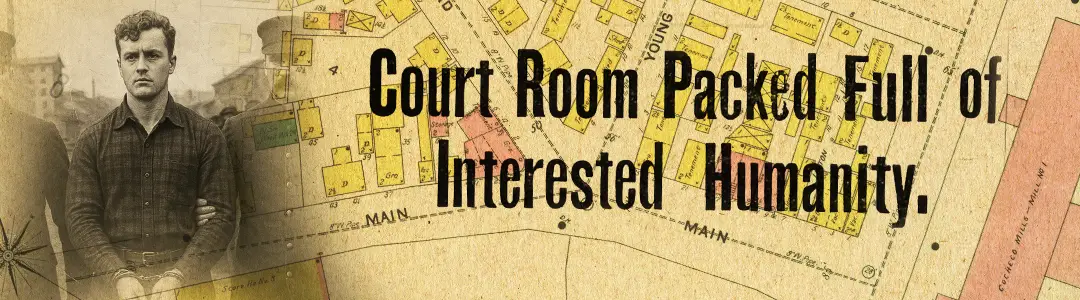
We return to the court… and “long before the hour… a large crowd had assembled… and a rush to gain admission”. As the prisoners were led into the courtroom, Benny Fry attempted to take photos. “Farrell wanted to kick the machine to pieces.”
Officer Smith retook the stand and offered a few more details of his observations of Williams firing at McNally. He was then followed by Dr. M.C. Lathrop, who recounted receiving a call from a woman a little before 11 p.m. regarding the injury to Dobbins. He arrived within half an hour and immediately identified a circular wound to the stomach area.
By the following morning, he was certain that the wound was fatal, and felt death was imminent. An autopsy was performed that afternoon, accompanied by Dr. John Ham, and they found extensive internal injuries. Both felt the bullet indicated a 38-calibre weapon. Based on their examination, he felt Dobbins was either sitting or stooping since the bullet appeared to have a downward trajectory. Dr. Ham then testified, basically as to the same observations and conclusions.
They were followed by William H. Davis, the owner or manager of a livery stable located on Chapel Street. Between 6 and 8 p.m. on the 4th, he had lent a team for a trip to the Hobart Farm. Michael Laughlin had rented it, and he was accompanied at the time by Frank Gold. On cross-examination, however, he could not say, definitively, that the second person was Gold.
Then it was Robert Moore, who testified that some time shortly after 10 p.m., he had been near the corner of Main and School streets. He was approached by Williams, who asked if there were any “French fancy” houses nearby, and said they were all out “for a good time”. He identified John Brown as being present. Shortly after that, a fight broke out, and he was aware that someone had been shot, though he did not see who fired it. He could not say that Williams appeared to be intoxicated, but felt that Brown was.
Napoleon Rivers was next to take the stand. He identified himself as the clerk at the Salmon Falls Hotel in Somersworth. Four men arrived at the facility between 8 and 10 a.m. on the 5th. He identified Scott, Gold, Farrell, and Brown. They had lunch and remained in the bar until early evening. Williams and one other male joined them sometime around midday. They all had a “good time” and all of them “had money”. According to Rivers, they all appeared to be sober when they left the premises, five of them leaving on a team driven by Joe St. Lawrence, who then testified that he had been at the hotel for maybe a quarter of an hour when the group engaged him to drive them all to the Waverly, a hotel near Central Park. A Somersworth resident, Joseph Lenox, was called and testified that he had been at the Waverly when the five arrived with St. Lawrence, but he left shortly thereafter.
Dover’s Assistant Marshall Wilkinson described the incident upon his arrival at the Waverly with other officers. His testimony, which contradicted the earlier newspaper reports, was that all five were present when the police showed up. They were arrested and brought to the station. John Brown was found to be armed with a loaded 38-calibre revolver.
That brought the hearing to a close. Solicitor Scott then moved to dismiss the complaint against William Scott on the basis that no evidence had been presented regarding his involvement in he charges before the court. Attorney Kivel assented and asked that Scott be discharged from custody. Judge Frost agreed, and Scott started to leave the room… except…he never made it beyond the outside hallway…
(this story will be continued)