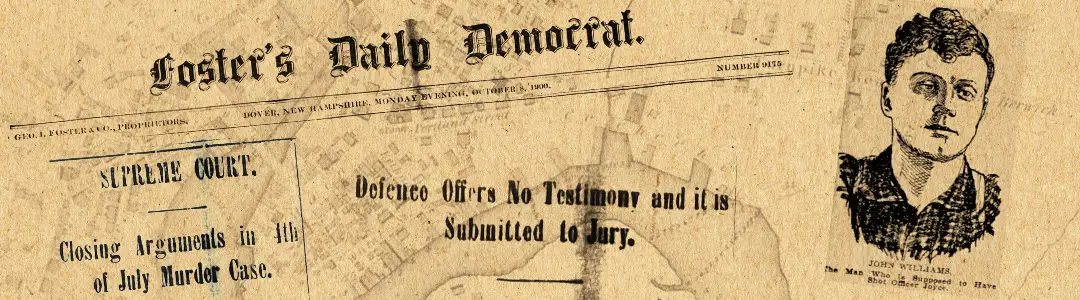
The trial begins. The first witness for the State is W.O. Ogden, who is identified as a civil engineer. He submits, and then describes in detail, a plan he has drafted showing the several locations on Main Street where the shootings occurred, the nearby buildings, and the distances involved between the incidents involving Russell/Gagnon and Dobbins/McNally that took place on July 4. He is then followed by a line of familiar names: Daniel Sullivan, who describes the confrontation on Third Street on the evening of the 3rd. James Lord, the watchman from the mill, who was standing on the opposite side of the street with Peter Durant, who observed Williams, Brown, and one other, first on the late morning of the 4th, once more in the afternoon, and one final time between 10:30 and 11. He was followed by Durant, Samuel Jackson, Robert Moore, Dr. Lathrop, Ross Ritchie, and Sadie Follett, all of whom testified as to their observations consistent with the story that had been given at the preliminary hearing, though perhaps in a bit more detail under cross-examination by Attorneys Kivel and Nason. Kitty Scanlon, now Kitty Campbell, described the incident at Young Street, but surprisingly, she was not subjected to any cross-examination.
She was followed by Ida Donahue, who testified she saw two men with revolvers. One was Williams, whom she identified in the courtroom; the other she said was not present (at the police court hearing, she had identified John Farrell). Then came Officer Smith, Napoleon Rivers from the Salmon Falls Hotel, Joseph St. Lawrence, and Joseph Lenox, who placed the men at the Waverly Hotel on the 5th. Dr. Ham corroborated the nature and extent of the wounds to Dobbins, and finally, a County Deputy Sheriff, W.W. Cashman, who was one of the law enforcement contingent involved in the arrest of the five at the Waverly on the 6th. The State then rested, and the trial ended for the day.
On the morning of the 8th of October, Attorney Kivel advised the Court that he had no evidence to present in favor of his clients. Judge Young inquired of Williams if he had obtained counsel or wished to be heard on his own behalf. Answering in the negative to both Williams stated, “I am innocent of the crime. I know nothing about it and have nothing further to say”.
Kivel then made a closing, described by Foster’s as “an eloquent argument” that consumed an hour and a half. Attorney Edwin G. Eastman, from the Attorney General’s office, spoke for the prosecution, focusing for the most part on Brown and Gold’s participation in the events, emphasizing that the two had been close companions throughout the day and with the intent “to run the affairs of the town, paint the city red” had been with Williams before and after the shooting, and should be held accountable. The charge to the jury by Judge Young took twenty minutes, and they left the courtroom to begin deliberations.
In mid-afternoon, the jury requested some further instructions, indicating that they “did not quite understand the charge”. Judge Young provided a response. (Just as an aside, our judge was John Young, the jury foreman in the case was named John Young, and early the same afternoon, a different jury had been picked to begin hearing a rape trial in which the defendant was a George F. Young, Jr.) At 8:55 p.m., after nine and a half hours, the jury reported a verdict, and “word was quickly telephoned to Cushman’s stables for the wagonette” to transport the defendants from the jail.
The verdict as to Williams was guilty of manslaughter in the first degree as to Dobbins and guilty of the assault on Russell, with findings of not guilty as to both Brown and Gold. “When the verdict against Williams was rendered, he smiled and looked at his partners who were shackled to him”. Brown and Gold “returned their thanks” to the jury. All three were retained in custody and returned to jail as “they shall be charged with assault with intent to kill Russell and Gagnon”.
And this creates some confusion, for the actual Superior Court files, skinny as they are, show that the trial that began on Oct. 5 involved two charges: the assault on Russell and the killing of Dobbins. There were two additional charges, initially scheduled for trial during the February term of court, and these involved the assault on Joseph Gagnon and the murder of John McNally. But something happened in the meantime. On November 5, Williams was sentenced to two terms in NH State Prison based on the October verdict: 50 years at hard labor on the Dobbins conviction, with an additional 20 years in the Russell case. On the 7th, he was transported to Concord.
But that seems to be the end of it. There are numbered files for the Gagnon and McNally case, but no recorded pleas, no trial, no sentencing, but also no formal dismissal. There doesn’t appear to be anything in Foster’s to indicate what may have happened, why the decision was made not to proceed, or when John Brown and Frank Gold may have been released from custody.
So what may have started with a bang on the 4th of July — several bangs, actually: Russell, Gagnon, Dionne, Dobbins, McNally, and the shots fired at Officer Smith — seems to have ended with a whimper. Of all the seemingly serious criminal behavior, the fairly extensive death and destruction inflicted on Dover and its citizens over three or four days, only Williams ended up being held accountable. It is possible that the remaining four met their fate at the hands of the Massachusetts courts, based on the events at the Lawrence brewery; however, a search of the internet did not yield any further references to Farrell, Scott, Brown, or Gold (or their various aliases).
But all the same, a rather remarkable story. It’s unlikely, however, that any of the remaining four “desperadoes” will be making any more visits to Dover anytime soon.