
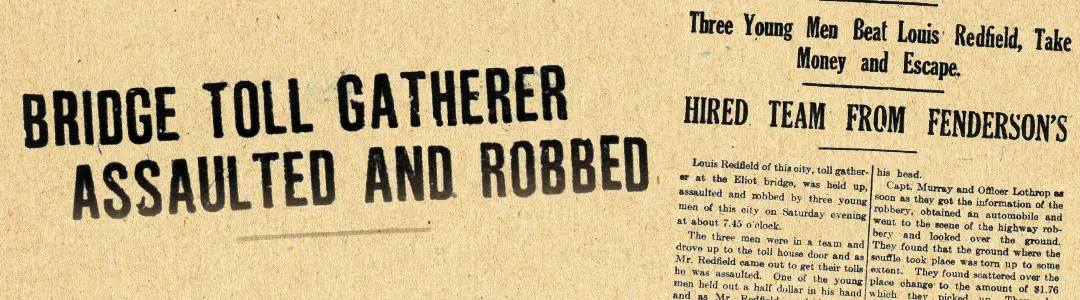
Here’s a story that relates to the long-gone past of Dover, well beyond the memory of anyone alive today — a toll road and trolley transportation to and from York Beach. Both involved what we know today as Gulf Road. To get from here to there (and there to here), New Hampshire to Maine (and back), there was a toll booth at the Eliot bridge. On Saturday evening, Nov. 27, 1915, around 7:45 p.m., three men in a horse-drawn team stopped at the booth and approached the toll-taker, a Dover resident named Louis Redfield. One offered money to pay the toll, and as he did so, a second man threw a robe over Redfield’s head and struck him with a hard instrument, knocking him to the ground. The men then “went into his pockets, getting most of the money that he had on his person”.
As all of this was happening, the trolley — also known as “an electric car” — was approaching from the Maine side of the bridge. Redfield boarded this vehicle for the ride into Dover, where he reported the robbery to Capt. Murray at the police station. An investigation showed that the horse and wagon had been rented that evening at Fenderson’s by three men who said they were off to visit a young lady at Sawyers. Returning to the Eliot bridge in a borrowed automobile (apparently still a lack of permanent police vehicles), officers found the animal and the wagon still at that location, the latter with a damaged front wheel. Examination of the area where the assault took place turned up $1.76 in scattered change, a necktie and a broken cuff button.
Officers traveled to Salmon Falls, where they visited several saloons, looking for the men described by Redfield, but came up empty-handed. A call was made to the Portsmouth police on the possibility that the trio had ridden the electric cars to that city. On Sunday, word was received from a crew at the Dover freight yards that “three young men answering the descriptions of the “much wanted highway men” had jumped a freight headed for Portland, so a call was made to that city with a full report on the fugitives.
On Dec. 2, the headline was “No Trace As Yet”, but there was a report that the three who had taken the freight from Dover had been seen briefly in Saco, then again in Portland, but no word since. Numerous departments in that area were notified to be on the lookout, and Marshall Wilkinson also “decided to send out postcards”. The morning’s mail “carried them to the police in various cities and towns in New England”. On the 6th: “Highwaymen Still Free”, this following a call from the Laconia police on the previous day that they had three men in custody fitting the descriptions of the suspects. Asst. Marshall Crowley made the trip and reported that the three “answered the description of the much-wanted trio almost perfectly”, but they were not them.
Then, on the morning of the 13th, one Edward McCabe showed up at the Dover police station and turned himself in, admitting to being one of the men involved in the Redfield assault and robbery. He was accompanied by Dover attorney and former short-term judge of the Dover court, James McCabe — no indication if the two were related. According to Edward, following the attack, he and the others walked to Rochester, then eventually to Sanford, and he returned to his home in Dover on Monday. Thus, it appears that the information provided about the three men on the train was unrelated to the subjects of Dover’s search. McCabe stated that he had been taken ill upon his return and he had not left his home until that morning when he presented himself to the authorities.
A hearing was scheduled forthwith. McCabe pleaded not guilty and waived a hearing. Judge Nason ordered that he be held without bail pending action by the February term of Superior Court. But that same day Atty. McCabe filed a petition with the Superior Court asking that bail be set. A brief hearing was held, and Judge Pike issued an order for bail in the amount of $500. That was quickly paid, James Dennis and Michael Redden signing as sureties, and the young McCabe was released.
There is no further news until an article on Jan. 10 tells us that Robert Ainsworth, another of the three, had been arrested in Providence. (By this time, the third member had been identified as Joseph Gingras, but his whereabouts remained unknown.) The arrest of Ainsworth came about following a tip that he was planning to enlist for military service at the recruiting station in the Rhode Island city. Marshall Wilkinson passed this information along to the Providence police. It turned out to be accurate. Ainsworth was located and taken into custody. Having agreed to return voluntarily, Asst. Marshall Crowley was dispatched. (You may have noticed that Crowley is the one to be called upon for the out-of-state travels.) Upon their arrival back in Dover “a large crowd was waiting…several hundred people lined up on St. Thomas St…”. Crowley decided “not to give the spectators a free show”. Requesting that a motor vehicle meet them on Third Street (they apparently had arrived by train), he and the prisoner entered the city building on Hale Street, leaving the curious crowd waiting at the station entrance on Locust.
A brief hearing took place on the 10th. Ainsworth was represented by Atty. Galloway. He waived the reading, pleaded not guilty, waived a hearing and did not contest the order that he be held without bail. The complaint before the court described the amount of “silver coin” taken from Redfield in the robbery to be $2.50.
(to be continued)
Read Part 2 here.
Visit the Crimes Along the Cochecho for all stories released so far.
Anthony McManus is a Dover, New Hampshire historian whose column “Crimes Along the Cochecho” explores the darker chapters of local history. A Dover native and Boston College Law School graduate, McManus served as City Attorney for Dover (1967-1973) and held various public offices before practicing law until 2001. His extensive historical work includes the “Historically Speaking” column in Foster’s Daily Democrat and his 2023 book “Dover: Stories of Our Past,” released for the city’s 400th anniversary. Through research, writing, and public presentations, McManus continues to illuminate both significant events and lesser-known stories that enrich understanding of Dover’s colorful past.